
 Listen to this article
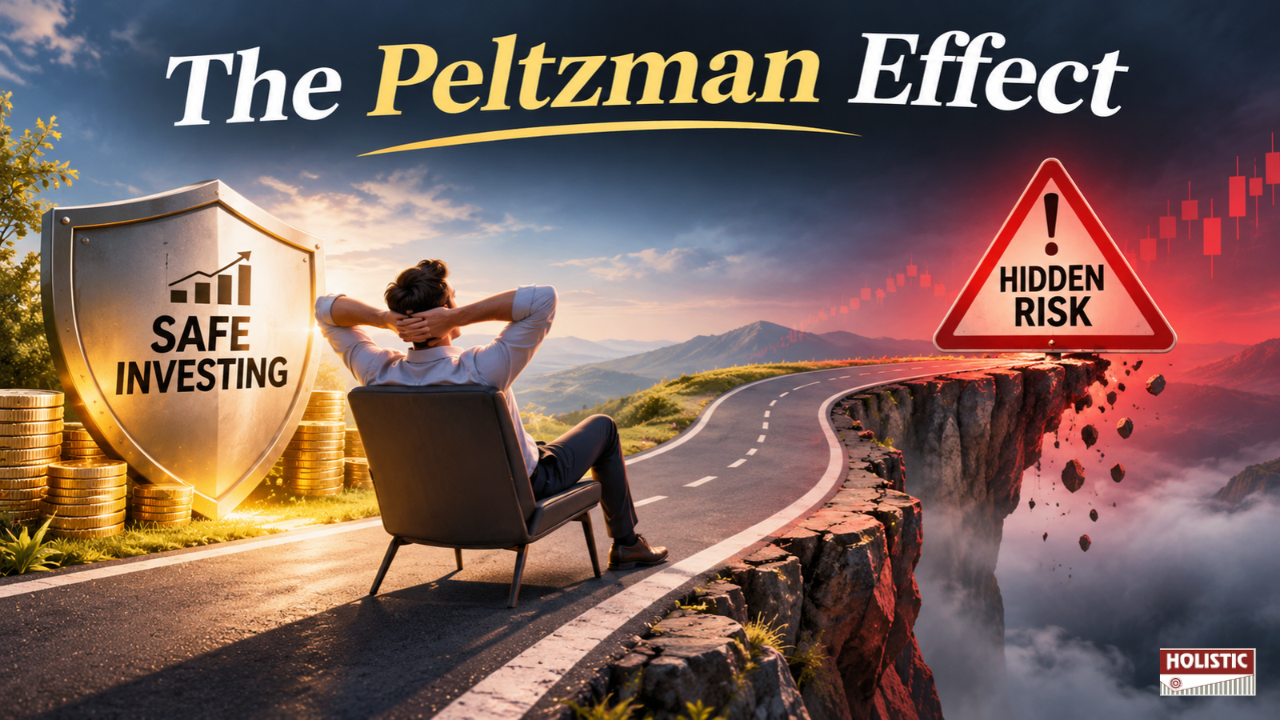
Ravi bought a new SUV last year. Six airbags, ABS, a five-star crash rating.
Within a month, his wife noticed something. On the highway, Ravi now cruises at 110 where he used to drive at 80.
Ask him and he will tell you, quite honestly, that he is not driving any faster. The car just feels safer.
Here is the uncomfortable part. Ravi’s money behaves exactly like his driving. And there is a good chance yours does too.
Economists have a name for this pattern: The Peltzman Effect. It explains why some of the most careful, conservative investors we meet end up carrying risks they never signed up for — not in spite of their safety nets, but because of them.
In this article, we will unpack how that happens, where it hides in a typical Indian portfolio, and a simple five-question check you can run on your own investments.
Table of Contents:
- What Is the Peltzman Effect?
- Your Hidden Risk Thermostat
- Trap One: Mistaking the Packaging for the Product
- Trap Two: Mistaking a Good Habit for a Good Plan
- Trap Three: Mistaking a Guarantee for Growth
- Trap Four: When the Safety Net Becomes a Licence
- Safety Lives in the Plan, Not in the Product
- The Peltzman Check: Five Questions Before You Call Anything “Safe”
- Quick Reference: What Your Safety Net Really Covers
- So, Should You Feel Less Safe?
- Where a Certified Financial Planner Fits In
- Frequently Asked Questions
What Is the Peltzman Effect?
In 1975, University of Chicago economist Sam Peltzman looked at the car-safety rules America had introduced in the late 1960s — seatbelts, padded dashboards, collapsible steering columns.
Everyone expected road deaths to fall sharply. Peltzman found something awkward instead. Drivers seemed to respond to safer cars by driving a little less carefully, and that change in behaviour ate into the benefit. Pedestrians, who got no seatbelts at all, appeared to pay part of the price.
The broader idea is called risk compensation: when we feel more protected, we quietly allow ourselves to take more risk.
To be fair to the seatbelt, the debate did not end there. Later research has found that risk compensation is real in many settings, but it usually cancels out only part of the safety benefit, not all of it. Seatbelts still save lives.
Hold on to that nuance, because we will come back to it. Safety is not the villain of this story. What we do with the feeling of safety is.
Your Hidden Risk Thermostat
Think of the air-conditioner in your bedroom, set at 24°C. When the room cools down, the AC does not keep cooling. It eases off until the room drifts back to 24.
Most of us carry a similar setting for risk. When something reduces risk in one corner of our life, we unconsciously turn it up somewhere else, until we are back to our “comfortable” level.
In personal finance, the safety device is rarely a seatbelt. It is usually a phrase:
- “It is government-backed.”
- “The returns are guaranteed.”
- “SIP will average it out.”
- “Index funds are the safe way to invest.”
- “Property prices never really fall.”
- “My financial plan is sorted.”
Each of these is at least partly true. The danger lies in the sentence that silently follows: “… so I can afford to …”
The riskiest words in personal finance are not “high returns”. They are “it’s safe, so…”
Let us look at the four ways this plays out, starting with the most common one.
Trap One: Mistaking the Packaging for the Product
Here is a question worth asking about every “safe” investment you own: what exactly does the guarantee guarantee?
Very often, the safety is real — but it sits on the outside of the box. What is inside the box can behave very differently.
The Gold Bond That Was Safe and Still Volatile
Sovereign Gold Bonds carry the Government of India’s backing. No new tranche has been issued since February 2024, but lakhs of investors still hold them, and many others now own gold through ETFs and gold funds.
The government guarantee protects you against one thing: the issuer failing to pay. It does not protect you against the price of gold.
If gold falls 25%, your bond falls with it. In India, gold prices peaked around 2012–13 and then spent roughly six years moving sideways and lower before the rally that began in 2019. Someone who parked half their net worth in “safe” gold in 2012 waited a very long time.
So what? Gold can be a useful diversifier in sensible proportions. The mistake is sizing it as though it were a fixed deposit.
The Bank Product That Was Not a Deposit
In March 2020, as part of Yes Bank’s rescue, its AT1 bonds worth roughly ₹8,400 crores were written off. Many retail holders had bought these at bank branches, believing they were close cousins of an FD.
The bank’s name was the airbag. The product itself had none.
Even genuine bank deposits have a limit to their protection. DICGC insurance covers up to ₹5 lakhs per depositor per bank, including interest. Depositors of PMC Bank learnt in 2019 how much that fine print can matter.
The Index Fund That Removed One Risk, Not All of Them
Index funds do something genuinely useful. They remove the risk of picking the wrong fund manager, and they keep costs low.
What they do not remove is market risk. The Nifty 50 fell nearly 40% between January and March 2020, and around 60% during the 2008 crisis. An index fund tracking it fell by the same amount.
The Peltzman trap here is subtle. An investor feels so reassured by “passive” that they drop their debt allocation altogether and go fully into equity. Then the first real crash arrives, and they discover their stomach was never consulted.
Practical tip: for every investment, write one line: “This protects me from ___, but not from ___.” If you cannot fill the second blank, you have not yet understood the product.
Packaging is one way we fool ourselves. The next one is sneakier, because it involves something we are rightly proud of.
Trap Two: Mistaking a Good Habit for a Good Plan
A SIP is one of the best financial habits an Indian family can build. It automates discipline and takes the guesswork out of timing.
But rupee-cost averaging smooths the price at which you buy. It does not change what you are buying.
A SIP decides how you buy. It doesn’t decide what you buy.
Consider Priya, a 31-year-old software engineer. She started a ₹25,000 monthly SIP split across three thematic funds that were topping the charts, reasoning that “the SIP will average out the volatility.”
When that sector corrected, all three funds fell together. Priya stopped her SIP — precisely the moment when averaging would have worked hardest for her.
The habit was right. The allocation made the habit unbearable.
There is a second, quieter version of this trap: automation. Because the SIP runs on its own, many investors stop looking at it altogether. “Set and forget” slowly becomes “forget forever”, and goals, risk levels and fund choices drift without anyone noticing.
What should you do? Keep the SIP. Then make sure each SIP is attached to a goal, sized by your asset allocation, and reviewed at least once a year.
Discipline cannot rescue a portfolio you can’t sit through.
Trap Three: Mistaking a Guarantee for Growth
Some investors avoid market risk so completely that they walk straight into a different one.
Take PPF. As of the October–December 2026 quarter, it earns 7.1%, tax-free, with sovereign backing. It is an excellent instrument.
The problem starts when guaranteed instruments become the entire plan. You have not removed risk. You have swapped market risk for two others: inflation risk and liquidity risk.
Here is what that swap looks like over 15 years for ₹10 lakh, assuming inflation of 6% a year.
|
Where ₹10 lakh sits for 15 years |
Assumed return | Value after 15 years | Worth in today’s money (at 6% inflation) |
|---|---|---|---|
|
FD at 7%, no tax payable |
7.0% | ₹27.59 lakh | ₹11.51 lakh |
| FD at 7%, taxed at 30% slab | 4.9% post-tax | ₹20.49 lakh |
₹8.55 lakh |
| Idle in a locker or current account | 0% | ₹10.00 lakh |
₹4.17 lakh |
Illustrative only. Figures assume constant annual compounding and a constant 6% inflation rate; the post-tax FD row ignores surcharge and cess. Actual interest rates, tax rates and inflation will vary. These are not guaranteed outcomes, and market-linked investments are subject to market risk.
Notice the second row. The “safe” FD more than doubles on paper, yet buys less than it did on day one.
PPF fares better because it is tax-free, but at 7.1% against 6% inflation, its real return works out to only about 1% a year. That makes it a fine stabiliser. It is not an engine for a 25-year retirement goal.
Add PPF’s 15-year lock-in, and the picture is complete: the money is safe, but it is neither growing meaningfully nor easily available.
Inflation never sends you a monthly statement. That is exactly why it is so expensive.
So far, the traps have been about misreading products. The next one is about misreading ourselves — and it is the purest form of the Peltzman Effect.
Trap Four: When the Safety Net Becomes a Licence
This is where the seatbelt story maps most directly onto money. We do not just misjudge a safe product. We use the comfort it gives us to justify a risky move somewhere else.
“The House Is Safe, So the Loan Can Be Big”
Property feels like the safest asset there is. You can see it, touch it, live in it. And because the asset feels so secure, buyers often stretch the loan far beyond what is comfortable.
Consider a ₹1 crore home loan over 20 years at 8.5%. The EMI is about ₹86,782. For a family with a take-home income of ₹1.45 lakh, that is roughly 60% of every month’s pay.
If the floating rate rises to 10%, the EMI climbs to about ₹96,502 — nearly ₹9,700 more a month — or the bank quietly extends the tenure instead.
The house did not become any riskier. The household did.
“My Emergency Fund Is Ready, So I Can Try F&O”
A healthy emergency fund is one of the most reassuring things a family can build. Sometimes it is too reassuring.
We have seen investors treat that buffer as permission to experiment with futures and options trading. SEBI’s own analysis of individual F&O traders found that about nine out of ten lost monies.
Money meant to protect you from a job loss ends up as margin money. The cushion becomes the very thing you fall on.
“My Plan Is Sorted, So This Is Just Play Money”
Once the big goals are funded, a strange lightness can set in. Stock tips, crypto, unlisted shares, a friend’s “sure-shot” idea — all of it begins to feel affordable, because “the core is safe.”
Behavioural economists call this the house-money effect. But every rupee you lose on the side is a rupee missing from your net worth, and it pushes your goals further away.
If you genuinely want a speculative allocation, there is a better way. Decide its size inside your plan, cap it, and track it as part of your total net worth — not in a separate mental pocket.
There is no such thing as play money. There is only money that has stopped being watched.
Step back and look at all four traps together, and a single pattern emerges. It is the most important idea in this article.
Safety Lives in the Plan, Not in the Product
No investment is safe or unsafe on its own.
A fixed deposit can be exactly the wrong choice for a 30-year-old’s retirement money. A small-cap fund can be perfectly reasonable as a modest slice of a 25-year goal. The same product changes character depending on how much you hold, why you hold it, and when you will need it.
Think of it like medicine. Paracetamol is about as safe as medicines get — at the right dose. The label tells you what the tablet is. Only the prescription tells you how much to take.
Investments work the same way. The product tells you what it is. Only your plan tells you how much of it belongs in your life.
True safety, then, is about fit: the right asset, in the right size, for the right horizon, with the right amount of liquidity. That is why we always say: Financial Planning First, Investment Products Second.
A product can be safe. Only a plan can make you safe.
The Peltzman Check: Five Questions Before You Call Anything “Safe”
Before you add any “safe” investment — or after you have already added one — run through these five questions.
- Safe from what, exactly? Default, price fall, inflation, illiquidity, or your own behaviour? Name the specific risk it removes.
- What is inside the wrapper? Look past the brand, the guarantee or the method to the actual asset you own.
- What has this safety made me comfortable doing elsewhere? A bigger loan, a riskier side bet, a skipped review?
- What happens to my goals if it falls 30%, gets locked for five years, or I need the money tomorrow? If the answer is “my plan breaks”, it is not safe for you.
- Is it sized by my plan or by my comfort? Comfort is a feeling. Allocation is a decision.
If even one answer makes you pause, that pause is worth paying attention to.
Quick Reference: What Your Safety Net Really Covers
| Feels safe because… | Genuinely protects you from | Does NOT protect you from | Peltzman behaviour to watch |
|---|---|---|---|
|
Sovereign Gold Bond / gold ETF |
Issuer default (SGB); purity and storage worries | Gold price falls and long flat periods | Holding far more gold than your plan needs |
| Bank-branded products | Depends on the product | Write-offs on non-deposit products; deposits above ₹5 lakh per bank |
Treating anything sold at a bank counter as an FD |
|
Index fund |
Fund-manager selection risk; high costs | Market falls of 40% or more | Dropping debt allocation entirely |
| SIP | Bad timing of a lump sum | Risk of the fund you chose |
Putting SIPs into narrow, volatile themes |
|
PPF / FD |
Market volatility | Inflation, tax drag, lock-in | Keeping long-term goal money entirely in fixed income |
| Property | Daily price volatility on a screen | Leverage, rate hikes, illiquidity |
Stretching EMI to 60% of income |
|
Emergency fund |
Short-term cash shocks | Nothing, if it is spent elsewhere | Using it as trading capital |
| Having a financial plan | Goal-less, random investing | Off-plan speculation |
“Play money” outside the plan |
So, Should You Feel Less Safe?
No. And this is where many discussions of the Peltzman Effect go wrong.
Remember what the research says: risk compensation is real, but it usually offsets only part of the benefit. Seatbelts still save lives. Guarantees, SIPs, insurance and emergency funds still protect families every single day.
The answer is not to throw away the seatbelt. It is to stop driving as though you cannot crash.
Wear your seatbelt. Then drive like you’re not wearing one.
In practice, that means three simple habits:
- Count everything. Track your total net worth in one place, including gold, property loans and any “side” investments.
- Give every product a job. Each investment should have a clear role — growth, stability, liquidity or protection — linked to a specific goal.
- Review once a year, even when nothing feels wrong. Especially when nothing feels wrong. Comfort is precisely when drift goes unnoticed.
Where a Certified Financial Planner Fits In
Go back to Ravi for a moment. He genuinely did not feel he was driving faster. That is what makes the Peltzman Effect so hard to catch on your own: it does not feel like risk-taking. It feels like confidence.
Sometimes you need someone in the passenger seat who can see the speedometer.
That is a large part of what a Certified Financial Planner does. Not picking the “best” product, but looking at the whole picture — your goals, your allocation, your loans, your insurance, your side bets — and pointing out where comfort has quietly turned into exposure.
In fairness, a financial plan is also a safety device, and the same rule applies to it. A plan is not a licence to stop paying attention. It is a map you return to as life changes.
If you are wondering whether your own safety nets are working for you or quietly working against you, an outside view can help. You can book an Initial Guidance Call (No Cost) with our team to talk it through.
Disclaimer: This article is for educational purposes only and does not constitute investment advice or a recommendation to buy or sell any product. Holistic Investment is an AMFI-registered Mutual Fund Distributor (ARN-4188) and APMI-registered PMS Distributor; insurance is distributed by our directors under their individual IRDA licences. Mutual fund investments are subject to market risks; read all scheme-related documents carefully. Past performance does not guarantee future results. Please consult a qualified professional before making financial decisions.
Frequently Asked Questions
Q1. What is the Peltzman Effect in simple words?
It is the tendency to take more risk when we feel more protected. A safety measure lowers our sense of danger, and we “spend” that comfort by behaving less carefully, which cancels out part of the benefit.
Q2. Who discovered the Peltzman Effect?
It is named after Sam Peltzman, an economist at the University of Chicago.
His 1975 study of American car-safety regulations suggested that drivers of safer cars tended to drive less carefully.
Q3. Is the Peltzman Effect the same as risk compensation?
Yes, the two terms are generally used to mean the same thing.
A stronger version of the idea, called risk homeostasis, argues that people fully offset every safety gain. That stronger claim is widely disputed.
Q4. How does the Peltzman Effect affect investors?
It shows up when a sense of safety leads to risky behaviour elsewhere.
Common examples include holding too much gold because it is “government-backed”, going 100% equity because index funds feel safe, stretching home loan EMIs because property feels secure, or speculating with “play money” once the main plan is in place.
Q5. Are SIPs risk-free?
No. A SIP is a method of investing, not an asset.
It helps average your purchase price over time, but your money still carries the full risk of the fund you choose. A SIP in a volatile fund remains volatile.
Q6. Is PPF a good investment since it is government-backed?
PPF is an excellent low-risk, tax-free instrument and a strong stabiliser in many portfolios.
However, at 7.1% (as of the October–December 2026 quarter), its real return after 6% inflation is only about 1% a year, and it has a 15-year lock-in. It works best as one part of a plan, not the whole plan.
Q7. Are index funds safe for beginners?
Index funds remove fund-manager risk and keep costs low, which many investors value.
But they carry full market risk and can fall 40% or more in a severe downturn. Whether they suit you depends on your goals, time horizon and asset allocation, not on the label “passive”.
Q8. Is the Peltzman Effect proven?
Risk compensation has been observed in many settings, from road safety to motor racing.
However, research generally finds that it offsets only part of a safety measure’s benefit. The size of the effect varies, so safety measures remain worthwhile.
Q9. How can I protect myself from the Peltzman Effect?
Ask what each safe investment actually protects you from, look past the wrapper to the real asset, track your total net worth in one place, and size every investment according to a written plan.
A periodic review with a Certified Financial Planner can help you spot blind spots you may not notice yourself.
Leave a Comment