
Open any old Post Office Recurring Deposit passbook from 2015 and you will see a rate that looks almost unbelievable today: 8.40%.
Open one from 2021 and the same scheme is paying 5.80%, on the same government guarantee, at the same post office counter.
Nothing about the RD changed in those six years. The interest rate did.
If you have ever wondered why your father’s RD seemed to double faster than yours will, or why the post office suddenly started announcing rates every three months instead of once a year, this page walks you through the entire journey.
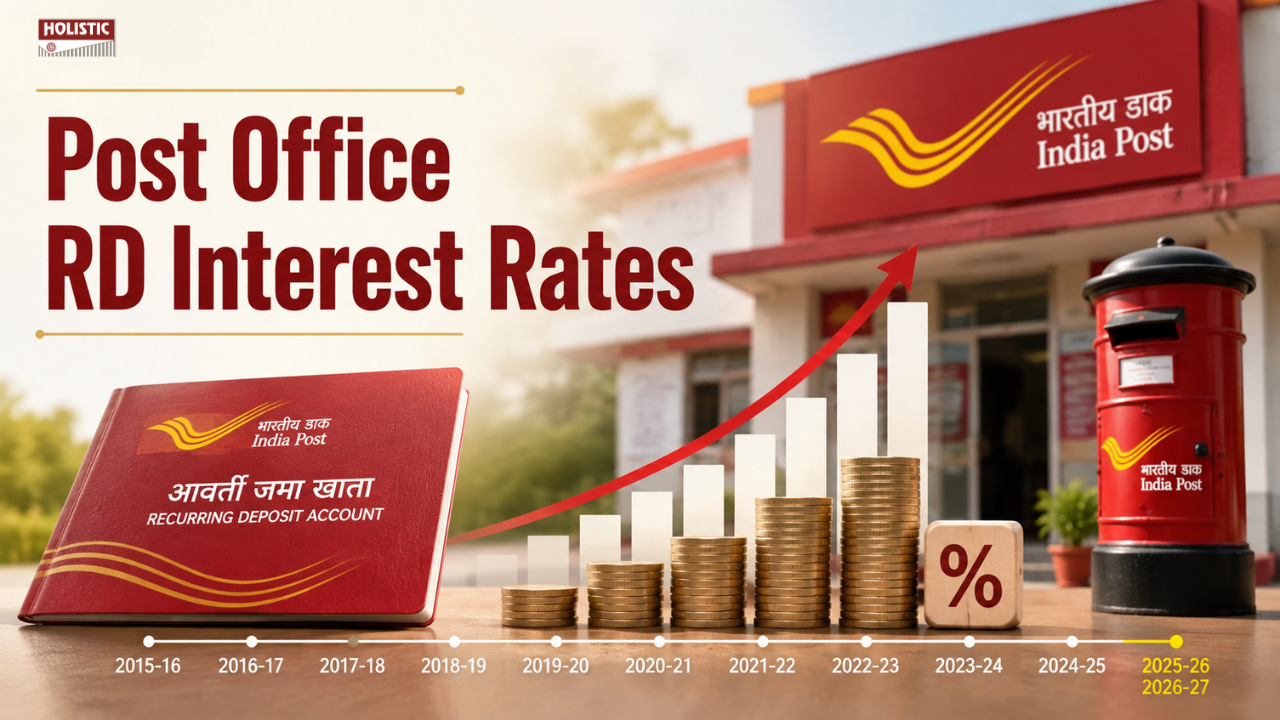
You’ll find the year-by-year and quarter-by-quarter Post Office RD interest rate from 2015-16, 2016-17 and 2017-18, right up to the rate in effect today.
Table of Contents:
- History of Post Office RD Interest Rates (2015-16 Onward)
- How to Open a Post Office RD Account
- How Is Post Office RD Interest Calculated?
- Post Office RD Interest Rates: Full Table, 2015-16 to 2026-27
- Post Office RD Interest Rate Trend: Year-Wise Average
- The Quarter the Rate Cut Was Withdrawn Within Hours
- Post Office RD vs Bank RD vs Mutual Fund SIP
- Frequently Asked Questions
- Conclusion
1. History of Post Office RD Interest Rates (2015-16 Onward)
The Post Office Recurring Deposit, officially the National Savings Recurring Deposit Account, lets you save a fixed amount every month for five years at a government-guaranteed rate.
For decades, that rate barely moved more than once a year.
In FY 2015-16, the RD paid a flat 8.40% for the entire financial year, from April 2015 to March 2016. There was no quarter-wise revision.
One rate, twelve months.
That changed on 1 April 2016. The Department of Economic Affairs, Ministry of Finance moved to quarterly rate reviews for every small savings scheme, RD included, linking each quarter’s rate to the average yield on comparable government securities.
This single decision is the reason FY 2016-17 onward looks completely different from FY 2015-16 in the table below: one flat number becomes four separate quarterly numbers, revised every April, July, October and January.
FY 2016-17: The First Full Year of Quarterly Rates
The RD opened FY 2016-17 at 7.40% for the April-June and July-September quarters, then eased to 7.30% for the last two quarters of the year.
That 100-basis-point drop from the flat 8.40% of FY 2015-16 was not a one-off cut.
It reflected softening government bond yields, and it set the pattern for the next two years: gently declining rates, revised every quarter instead of once a year.
FY 2017-18: The Slide Continues
FY 2017-18 opened at 7.20% and drifted down through the year: 7.10% for the middle two quarters, before closing at 6.90% in the January-March 2018 quarter.
By the end of FY 2017-18, the RD rate had fallen 150 basis points from where FY 2015-16 had ended.
For a five-year deposit, that difference compounds into real money, which is exactly why the timing of when you opened your RD used to matter so much.
A brief recovery followed. FY 2018-19 and FY 2019-20 saw the rate climb back toward 7.30%, before the sharpest single move in the scheme’s history arrived without much warning.
2. How to Open a Post Office RD Account
Opening an RD account takes a single visit to the post office, or in some circles, an online transfer if your post office savings account is digitally linked.
Eligibility and Documents
- Any resident Indian adult can open a single or joint account (up to three adults).
- A guardian can open and operate an account on behalf of a minor.
- A minor aged 10 or above can open and run the account independently.
- KYC documents needed: Aadhaar, PAN, and a passport-size photograph.
Deposit Rules
- Minimum monthly deposit: ₹100, in multiples of ₹10 thereafter, with no upper limit.
- Standard tenure: 5 years, extendable in blocks of 5 years.
- A loan of up to 50% of the balance is available after 12 regular instalments.
- Premature closure is allowed after 3 years, but the pay-out falls to the savings account rate.
Pro tip: deposits made between the 1st and 15th of a month must be repeated by the 15th of every subsequent month; accounts opened between the 16th and month-end follow the last working day as the due date.
Missing a due date attracts a small default fee, so this is worth diarising before you commit to a monthly figure you might struggle to sustain.
3. How Is Post Office RD Interest Calculated?
Post Office RD interest is compounded quarterly, unlike a bank savings account where interest is simple and daily.
Every quarter, the interest earned so far is added to your balance, and the next quarter’s interest is calculated on this slightly larger balance.
Because each of your 60 monthly instalments joins the RD at a different point in time, each one compounds for a different number of quarters by the time the account matures.
The instalment you deposit in month 1 earns interest for nearly five years; the instalment you deposit in month 60 earns almost nothing before maturity.
A Worked Example
Suppose you deposit ₹5,000 every month in a Post Office RD opened when the rate is 6.70% per annum, for the standard 5-year tenure.
- Total amount you deposit over 5 years: ₹3,00,000
- Approximate interest earned: ₹56,800
- Approximate maturity value: ₹3,56,800
This example is illustrative only, based on the 6.70% rate applicable when the deposit is opened and standard quarterly-compounding RD maths. It is not a projection or a guarantee. The rate that applies to a fresh RD can change every quarter, though once your account is opened, your rate stays fixed for that account until maturity.
4. Post Office RD Interest Rates: Full Table, 2015-16 to 2026-27
Here is the complete Post Office RD interest rate history, financial year by financial year and quarter by quarter, from FY 2015-16 to the current quarter.
| Financial Year | Period | RD Interest Rate |
|---|---|---|
| 2015-16 | Full Year (Apr 2015 – Mar 2016) | 8.40% |
| 2016-17 | Q1: Apr – Jun 2016 | 7.40% |
| 2016-17 | Q2: Jul – Sep 2016 | 7.40% |
| 2016-17 | Q3: Oct – Dec 2016 | 7.30% |
| 2016-17 | Q4: Jan – Mar 2017 | 7.30% |
| 2017-18 | Q1: Apr – Jun 2017 | 7.20% |
| 2017-18 | Q2: Jul – Sep 2017 | 7.10% |
| 2017-18 | Q3: Oct – Dec 2017 | 7.10% |
| 2017-18 | Q4: Jan – Mar 2018 | 6.90% |
| 2018-19 | Q1: Apr – Jun 2018 | 6.90% |
| 2018-19 | Q2: Jul – Sep 2018 | 6.90% |
| 2018-19 | Q3: Oct – Dec 2018 | 7.30% |
| 2018-19 | Q4: Jan – Mar 2019 | 7.30% |
| 2019-20 | Q1: Apr – Jun 2019 | 7.30% |
| 2019-20 | Q2: Jul – Sep 2019 | 7.20% |
| 2019-20 | Q3: Oct – Dec 2019 | 7.20% |
| 2019-20 | Q4: Jan – Mar 2020 | 7.20% |
| 2020-21 | Q1: Apr – Jun 2020 | 5.80% |
| 2020-21 | Q2: Jul – Sep 2020 | 5.80% |
| 2020-21 | Q3: Oct – Dec 2020 | 5.80% |
| 2020-21 | Q4: Jan – Mar 2021 | 5.80% |
| 2021-22 | Q1: Apr – Jun 2021 | 5.80% |
| 2021-22 | Q2: Jul – Sep 2021 | 5.80% |
| 2021-22 | Q3: Oct – Dec 2021 | 5.80% |
| 2021-22 | Q4: Jan – Mar 2022 | 5.80% |
| 2022-23 | Q1: Apr – Jun 2022 | 5.80% |
| 2022-23 | Q2: Jul – Sep 2022 | 5.80% |
| 2022-23 | Q3: Oct – Dec 2022 | 5.80% |
| 2022-23 | Q4: Jan – Mar 2023 | 5.80% |
| 2023-24 | Q1: Apr – Jun 2023 | 6.20% |
| 2023-24 | Q2: Jul – Sep 2023 | 6.50% |
| 2023-24 | Q3: Oct – Dec 2023 | 6.70% |
| 2023-24 | Q4: Jan – Mar 2024 | 6.70% |
| 2024-25 | Q1: Apr – Jun 2024 | 6.70% |
| 2024-25 | Q2: Jul – Sep 2024 | 6.70% |
| 2024-25 | Q3: Oct – Dec 2024 | 6.70% |
| 2024-25 | Q4: Jan – Mar 2025 | 6.70% |
| 2025-26 | Q1: Apr – Jun 2025 | 6.70% |
| 2025-26 | Q2: Jul – Sep 2025 | 6.70% |
| 2025-26 | Q3: Oct – Dec 2025 | 6.70% |
| 2025-26 | Q4: Jan – Mar 2026 | 6.70% |
| 2026-27 | Q1: Apr – Jun 2026 | 6.70% |
| 2026-27 | Q2: Jul – Sep 2026 (Current) | 6.70% |
Two things jump out.
First, the FY 2015-16 to FY 2019-20 stretch shows a slow, steady decline from 8.40% toward 7.20%, in step with falling government bond yields.
Second, FY 2020-21 shows a cliff, not a slope: the rate drops a full 140 basis points in one quarter and then stays flat at 5.80% for three entire years.
5. Post Office RD Interest Rate Trend: Year-Wise Average
Averaging the four quarterly rates within each financial year makes the long-term trend easier to read at a glance.
| Financial Year | Average RD Rate |
|---|---|
| 2015-16 | 8.40% |
| 2016-17 | 7.35% |
| 2017-18 | 7.08% |
| 2018-19 | 7.10% |
| 2019-20 | 7.23% |
| 2020-21 | 5.80% |
| 2021-22 | 5.80% |
| 2022-23 | 5.80% |
| 2023-24 | 6.53% |
| 2024-25 | 6.70% |
| 2025-26 | 6.70% |
| 2026-27 (so far) | 6.70% |
The pattern across a decade is unmistakable: a gentle descent from above 8% to around 7% by FY 2019-20, a sharp fall to 5.80% through the pandemic years, and a gradual climb back to 6.70%, where the rate has now held steady for nine consecutive quarters.
For context, that nine-quarter stretch of unchanged rates, running from Q4 FY 2023-24 through Q2 FY 2026-27, is one of the longest periods of RD rate stability since quarterly reviews began in 2016.
6. The Quarter the Rate Cut Was Withdrawn Within Hours
Most rate revisions in this history are unremarkable: a notification, a new number, a new quarter.
One was not.
On 31 March 2021, the government notified sharp cuts to small savings rates for Q1 FY 2021-22, with the RD rate itself proposed to fall further from the pandemic-era 5.80%.
Within hours, that notification was withdrawn.
The rates for the new quarter were left unchanged from the previous quarter instead.
| The lesson for savers isn’t about the specific rate.
It’s that even a government-guaranteed rate is a policy decision, not a law of nature. It can move against you as easily as it can move in your favour, and often with very little notice. |
This is precisely why financial planning starts with what a goal needs, not with chasing whichever instrument happens to be paying the highest headline rate this quarter.
An RD that pays 8.40% one year and 5.80% five years later is still a useful tool for a short, defined savings goal.
It was never designed to be the engine for a goal that is 15 or 20 years away, where compounding at a market-linked rate, sustained through the ups and downs, tends to do far more of the work.
7. Post Office RD vs Bank RD vs Mutual Fund SIP
Not every rupee you save needs to sit in the same instrument.
Here is how the Post Office RD compares with its two closest alternatives.
| Feature | Post Office RD | Bank RD | Mutual Fund SIP |
|---|---|---|---|
| Current rate/return | 6.70% (fixed, Govt-set) | Typically 6.5%-7.5%, bank-specific | Market-linked, no fixed rate |
| Guarantee | Government-backed | Bank-backed, DICGC insured up to ₹5 lakh | No capital or return guarantee |
| Tenure | 5 years, extendable | Flexible, typically 6 months-10 years | No fixed tenure, goal-based |
| Taxation | Interest fully taxable, no TDS at post office | Interest fully taxable, TDS applies | Equity-oriented gains taxed per capital gains rules |
| Best suited for | Short, fixed savings goals with zero risk appetite | Similar to Post Office RD, with bank convenience | Long-term goals where inflation-beating growth matters |
A Post Office RD and a mutual fund SIP are not competing for the same goal.
An RD suits a wedding you are saving for in three years, or a car down payment next year, where you cannot afford the balance to swing with the market.
An SIP suits a goal a decade or more away, where short-term swings matter less than staying invested long enough for compounding to do its work.
Financial Planning First, Investment Products Second.
That means the right question is never “which pays more this quarter”, but “what does this specific goal actually need”.
It is also worth being honest about a behavioural pattern AMFI’s SIP data has documented for years: investors on Direct mutual fund plans discontinue their SIPs at meaningfully higher rates than those investing through a Regular plan with an advisor relationship.
The lower expense ratio on a Direct plan is real and mathematically correct.
But a saving that gets abandoned halfway through a market dip rarely outperforms a slightly costlier plan that a client actually stays invested in for the full journey.
8. Frequently Asked Questions
Q1. What is the current Post Office RD interest rate?
The Post Office RD interest rate for the July-September 2026 quarter (Q2 of FY 2026-27) is 6.70% per annum, unchanged from the previous quarter and the eight quarters before it.
Q2. What was the Post Office RD interest rate in 2015-16?
The RD paid a flat 8.40% per annum for the full FY 2015-16 (April 2015 to March 2016). This was before quarterly rate reviews began, so there was only one rate for the entire year.
Q3. What was the RD interest rate in 2016-17 and 2017-18?
FY 2016-17 ranged from 7.40% in the first half of the year to 7.30% in the second half. FY 2017-18 opened at 7.20% and eased through the year to 6.90% by the January-March 2018 quarter. The full quarter-wise breakdown is in the table above.
Q4. Why did the Post Office RD rate fall so sharply in 2020-21?
The rate dropped from 7.20% in Q4 FY 2019-20 to 5.80% in Q1 FY 2020-21, a cut of 140 basis points in a single quarter. This tracked a broader fall in government bond yields during the early pandemic period, and the 5.80% rate then held for three full years, through FY 2022-23.
Q5. Does the RD rate change for an account I have already opened?
No. The rate that applies on the day you open your RD account stays fixed for that account’s full tenure. Quarterly revisions only affect RD accounts opened fresh in that quarter, not your existing balance.
Q6. Is a Post Office RD better than a mutual fund SIP?
They serve different jobs. An RD offers a guaranteed, government-backed rate ideal for short-term goals where capital safety matters more than growth. An SIP in equity mutual funds suits long-term goals where you can stay invested through market cycles. Most well-planned portfolios use both, matched to the right goal.
9. Conclusion
The Post Office RD interest rate has travelled a long road: 8.40% in 2015-16, a slow decline through 2016-17 and 2017-18 to below 7%, a pandemic-era cliff to 5.80%, and a gradual climb back to today’s 6.70%.
Through every one of those changes, the RD has kept its core promise intact: a government guarantee, a fixed monthly discipline, and a rate that cannot be changed once your account is open.
That reliability is exactly what makes it a strong tool for short, specific savings goals, and exactly why it was never meant to carry the weight of your entire long-term wealth plan on its own.
If you are trying to work out how much of your monthly savings belongs in a Post Office RD, how much in equity mutual funds, and how the two should work together toward your specific goals, a conversation with a Certified Financial Planner can help you get the mix right for your situation, not just for this quarter’s headline rate.

Leave a Comment