


 Listen to this article
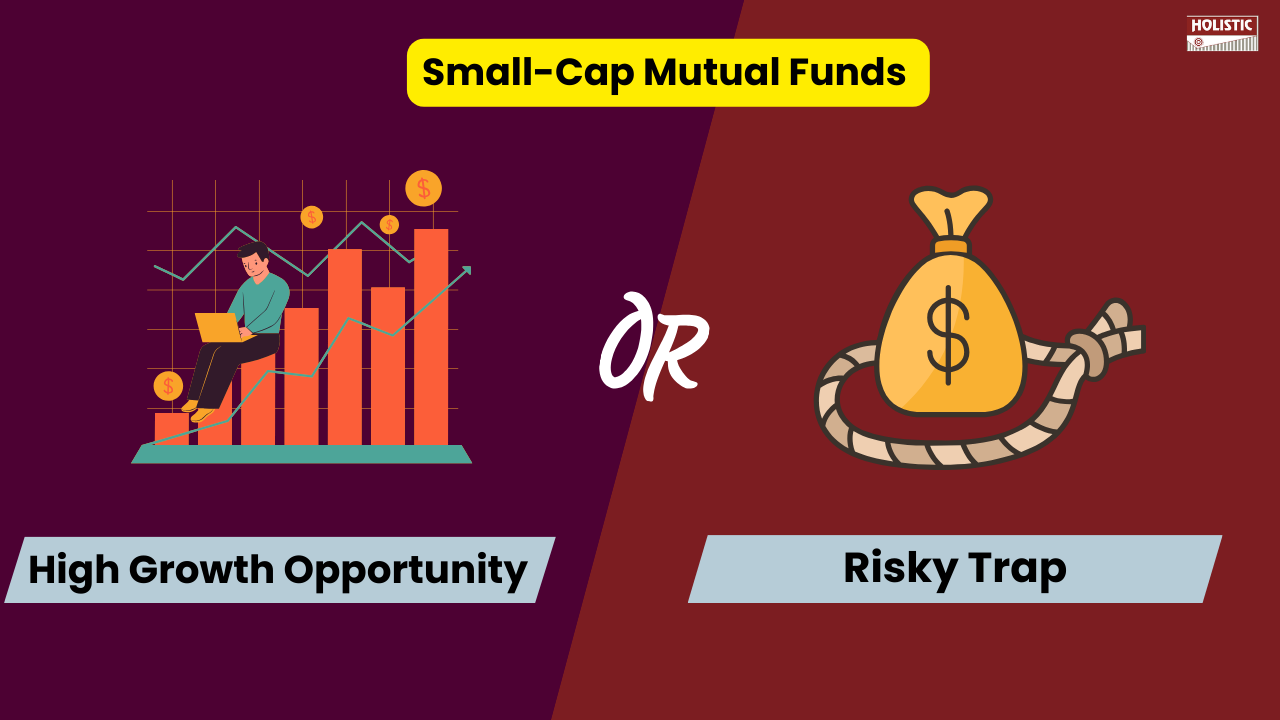
Small-cap mutual funds often divide investors into two camps.
Some swear by their wealth-creation potential, while others fear their sharp ups and downs.
So which is it—profit or loss? And more importantly, who should actually invest in small-cap mutual funds?
Before answering that, let’s take a step back and understand how the equity market itself is structured.
Table of Contents
- Understanding Market Capitalisation
- What Makes Small-Cap Stocks Different?
- Why Small Caps Are So Volatile
- The Short-Term Profit Illusion
- Why Time Is the Biggest Ally in Small-Cap Investing
- The Long-Term Investing Paradox
- Who Should Consider Small-Cap Mutual Funds?
- How Much Exposure Is Sensible?
- Handling Volatility the Right Way
- Final Thoughts: Opportunity with Discipline
1. Understanding Market Capitalisation
The Indian stock market has close to 6,500 listed companies, but investors don’t evaluate all of them equally.
To make sense of this vast universe, stocks are classified based on market capitalisation, which reflects the size and economic significance of a company.
- Large-cap stocks include the top 100 companies by market value. These businesses are leaders in their industries, have established revenue streams, strong balance sheets, and are closely tracked by analysts and institutions. They tend to offer stability rather than explosive growth.
- Mid-cap stocks comprise the next 250 companies. These are firms that have moved beyond the early stage but are still expanding. They often deliver a balance of growth and risk, making them attractive during economic upcycles.
- Small-cap stocks include all companies beyond the top 350. This is the largest segment numerically and also the least researched. These companies are smaller in size, operate in niche areas, and are still proving their business models.
While small-cap stocks form the backbone of future market leaders, they are also the most unpredictable segment of the market.
2. What Makes Small-Cap Stocks Different?
Have you ever looked at a large-cap company and wondered where it started?
Many of today’s giants were once obscure small-cap names.
Small-cap companies are usually:
- In early or mid-stages of their business lifecycle
- Operating with limited resources and bargaining power
- More dependent on a few products, clients, or markets
- Still building governance, systems, and scalability
This stage gives them room to grow rapidly, but it also means mistakes, slowdowns, or external shocks can hurt them more severely.
Their future success depends heavily on execution quality and management capability.
That’s what makes small caps fascinating—but also demanding—for investors.
3. Why Small Caps Are So Volatile
Volatility is not an exception in small caps—it is the norm.
Compared to large companies, small-cap firms typically face:
- Restricted access to capital during downturns
- Higher operating leverage
- Lower liquidity in their stocks
- Greater sensitivity to interest rates and economic cycles
Because of this, their share prices can swing sharply.
In a good market phase, optimism and earnings growth can push prices up very quickly.
But when sentiment turns, the same stocks can correct deeply and suddenly.
So the real question is not whether small caps will be volatile—but can you stay invested when volatility shows up?
4. The Short-Term Profit Illusion
Small-cap funds often look most attractive after they have already delivered strong returns.
That’s when headlines turn positive and investor interest peaks.
Unfortunately, this leads many investors into a familiar trap:
- Enter after a sharp rally
- Get uncomfortable during normal corrections
- Exit just before the recovery begins
Small-cap investing does not reward impatience.
These funds go through long periods of consolidation before the next growth phase begins.
Treating them like short-term trading instruments almost guarantees disappointment.
Equity mutual funds—especially in the small-cap category—are meant to capture business growth over time, not quick market moves.
5. Why Time Is the Biggest Ally in Small-Cap Investing
The risk–reward equation of small caps works only when time is on your side.
Historically:
- Large-cap funds tend to deliver steady long-term returns of around 11–12%
- Small-cap funds, over full market cycles, can generate higher returns, but with deeper interim drawdowns
This additional return does not come every year.
It shows up only over long holding periods, typically a decade or more.
Small companies need time to expand capacity, strengthen margins, and establish competitive advantages.
The real compounding in small caps often happens after years of patience, not during the initial excitement phase.
6. The Long-Term Investing Paradox
Isn’t it strange how investor behaviour changes based on the product label?
Many people are perfectly comfortable locking money away for 15 years in PPF or 20–25 years in insurance policies—often without questioning returns.
Yet, when it comes to equity mutual funds, especially small caps, the expectation suddenly shifts to quick profits.
Why the contradiction?
When you invest in equities, you’re investing in businesses, not lottery tickets.
Businesses take time to expand capacity, gain market share, improve margins, and build competitive advantages.
These changes unfold over years, not months.
Impatience in equity investing doesn’t reduce risk—it creates it.
Patience, on the other hand, is not a passive trait; it’s an active advantage that allows compounding to work uninterrupted.
7. Who Should Consider Small-Cap Mutual Funds?
Small-cap mutual funds are not meant for everyone—and that’s perfectly okay.
They are better suited for investors who:
- Have a minimum investment horizon of 10 years
- Can emotionally handle periods of sharp underperformance
- Already have a solid base in large-cap and mid-cap funds
- Are investing for long-term goals such as retirement or children’s education
They are not suitable for:
- Short-term goals
- Investors nearing their financial goal date
- Those who panic during market corrections
The key question isn’t “Can small caps give high returns?”
It’s “Can I stay invested long enough to earn them?”
8. How Much Exposure Is Sensible?
Small caps work best as a satellite allocation, not the core of a portfolio.
A well-structured equity portfolio usually looks like this:
- Large caps provide stability and predictability
- Mid-caps add growth potential
- Small caps enhance long-term return potential
Overexposing your portfolio to small caps increases volatility without proportionate benefits.
The right allocation depends on factors like age, income stability, risk tolerance, and time horizon—but restraint matters.
In investing, concentration increases risk, while thoughtful diversification improves outcomes.
9. Handling Volatility the Right Way
Market volatility is uncomfortable—but unavoidable.
Corrections can be triggered by global events, interest rate changes, geopolitical tensions, or economic slowdowns.
These are normal parts of market cycles, not signals to abandon long-term plans.
What helps investors navigate this?
- Systematic Investment Plans (SIPs) to average costs
- Staying invested across market phases
- Diversifying across asset classes like equity, debt, gold, and real estate
Over time, volatility becomes less of a threat and more of a mechanism that rewards disciplined behaviour.
10. Final Thoughts: Opportunity with Discipline
Small-cap mutual funds are neither magic wealth creators nor reckless gambles.
They are high-potential tools that demand patience, emotional control, and realistic expectations.
The biggest risk isn’t market volatility—it’s investor behaviour during volatile phases.
Used thoughtfully, small caps can meaningfully enhance long-term returns.
Used impulsively, they can derail financial plans.
For investors unsure about allocation, timing, or suitability, a Certified Financial Planner (CFP) can help structure small-cap exposure in line with long-term goals and risk capacity.


Leave a Reply