

 Listen to this article
Can the SUD Life Assured Returns Plan truly provide financial security and predictable returns, or do its guaranteed benefits come with important trade-offs?
Does the SUD Life Assured Returns Plan offer the right balance between guaranteed savings and life protection, or are there better alternatives available?
Is the SUD Life Assured Returns Plan a smart choice for risk-averse investors, or does the comfort of assured returns come at the cost of wealth creation?
This article takes a closer look at the plan, examining its key features, benefits, and limitations to help you understand whether it can effectively support your financial goals.
Table of Contents:
What is the SUD Life Assured Returns Plan?
What are the features of the SUD Life Assured Returns Plan?
Who is eligible for the SUD Life Assured Returns Plan?
What are the benefits of the SUD Life Assured Returns Plan?
Grace Period, Discontinuance and Revival of the SUD Life Assured Returns Plan
Free Look Period for the SUD Life Assured Returns Plan
Surrendering the SUD Life Assured Returns Plan
What are the advantages of the SUD Life Assured Returns Plan?
What are the disadvantages of the SUD Life Assured Returns Plan?
Research Methodology of SUD Life Assured Returns Plan
Benefit Illustration – IRR Analysis of SUD Life Assured Returns
SUD Life Assured Returns Plan Vs. Other Investments
SUD Life Assured Returns Plan Vs. Pure-term + PPF/Equity Mutual Fund
Final Verdict on SUD Life Assured Returns Plan
What is the SUD Life Assured Returns Plan?
SUD Life Assured Returns is a Non-Linked, Non-Participating, Individual, Savings Life Insurance plan.
This plan blends protection with savings. The plan helps you build a lump sum at maturity to support your future goals.
What are the features of the SUD Life Assured Returns Plan?
- Guaranteed Maturity Benefit: Receive the Sum Assured on Maturity at the end of the policy term.
- Financial Protection for Loved Ones: Provides life cover to support your family financially in the event of the Life Assured’s death during the policy term.
- Higher Premium, Higher Maturity Benefit: The Sum Assured on Maturity increases with the premium selected, allowing you to choose a benefit based on your financial capacity.
- Flexible Policy and Premium Payment Terms: Choose from available premium payment terms and policy terms to suit your financial requirements.
- Tax Benefits: Tax benefits may be available as per the prevailing provisions of the Income Tax Act, 2025, as amended from time to time.
Who is eligible for the SUD Life Assured Returns Plan?
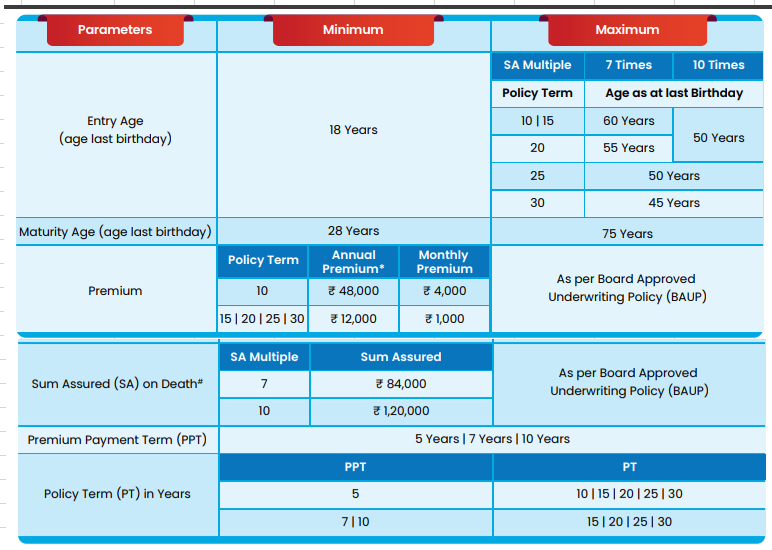
What are the benefits of the SUD Life Assured Returns Plan?
1. Maturity Benefit
On survival of the Life Assured up to the end of the policy term, provided the SUD Life Assured Returns Plan policy is in force, Sum Assured on Maturity (SAM) will be paid, and the contract ceases immediately.
Maturity Benefit is based on the Age of Life Assured, Premium Payment Term, Policy Term, Annual Premium & Sum Assured Multiple as chosen by the policyholder at inception of the policy.
2. Death Benefit
In case of the death of the Life Assured during the SUD Life Assured Returns Plan policy term, provided the policy is in force, the death benefit will be paid out as a lump sum to the nominee/beneficiary, and the policy will terminate.
Death Benefit is the highest of:
- Sum Assured on Death Or
- Sum Assured Multiple (7 or 10) as chosen by the Policyholder multiplied by the Annualised Premium Or
- Surrender Value as on Date of Death of the Life Assured Or
- 105% of the total premiums paid
Grace Period, Discontinuance and Revival of the SUD Life Assured Returns Plan
Grace Period
A grace period of 30 days for Quarterly/Half-Yearly or Yearly Premium Payment mode and 15 days for monthly mode is applicable to pay the due premium.
Discontinuance
Lapse: If the due premiums for the first full policy year have not been paid within the grace period, then the SUD Life Assured Returns Plan policy will lapse. Life cover will cease, and no benefits shall become payable under the lapsed policy.
Reduced Paid-Up: If the premiums have been paid for at least the first full policy year and subsequent premiums are not paid, then the Policy will acquire Reduced Paid-Up status and continue with reduced benefits
Revival
Lapsed policy and Reduced Paid-Up policy can be revived within a period of 5 years from the due date of the first unpaid premium.
Free Look Period for the SUD Life Assured Returns Plan
If you disagree with any of those terms or conditions in the policy, you have an option to return the policy to us within 30 days from the date of the receipt of the policy document, whether received electronically or otherwise.
Surrendering the SUD Life Assured Returns Plan
You can surrender your policy any time after completion of the first policy year, provided one full year premium has been received.
The surrender value payable would be the higher of the Guaranteed Surrender Value (GSV) and Special Surrender Value (SSV).
Special Surrender Value will be acquired after the receipt of one full Policy Year premium, whereas the Guaranteed Surrender Value will be acquired after the receipt of the first two consecutive full Policy Year premiums.
What are the advantages of the SUD Life Assured Returns Plan?
- Higher Premium, Higher Maturity Benefit: The Sum Assured on Maturity increases with the premium amount selected.
- Loan Facility: A loan can be availed against the policy, subject to the applicable terms and conditions, up to 70% of the Surrender Value.
- Guaranteed Benefits: The policy provides guaranteed payouts in the form of either a death benefit or a maturity benefit, as applicable under the policy terms.
What are the disadvantages of the SUD Life Assured Returns Plan?
- Inadequate Life Cover: The Sum Assured may be insufficient to meet the family’s long-term financial needs.
- Low Returns: The returns offered by the plan are relatively low, particularly when compared with other long-term investment options.
- No Loyalty Additions: The plan does not provide any additional benefits or bonuses for continuing the policy for a longer period.
Research Methodology of SUD Life Assured Returns Plan
The SUD Life Assured Returns Plan offers guaranteed benefits, which may appear attractive to investors seeking certainty. However, the guarantee alone should not be the deciding factor when evaluating a long-term investment.
It is equally important to assess whether the returns generated are adequate to beat inflation and support meaningful wealth creation.
Let us evaluate the potential return from the SUD Life Assured Returns Plan based on the figures provided in the SUD Life Assured Returns Plan policy brochure.
Benefit Illustration – IRR Analysis of SUD Life Assured Returns
Consider a 35-year-old male who opts for the SUD Life Assured Returns Plan with a Sum Assured of ₹12 lakh.
The premium payment term is 10 years, while the policy term is 25 years. The annual premium is ₹1.20 lakh.
| Male | 35 years |
| Sum Assured | ₹ 12,00,000 |
| Policy Term | 25 years |
| Premium Paying Term | 10 years |
| Annualised Premium | ₹ 1,20,000 |
At the end of the SUD Life Assured Returns Plan policy term, the policy provides a maturity benefit of ₹33.01 lakh as the Sum Assured on Maturity.
Based on the premium outflows and the maturity proceeds, the Internal Rate of Return (IRR) works out to approximately 5.01% as per the SUD Life Assured Returns Plan maturity calculator.
| Age | Year | Annualised premium / Maturity benefit | Death benefit |
| 35 | 1 | -1,20,000 | 12,00,000 |
| 36 | 2 | -1,20,000 | 12,00,000 |
| 37 | 3 | -1,20,000 | 12,00,000 |
| 38 | 4 | -1,20,000 | 12,00,000 |
| 39 | 5 | -1,20,000 | 12,00,000 |
| 40 | 6 | -1,20,000 | 12,00,000 |
| 41 | 7 | -1,20,000 | 12,00,000 |
| 42 | 8 | -1,20,000 | 12,00,000 |
| 43 | 9 | -1,20,000 | 12,00,000 |
| 44 | 10 | -1,20,000 | 12,00,000 |
| 45 | 11 | 0 | 12,00,000 |
| 46 | 12 | 0 | 12,00,000 |
| 47 | 13 | 0 | 12,00,000 |
| 48 | 14 | 0 | 12,00,000 |
| 49 | 15 | 0 | 12,00,000 |
| 50 | 16 | 0 | 12,00,000 |
| 51 | 17 | 0 | 12,00,000 |
| 52 | 18 | 0 | 12,00,000 |
| 53 | 19 | 0 | 12,00,000 |
| 54 | 20 | 0 | 12,00,000 |
| 55 | 21 | 0 | 12,00,000 |
| 56 | 22 | 0 | 12,00,000 |
| 57 | 23 | 0 | 12,00,000 |
| 58 | 24 | 0 | 12,00,000 |
| 59 | 25 | 0 | 12,00,000 |
| 60 | 33,01,848 | ||
| IRR | 5.01% |
While the guaranteed nature of the benefit provides certainty, the return of 5.01% is relatively modest, particularly when compared with other debt-oriented investment avenues.
Over a long investment horizon, returns that do not adequately stay ahead of inflation can limit the growth of your wealth and reduce the corpus available for achieving future financial goals.
Therefore, despite offering guaranteed maturity benefits, the SUD Life Assured Returns Plan may not be an efficient choice for long-term wealth creation.
SUD Life Assured Returns Plan Vs. Other Investments
As part of our analysis, let us compare the returns from the SUD Life Assured Returns Plan with alternative investment options using the same assumptions as in the earlier illustration.
Although the SUD Life Assured Returns Plan combines life insurance and investment in a single product, it is useful to evaluate these two needs separately to understand whether the combination offers better value.
SUD Life Assured Returns Plan Vs. Pure-term + PPF/Equity Mutual Fund
For the comparison, we consider a pure-term insurance policy with a Sum Assured of ₹12 lakh. The annual premium for the 25-year policy term, with a limited premium payment term of 10 years, is ₹11,700.
After paying the term insurance premium, the remaining ₹1,08,300 can be invested towards long-term financial goals.
| Pure Term Life Insurance Policy | |
| Sum Assured | ₹ 12,00,000 |
| Policy Term | 25 years |
| Premium Paying Term | 10 years |
| Annualised Premium | ₹ 11,700 |
| Investment | ₹ 1,08,300 |
The investment component can then be selected based on the investor’s risk profile and investment horizon.
For our analysis, we consider two alternatives: the Public Provident Fund (PPF) as a debt-oriented option and an Equity Mutual Fund as a growth-oriented option.
| Term Insurance + PPF | Term insurance + Equity Mutual Fund | ||||
| Age | Year | Term Insurance premium + PPF | Death benefit | Term Insurance premium + Equity Mutual Fund | Death benefit |
| 35 | 1 | -1,20,000 | 12,00,000 | -1,20,000 | 12,00,000 |
| 36 | 2 | -1,20,000 | 12,00,000 | -1,20,000 | 12,00,000 |
| 37 | 3 | -1,20,000 | 12,00,000 | -1,20,000 | 12,00,000 |
| 38 | 4 | -1,20,000 | 12,00,000 | -1,20,000 | 12,00,000 |
| 39 | 5 | -1,20,000 | 12,00,000 | -1,20,000 | 12,00,000 |
| 40 | 6 | -1,20,000 | 12,00,000 | -1,20,000 | 12,00,000 |
| 41 | 7 | -1,20,000 | 12,00,000 | -1,20,000 | 12,00,000 |
| 42 | 8 | -1,20,000 | 12,00,000 | -1,20,000 | 12,00,000 |
| 43 | 9 | -1,20,000 | 12,00,000 | -1,20,000 | 12,00,000 |
| 44 | 10 | -1,20,000 | 12,00,000 | -1,20,000 | 12,00,000 |
| 45 | 11 | 0 | 12,00,000 | 0 | 12,00,000 |
| 46 | 12 | 0 | 12,00,000 | 0 | 12,00,000 |
| 47 | 13 | 0 | 12,00,000 | 0 | 12,00,000 |
| 48 | 14 | 0 | 12,00,000 | 0 | 12,00,000 |
| 49 | 15 | 0 | 12,00,000 | 0 | 12,00,000 |
| 50 | 16 | 0 | 12,00,000 | 0 | 12,00,000 |
| 51 | 17 | 0 | 12,00,000 | 0 | 12,00,000 |
| 52 | 18 | 0 | 12,00,000 | 0 | 12,00,000 |
| 53 | 19 | 0 | 12,00,000 | 0 | 12,00,000 |
| 54 | 20 | 0 | 12,00,000 | 0 | 12,00,000 |
| 55 | 21 | 0 | 12,00,000 | 0 | 12,00,000 |
| 56 | 22 | 0 | 12,00,000 | 0 | 12,00,000 |
| 57 | 23 | 0 | 12,00,000 | 0 | 12,00,000 |
| 58 | 24 | 0 | 12,00,000 | 0 | 12,00,000 |
| 59 | 25 | 0 | 12,00,000 | 0 | 12,00,000 |
| 60 | 45,03,775 | 1,03,45,612 | |||
| IRR | 6.58% | 10.85% | |||
In the PPF scenario, the balance amount is invested in PPF. While the minimum investment requirement is ₹500 and the account has a 15-year tenure, adjustments are made towards the later years to align the investment with the cash flows considered in the illustration.
The investment grows to a maturity value of ₹45.03 lakh, resulting in an IRR of 6.58% for the combined term insurance and PPF strategy.
In the Equity Mutual Fund scenario, the same surplus is invested in an equity mutual fund, assuming returns appropriate for a long-term equity investment.
The investment grows to ₹1.16 crore before tax. After accounting for applicable capital gains tax, the post-tax value works out to ₹1.03 crore, resulting in a post-tax IRR of 10.85% for the combined term insurance and equity mutual fund strategy.
| Equity Mutual Fund Tax Calculation | |
| Maturity value after 25 years | 1,16,50,985 |
| Purchase price | 10,83,000 |
| Long-Term Capital Gains | 1,05,67,985 |
| Exemption limit | 1,25,000 |
| Taxable LTCG | 1,04,42,985 |
| Tax paid on LTCG | 13,05,373 |
| Maturity value after tax | 1,03,45,612 |
The comparison highlights an important principle: insurance and investments need not be bundled into a single product.
By purchasing adequate life cover through a pure-term policy and investing the balance separately based on your risk profile and time horizon, you may achieve greater flexibility and potentially higher wealth creation.
In this illustration, the SUD Life Assured Returns Plan falls short on both fronts—it provides relatively low life cover and generates modest investment returns.
Separating the two objectives can therefore be a more effective approach to protecting your family while building wealth for your long-term financial goals.
Final Verdict on SUD Life Assured Returns Plan
As the name suggests, the SUD Life Assured Returns Plan offers guaranteed benefits, which may appear attractive to investors seeking certainty. However, a guarantee alone should not be the primary consideration when evaluating a long-term investment.
What matters is whether the returns are sufficient to beat inflation and help build an adequate corpus for your future financial goals and it also has a high agent commission.
Our analysis of the SUD Life Assured Returns Plan shows that the returns are relatively low and may not adequately compensate for the impact of inflation over the long term.
As a result, the corpus accumulated may fall short of what is required to meet your financial goals.
Therefore, despite the certainty of guaranteed benefits, the plan may not be an efficient investment option for long-term wealth creation.
Another significant limitation is the bundling of insurance and investment in a single product.
A more effective approach is to separate these two objectives—opt for a pure-term life insurance policy for adequate financial protection and invest separately in suitable investment avenues based on your goals, risk profile, and time horizon.
This gives you greater flexibility and allows each financial objective to be addressed more efficiently.
Do Quora, Facebook, and Twitter have the final say when it comes to financial advice?
For personalised financial planning based on your risk profile, investment horizon, and financial goals, consider consulting a Certified Financial Planner.
A well-structured financial plan can help you channel your savings effectively and work towards achieving your financial objectives with greater clarity and discipline.
Leave a Comment