


 Listen to this article
When you enquire a person from rural India about their investment practices then the most frequent answer you get would be Chit funds.
Chit funds are one of the oldest investment instruments that originated in the 18th century and account for 60% of rural savings.
As per the study done in 2017, there are over 18 crore subscribers for chit funds.
Given the magnitude of the investors in chits, is it a viable option to consider?
How do they fare when pitted against Mutual funds?
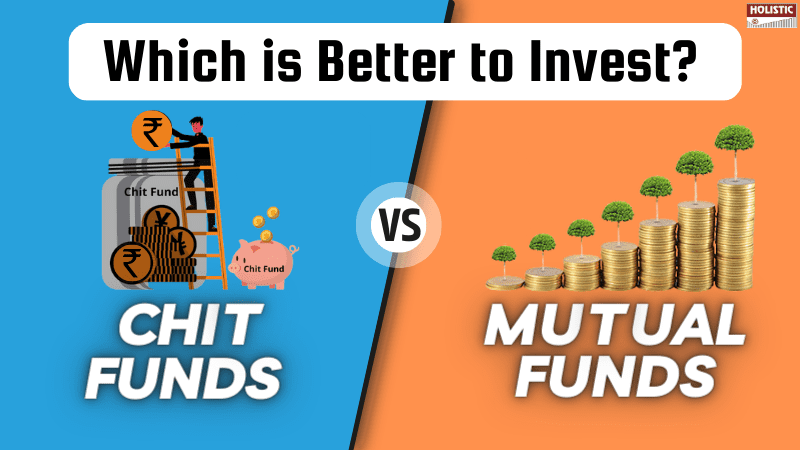
For many, the debate of chit funds vs mutual funds is common, as investors try to balance short-term liquidity with potential returns.
Choosing the right chit fund requires understanding both the benefits and risks involved.
Table of Contents:
2.Investment Strategy of Chit Funds
7.Differences between Chit Funds Vs Mutual Funds
8.But is that the complete picture of Chit Funds?
9.Franklin Templeton Debt Fund Closure
10.Ideal Risk Reward in Chit Funds?
11.Short-Term vs Long-Term Chit Funds
12.Do Chit Funds help in Compounding?
How do Chit Funds work?
A chit fund is a savings scheme where a group of individuals come together and contribute a certain amount of money at regular intervals.
The funds are then distributed among the group, typically on a winning lot or bidding basis.
Let’s consider Mr. X pools 10 of his friends and creates a group.
This group may be his close friends or relatives whom he trusts.
They vow to invest Rs. 10000 for a period of 10 months.
Mr. X is the organizer of the group who takes up a commission every month as he takes responsibility for collecting the money from the group.
In India, these schemes are also referred to as chitti funds or chit’s funds, and many small investors choose formats like Rs. 25,000 chit format for 10 months or Rs. 50,000 chits for 10 months depending on their capacity.
Investment Strategy of Chit Funds
On the designated date of the meeting, the group meets and the bidding is conducted.
- Each of you contributes Rs 10,000 to the organizer.
- The accumulated corpus is Rs.1,00,000. This amount is given to the person who bids the lowest.
- Bid winner (Winning Bid of 70,000) is bound to pay a commission to the organizer which is usually 5% of the corpus accumulated.
- The difference between the pooled amount and the lowest bid is usually split evenly amongst the members of the group
- So, in essence, you pay only Rs. 7000 and take back Rs. 65,000 on the day.
This example demonstrates how chit funds work making it easier for first-time investors to understand short-term financial planning.
This is how the pay-out may look for each bidder.
| Instalment | Contribution per head | Accumulated corpus | Winning Bid | Difference | Discount per head | Effective amount invested | Agent Commission |
| 1 | 10,000 | 1,00,000 | 70,000 | 30,000 | 3,000 | 7,000 | 5,000 |
| 2 | 10,000 | 1,00,000 | 75,000 | 25,000 | 2500 | 7,500 | 5,000 |
| 3 | 10,000 | 1,00,000 | 80,000 | 20,000 | 2000 | 8,000 | 5,000 |
| 4 | 10,000 | 1,00,000 | 83,000 | 17,000 | 1700 | 8,300 | 5,000 |
| 5 | 10,000 | 1,00,000 | 85,000 | 15,000 | 1500 | 8,500 | 5,000 |
| 6 | 10,000 | 1,00,000 | 87,000 | 13,000 | 1300 | 8,700 | 5,000 |
| 7 | 10,000 | 1,00,000 | 89,000 | 11,000 | 1100 | 8,900 | 5,000 |
| 8 | 10,000 | 1,00,000 | 91,000 | 9,000 | 900 | 9,100 | 5,000 |
| 9 | 10,000 | 1,00,000 | 93,000 | 7,000 | 700 | 9,300 | 5,000 |
| 10 | 10,000 | 1,00,000 | 95,000 | 5,000 | 500 | 9,500 | 5,000 |
| Total | 15,200 | 84,800 | 50,000 | ||||
What’s in it for us?
As a Participant in Chit Funds
- If you manage to win the bid in the first few rounds, you can get a lump sum amount. This amount can be used to repay any loans or can be used for any personal financial needs.
- Chit funds help in accumulating corpus for short-term financial needs. You are well aware of your financial needs and can plan out when you invest.
- You definitely make some return when you invest in Chit funds as the discount is shared with all the participants.
- The bidder receives the money instantly sans any delay or paper works, unlike personal/business loans where delays and paperwork are inevitable.
- People from lower-income households can also participate.
- The returns are not subjected to market risks and volatility.
- Just in case the organizer swindles the corpus at some point in time all of us will be at loss.
- Participant default should also be taken into account, as one such instance will lead to the collapse of the entire system.
- Participants often compare chit fund vs RD or chits or sip which is better to decide the most suitable option.
- Using a chit fund calculator can also help in understanding projected returns for schemes like 10 months’ chit plan.
As an Organizer in Chit Funds
- The organizer lives off the commission he /she receives from participants like us.
- They may manage one or more Chit Funds and can get a good amount of money just by facilitating the auctions.
- They are the ones who bring in all the participants and initiate this group.
- They should ensure that the parties submit the instalments on time and are responsible for collecting and settling the money.
Organizers often operate multiple schemes, including recognized chit fund companies earning from chit commission.
Experienced organizers may manage branded plans such as chit funds or margadarsi chit fund plans.
But what about investing in Mutual funds?
Should you invest in them rather?
Keep reading to find out what is rather a Viable Investment Option for you to invest in.
How do Mutual Funds work?
In Mutual funds, you indirectly invest in stocks, bonds, and other securities that the fund houses choose.
These security or stock selections can be made on a theme or are based on the market cap or the various indices available.
When you invest, you are allotted units based on the Mutual Fund’s Net asset value (NAV).
When the values of the underlying securities or stocks grow. the NAV also increases, thus helping in generating capital appreciation.
You can select different mutual funds for each of your financial goals (Short term, Medium Term and long-term) based on your time horizon and can invest in them according to your financial goals.
Many new investors also compare sip 10-month chit fund schemes with mutual funds to determine which aligns better with their goals.
Chit Funds Vs Mutual funds
Now that you got to know what Chit Funds and Mutual funds are, let’s see how they are similar and how they are different, and which instrument should be chosen when.
Similarities between Chit Funds Vs Mutual Funds
- Both Mutual funds (Short term Debt funds) and Chit funds offer good short-term investment options.
- Chit funds and Mutual funds both pool in their money from their participants and buy stakes (in the case of mutual funds) or put them in the pots (for bidding).
- For Financial Goals lesser than 1 year, both Short Term Mutual Funds and Chit Funds offer a good solution.
Chit Funds vs RD vs SIP
When comparing chit funds, recurring deposits (RDs), and SIPs (Systematic Investment Plans), it becomes clear why mutual funds and SIPs are generally the safer and more reliable choice for long-term wealth creation.
Chit funds provide quick access to lump sums, making them useful for immediate financial needs.
However, they carry high risks, including participant default, organizer fraud, and lack of regulatory oversight.
Even with potential short-term returns, the unpredictability of chit fund returns can outweigh the benefits, especially for those seeking stable growth.
Recurring deposits (RDs), on the other hand, offer fixed returns and are less risky, but the growth is modest.
RDs cannot match the compounding power and capital appreciation offered by mutual funds.
SIPs in mutual funds provide the best of both worlds: regular, disciplined investing with professional fund management.
With a mutual fund SIP, you invest a small amount every month, which helps average out market volatility and lets compounding work over the long term.
Unlike chit funds, your investment in a SIP is regulated, secure, and flexible—you can start with as little as Rs. 500 and pause or stop anytime.
In essence, while chit funds may serve as a short-term liquidity tool and RDs offer safe but low returns, SIPs in mutual funds remain the most suitable option for achieving long-term financial goals with minimal risk and better wealth growth.
Differences between Chit Funds Vs Mutual Funds
There are contrasting differences between Chit Funds and Mutual Funds. The following table talks about the same.
| Aspect | Chit Funds | Mutual Fund |
| Organizational structure/Ownership | Typically organized by individuals or private companies. | Organized by professionally managed fund houses. |
| Regulation: | Local chit funds are not regulated as people often create a group and work amongst themselves. | Highly regulated by SEBI. |
| Investment horizon | Primarily for short-term financial needs. | Can be customized by choosing the type of fund according to our financial needs. |
| Returns | Investment returns depend on the lot /winning bids. | Investment returns depend on the performance of underlying stocks. |
| Agent Commissions | The commission fees are typically around 5%. | The fund management fee is usually around 1-1.5% depending on the fund. |
| A number of approved funds | Very less | All funds are approved by SEBI. |
| Probability of Default | Mid-High | Zero |
But is that the complete picture of Chit Funds?
Now you might be thinking that, ok, Chit funds aren’t that bad and could be considered for short-term financial requirements. But that is not the complete picture. Let’s see what are the major drawbacks of Chit Funds are.
The Participant risk in Chit Funds
This is the risk when one of your fellow chit-participant’s defaults.
Let’s consider an ideal situation where all the people pay their share to the organizer.
In such cases, there are no issues and the person who bids the lower wins the bid.
But What if a person wins the bid earlier and fails to make payments for the upcoming rounds?
The whole system collapses and all the people who haven’t redeemed their money stand at a loss.
You, as a fellow participant do not have any redressal mechanism.
No regulations can help you reclaim the money.
This is why investors look for safer alternatives like approved chit, or choose top 10 chit fund companies in India to reduce participant risk.
Comparing chit fund vs personal loan is also common.
The Organizer Risk in Chit Funds
This is one of the major risks in Chit funds.
There have been cases where the organizers have defaulted and all the people who have invested go empty-handed.
The organizer is entrusted with the job of making sure that the funds should keep flowing from the other participants.
But just in case the participant defaults the organizer should have the capability to repay the same from his pocket.
There may be several questions raised by the participants regarding the other defaulted co-participant as to why he /she was chosen first up and questions may be raised on the background and repaying capabilities of the other participants.
You may also raise a fair question when the organizer is your relative or your friend and that you can trust him completely.
But is the organizer capable of spending the money from his pocket to ensure the Chit Fund is alive and kicking?
Franklin Templeton Debt Fund Closure
All of us would have heard about the 6-debt fund closure of Franklin Templeton some years back.
These debt funds had a combined AUM of about Rs. 25,300 Cr.
Even though the funds were wound up there was not a single participant who lost his money due to the closure.
That is the striking difference between a Mutual fund and a Chit fund.
In Mutual funds, you get the money invested even if the fund house closes down the fund.
That is because of the regulations in place for Mutual funds.
Is there any authorized regulatory body like SEBI which helps in such complaints from Chit funds? Absolutely none.
Ideal Risk Reward in Chit Funds?
By now you might have been aware of the pros and cons of investing in Chit funds.
But you may also think counterintuitive that there is also a possibility of generating a mediocre return when investing in a Chit fund.
Here the one question that you should ask yourself is, At What cost?
What is the cost which I am paying to achieve this mediocre investment return?
Of course, there are risks in every investment instrument out there in the market.
But if there is an investment instrument that gives us returns of about 12% with our entire capital at risk, then we will have to think otherwise.
Investors often compare chit fund returns, chit fund vs RD, and SIP or chit fund which is better to understand the realistic risk-reward scenario.
Short-Term vs Long-Term Chit Funds
Chit funds come in various durations, generally categorized as short-term chit funds and long-term chit funds.
Understanding the difference can help investors evaluate risk, liquidity, and potential returns, even if one does not actively recommend them.
Short-term chit funds usually last from 6 to 12 months, with participants contributing smaller amounts at regular intervals.
These schemes appeal to those seeking quick access to lump sums for immediate financial needs.
The shorter duration reduces the uncertainty of long-term participant defaults, but it also limits the potential returns and the benefits of pooling money over time.
Many search for options like 1-year chit fund, 10 months’ chit plan, or short term chit funds to estimate pay-outs and timing.
Long-term chit funds, on the other hand, can run for 2 to 5 years or more.
While these may allow for larger accumulated sums and potentially higher returns per participant, they carry increased participant and organizer risk due to the extended timeline.
Missed payments or defaults over a long period can significantly affect all participants.
Long-term schemes also reduce liquidity, as the money is tied up until the chit is closed.
Whether short-term or long-term, both types of chit funds rely heavily on the trustworthiness of the organizer and the discipline of participants.
Investors often compare these with safer options like mutual funds, SIPs, or RDs to gauge whether the potential returns justify the risks.
Using tools such as a chit fund calculator or checking approved chit fund companies in India can help evaluate the scheme, even if one chooses not to participate.
Do Chit Funds help in Compounding?
Mutual funds are better known to compound easily when invested over a longer period of time.
The compounding effect increases with the increase in your investment horizon for every SIP.
Let me give you an example. Franklin India Prima fund was launched in 1993. This fund has grown at a CAGR of 18.2 % over 29 years.
To put things into perspective, Rs.10,000 invested in this fund in 1993 would have fetched you an astounding amount of Rs.14,95,789.50.
This is the magic of Mutual funds helping us build wealth over the long term.
But on the flip side, just ask this question to yourself.
Do Chit fund investments offer any compounding effect like mutual funds?
There is no option of allowing your money to compound as in the case of mutual funds.
The money is usually withdrawn once the chit is closed and is generally devoured.
These increases forced spending rather than compounding, which is the essence of investing.
This is why many investors look for chit fund schemes, short term chit funds, or 1-year chit fund to understand their limitations compared to mutual funds.
Saradha Chit Scam:
Many of us would have heard about the Saradha Chit fund scam which rocked our nation in 2013.
Saradha chit funds had mopped up about ₹ 4000 crores through its chit funds, most of the money coming from rural Bengal households.
People were offered up to 50% returns on their invested amount.
This spread as a wild forest fire to the neighbouring states and at one point the Saradha group of companies had 239 companies under their umbrella.
Several top politicians, actors, and sportsmen were associated with the Saradha group and were actively promoting the company.
The popularity of this Chit fund was so much so that they even roped in the Argentine Star Lionel Messi to play in a football match funded by them.
At one point in time, the fund’s cash inflow was lower than the cash outflow and its probe was ordered.
The owner Sudipta Sen also confessed to this Ponzi scheme and was arrested later.
Many people who had invested their hard-earned money were left in the lurch and some agents even ended their lives as people came to them demanding the money.
Scams like these highlight the importance of checking chit fund license cost, approved chit, and chit fund companies in India before investing.
You can read more about it here.
Final Verdict:
We have seen what Chit funds offer, and their pros and cons, and we also did a comparative study with mutual funds.
Though there is a decent return on Chit funds the risks are high and the disadvantages of Chit funds outweigh its advantages.
So, you can better opt for a Mutual fund as all these risks are negated.
You can also start a Mutual Fund SIP (Systematic Investment Plan) with as low as Rs. 500 and can stop it whenever you want to.
All of this is at a lower risk than Chit funds.
So, for an all-around financial investment plan Mutual funds offer the best strategies hands-down. Happy Investing!
For anyone considering chit fund investment, understanding formats like 10 months’ chit plan, 50k chit plan for 10 months, or Rs. 5000 chit format for 10 months can help in planning short-term liquidity—but always weigh the risk against safer instruments like mutual funds.


Nice article