
 Listen to this article
A practical guide to understanding risk, returns, and real-world surprises
If someone asked you where to park your savings safely, what would you say?
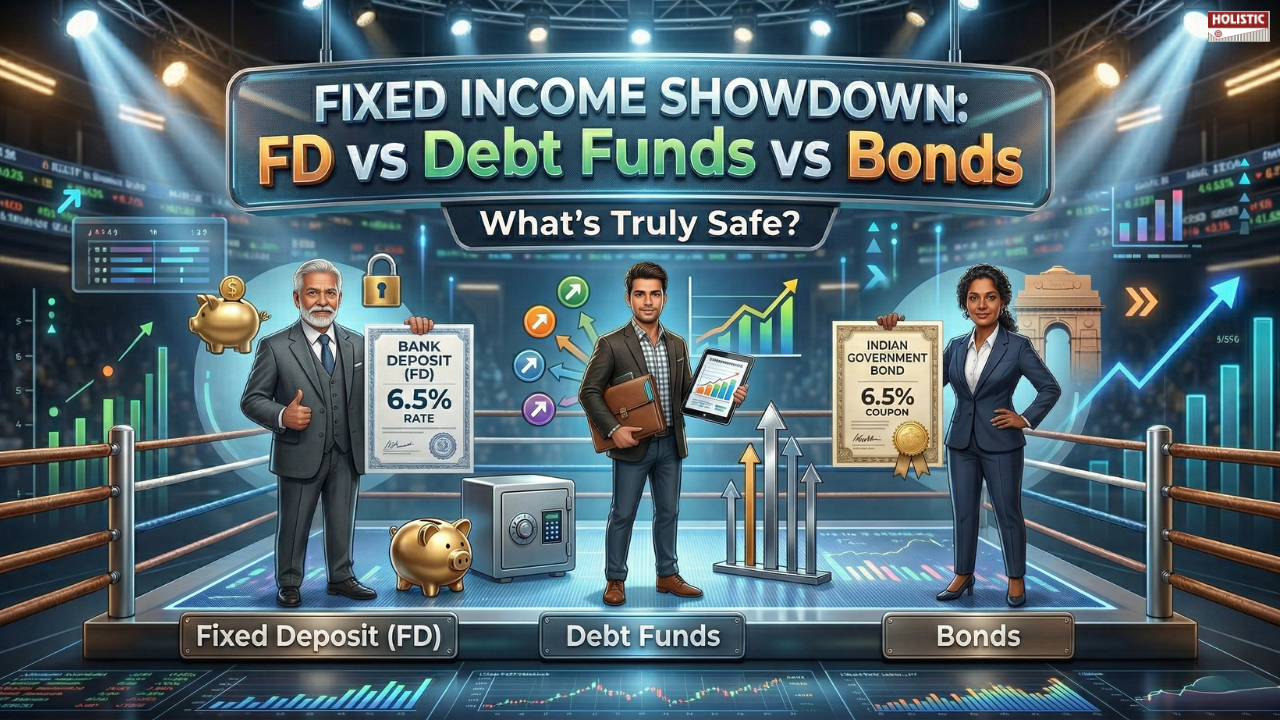
A Fixed Deposit? A debt mutual fund? Or maybe bonds that promise higher returns?
For decades, the default answer in most Indian households has been simple: FD = safety.
But today, with more options available and conversations shifting toward “better returns,” the definition of safety itself feels blurred.
So let’s ask the real questions:
- Is safety about guaranteed returns or protecting your capital?
- Can higher returns ever come without hidden risks?
- And most importantly—what should you choose?
Let’s break it down in a simple, no-jargon way.
Table of Contents:
- What does “safe investment” really mean?
- Fixed Deposits: Stability You Can Count On
- Debt Mutual Funds: The “In-Between” Option
- Bonds: Predictable Income or Hidden Risk?
- Real-World Lessons: When “Safe” Didn’t Stay Safe
- The hidden risk most investors ignore
- Final verdict: What is truly safe?
What Does “Safe Investment” Really Mean?
Before you decide between FDs, debt funds, or bonds, pause for a moment.
What does safe actually mean to you?
Is it:
- Getting back exactly what you invested?
- Earning predictable, steady returns?
- Or growing your money faster than inflation?
Because here’s the uncomfortable truth most investors ignore:
No single investment delivers all three at the same time.
If something offers certainty, it usually sacrifices growth.
If something offers higher returns, it introduces uncertainty.
So instead of asking “Which is safest?”, a better question is:
“Safe for what purpose?”
Fixed Deposits: Stability You Can Count On
Fixed Deposits (FDs) are the default choice for most Indian households—and for good reason.
They are simple. Predictable. Familiar.
Why do investors trust FDs so much?
- Returns are guaranteed from day one
- No exposure to market volatility
- Easy to understand and execute
- Ideal for conservative investors
Today, most banks offer returns in the 6%–7.5% range, depending on tenure.
But does that automatically make them “safe”?
The safety reality
FDs are insured under the Deposit Insurance and Credit Guarantee Corporation (DICGC).
- Up to ₹5 lakhs per depositor per bank → fully protected
- Anything above that → not guaranteed
This means if you park ₹20 lakhs in a single bank, only ₹5 lakhs is legally protected.
Now, will large banks fail? Highly unlikely—but not impossible.
The hidden trade-offs
FDs feel safe because they don’t fluctuate. But look deeper:
- Fully taxable → reduces effective returns
- Inflation risk → real returns may be close to zero
- Liquidity penalty → early withdrawal costs you
So while your capital is stable, your purchasing power may not be.
Bottom line: FDs offer certainty, but that certainty comes at the cost of long-term growth.
Debt Mutual Funds: The “In-Between” Option
Debt mutual funds are often positioned as a smarter alternative to FDs.
They invest in:
- Government securities
- Corporate bonds
- Treasury bills
- Money market instruments
At first glance, they seem like the best of both worlds.
But are they really?
Where debt funds score
- Historically delivered 6%–8% returns
- No fixed lock-in (in most categories)
- No annual TDS (tax applies only on redemption)
- Potentially better post-tax efficiency (depending on structure)
Sounds better than FDs already, right?
But here’s where things get interesting.
The risks most investors underestimate
Debt funds are market-linked instruments. That changes everything.
They come with two key risks:
1. Credit Risk
What if the borrower (company issuing the bond) cannot repay?
Even highly rated companies have defaulted in the past.
2. Interest Rate Risk
When interest rates rise:
- Existing bond prices fall
- Fund NAV drops
This can lead to temporary losses, something FD investors are not used to seeing.
Why perception becomes the problem
Many investors enter debt funds thinking:
“This is just like an FD, but with slightly better returns.”
That assumption is dangerous.
Debt funds require:
- Understanding of categories (liquid, short duration, gilt, credit risk, etc.)
- Careful selection of portfolio quality
- Patience during volatility
The real takeaway
Debt funds are not unsafe.
But they are not “set-and-forget” products like FDs either.
Bottom line: Debt funds can enhance returns—but only if you understand what you’re investing in.
Bonds: Predictable Income or Hidden Risk?
At their core, bonds sound simple.
You lend money.
You earn interest.
You get your money back at maturity.
So why do so many investors misunderstand them?
Because while the structure is simple, the risk beneath the surface isn’t always obvious.
What Are You Really Buying When You Invest in Bonds?
When you invest in a bond, you are essentially acting like a lender.
But who are you lending to?
That’s where things start to matter.
Types of bonds you’ll encounter:
- Government bonds (G-Secs): Backed by the Government of India
- PSU bonds: Issued by public sector companies
- Corporate bonds: Issued by private companies
At first glance, they may all look similar—fixed interest, defined tenure.
But would you lend money to the government and a struggling company with the same level of comfort?
Probably not.
Returns: Why Higher Isn’t Always Better
Bond returns in India typically fall in this range:
- Government bonds → ~7% to 7.5%
- High-quality corporate bonds → ~8% to 9%
- Lower-rated bonds → 10% to 12% (or more)
Now ask yourself:
Why would one bond pay 7% and another 11%?
The answer is simple:
Because the borrower is riskier.
Higher returns are not a bonus.
They are compensation for taking on more uncertainty.
The Two Risks Most Investors Overlook
Many investors assume bonds are “fixed income” and therefore safe.
But bonds carry risks that don’t always show up immediately.
i. Credit Risk: The Default Nobody Sees Coming
What happens if the issuer cannot repay?
You don’t just lose returns.
You may lose capital.
And the uncomfortable truth is:
Defaults rarely come with early warning signs for retail investors.
ii. Interest Rate Risk: The Silent Impact
Even if the issuer is perfectly safe, bond prices fluctuate.
- When interest rates rise → bond prices fall
- When interest rates fall → bond prices rise
So if you need to sell before maturity, you may not get back what you expected.
This is especially relevant for long-term government bonds.
Real-World Lessons: When “Safe” Didn’t Stay Safe
If bonds were truly risk-free, these events wouldn’t have happened.
What history has shown:
- IL&FS crisis (2018):
A large infrastructure lender defaulted, shaking the entire debt market - DHFL collapse (2019):
Once considered reliable, it failed to meet obligations, impacting investors - Yes Bank AT1 bonds (2020):
Entire investments were written off overnight
Here’s the key takeaway:
These were not unknown or shady institutions. They were widely trusted.
Which raises a deeper question:
If “reputable” issuers can fail, how do you define safety?
The Accessibility Problem: Not Built for Everyone
Unlike FDs or mutual funds, bonds come with practical challenges:
- Many corporate bonds require large minimum investments
- Liquidity in the secondary market is often limited
- Pricing and risk assessment are not always transparent
Yes, platforms today make bonds more accessible.
But accessibility does not eliminate complexity.
So, Are Bonds Safe or Not?
The honest answer?
It depends entirely on what you buy.
- Government bonds → Very high safety, but sensitive to interest rates
- PSU bonds → Relatively stable, but not risk-free
- Corporate bonds → Wide spectrum—from stable to highly risky
Bonds are not a single category.
They are a range of instruments with very different risk profiles.
When Do Bonds Actually Make Sense?
Bonds are most useful when:
- You need predictable income
- You are in the withdrawal or retirement phase
- You want to stabilise your portfolio
But if you are in the wealth-building phase, chasing high-yield bonds can do more harm than good.
Because at that stage, the focus should be growth—not incremental yield.
The Real Insight
Bonds don’t fail investors.
Misunderstanding bonds does.
Chasing higher yields without understanding credit risk…
Ignoring liquidity constraints…
Assuming “fixed income” means “no risk” …
That’s where things go wrong.
Bottom line: Bonds can be powerful tools—but only when used with clarity, caution, and context.
The Hidden Risk Most Investors Ignore
Here’s something uncomfortable but true:
Most investors don’t lose money because they chose the wrong product.
They lose money because they used the right product in the wrong way.
Sounds surprising?
Think about it.
Was a fixed deposit ever designed to hold your entire life savings?
Was a high-yield bond meant to be your only source of safety?
Was a debt fund supposed to replace every low-risk allocation?
Yet, that’s exactly what happens.
Where things actually go wrong
The real risk doesn’t come from the instrument.
It comes from behaviour.
Investors often:
- Park large sums in one single bank, assuming safety is absolute
- Chase higher returns in bonds, ignoring underlying credit quality
- Treat debt mutual funds as guaranteed products, like FDs
- Ignore how interest rates impact bond values
- Overestimate their understanding of “low-risk” investments
And then, when something breaks—even slightly—the impact feels disproportionate.
Not because the product failed.
But because everything depended on that one decision.
Concentration: The silent wealth destroyer
Imagine this:
- ₹25 lakhs in one bank FD
- ₹15 lakhs in one corporate bond
- ₹10 lakhs in one debt fund
Individually, each may seem reasonable.
But together?
You are one event away from a serious financial shock.
This is what most investors underestimate:
Risk is not just about what you invest in.
It’s about how concentrated your exposure is.
The illusion of “safe”
Many investments feel safe because:
- They don’t show daily volatility
- They offer fixed or stable returns
- They are widely recommended
But absence of visible movement is not absence of risk.
A bond default doesn’t warn you gradually.
A liquidity freeze doesn’t send reminders.
It just happens.
And when it does, concentration magnifies the damage.
What actually reduces risk?
Not prediction.
Not chasing ratings.
Not switching products every year.
It’s something far simpler—and far more powerful:
Diversification.
- Across banks (to stay within insurance limits)
- Across instruments (FDs + debt funds + bonds)
- Across issuers (not relying on one entity)
- Across time horizons
Diversification may feel boring.
But in fixed income investing, boring is exactly what protects you.
Final Verdict: What Is Truly “Safe”?
So, after everything we’ve discussed, what’s the safest option?
The honest answer is:
There isn’t one.
Because safety is not universal—it is personal.
It depends on what you want:
- Want certainty of capital?
→ Fixed Deposits (within ₹5 lakh per bank limit) - Want better efficiency and slightly higher returns?
→ High-quality debt mutual funds - Want maximum default safety?
→ Government bonds
But here’s the real takeaway
Most investors are asking the wrong question.
Instead of asking:
“Which product is safest?”
Ask:
“Is my overall portfolio structured safely?”
Because:
Safety doesn’t come from the product.
It comes from how you combine and use it.
A balanced mix, aligned with your goals, horizon, and risk tolerance, will always outperform a single “safe” bet taken too far.
And if you want to build that balance with clarity—between returns, taxation, liquidity, and risk—consulting a Qualified CFP Professional can help you get it right from the start.

Leave a Comment