
 Listen to this article
At first glance, renaming Form 16 to Form 130 may look like a minor administrative tweak.
After all, what difference does a number make?
But pause for a moment—if the document you rely on every year for filing your income tax return changes its identity, doesn’t that signal something deeper?
The introduction of the Income Tax Act 2025, effective from April 1, 2026, marks one of the most significant structural updates to India’s tax system in decades.
And the shift from Form 16 to Form 130 is just one visible part of a much larger transformation.
Table of Contents
- What Was Form 16 and Why It Mattered?
- Form 130: The New Salary Certificate Explained
- Why the Government Renamed Tax Forms
- Key Changes Under the Income Tax Act 2025
- What This Means for Salaried Employees
- Will This Affect Your Tax Filing Process?
- Common Mistakes to Avoid During Transition
- How to Stay Prepared for the New Tax System
- Final Thoughts
1. What Was Form 16 and Why It Mattered?
For years, Form 16 has been the backbone of tax compliance for salaried individuals.
It served as:
- A summary of your annual salary
- A record of deductions claimed
- Proof of tax deducted at source (TDS)
Most taxpayers didn’t even think twice—they simply waited for Form 16, plugged the numbers into their return, and filed their taxes.
So when such a familiar document gets renamed, it naturally raises an important question:
Is this just a new label, or does it reflect a new system?
2. Form 130: The New Salary Certificate Explained
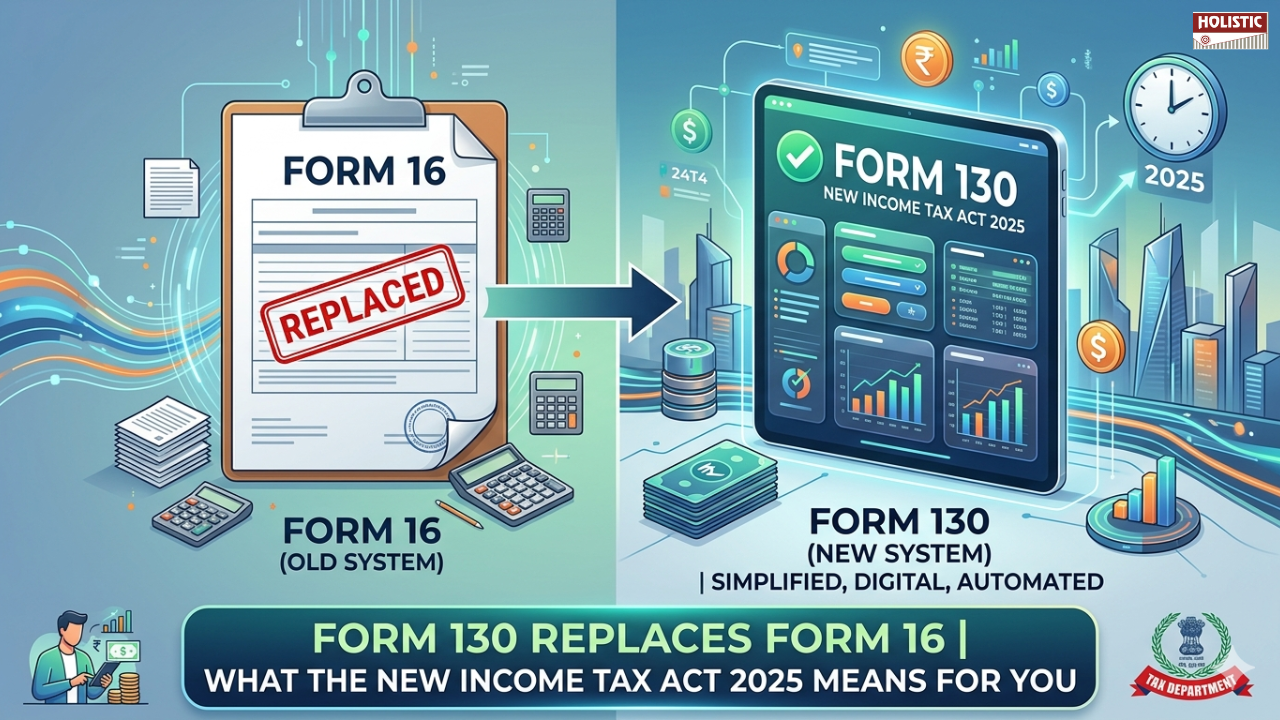
Under the new Income Tax Act 2025, Form 16 is now known as Form 130.
Functionally, it continues to serve the same purpose:
- Reporting salary income
- Capturing deductions and exemptions
- Reflecting TDS deducted by the employer
However, the change is not just cosmetic.
It aligns with the broader restructuring of the tax framework, where section numbers, terminologies, and reporting formats are being standardized.
In simple terms:
Your salary certificate hasn’t disappeared—it has been reorganized into a more structured system.
3. Why the Government Renamed Tax Forms
Why go through the effort of renaming forms that taxpayers are already familiar with?
The answer lies in long-term efficiency and modernization.
• Simplification
The earlier system evolved over decades, leading to complex numbering and scattered references. The new framework aims to make tax documents easier to understand.
• Uniformity
A standardized numbering system ensures consistency across forms, sections, and processes.
• Digital Integration
As tax filing becomes increasingly digital, structured formats help streamline automation, data matching, and processing.
• Reduced Confusion
Ironically, while the transition may feel confusing initially, the goal is to reduce ambiguity in the long run.
So the real objective isn’t just renaming—it’s rebuilding the system from the ground up.
4. Key Changes Under the Income Tax Act 2025
The introduction of Form 130 is part of a broader overhaul.
Some notable changes include:
- Replacement of the Income Tax Act 1961
- Renumbering of key sections (like 80C, 80D, etc.)
- Introduction of the term “Tax Year” instead of Financial Year/Assessment Year
- Streamlined compliance and reporting mechanisms
This raises an interesting thought:
Are we witnessing just a reform—or a complete reset of how taxation is structured in India?
5. What This Means for Salaried Employees
For salaried individuals, the immediate impact is straightforward—but important.
- Your employer will now issue Form 130 instead of Form 16
- The structure and purpose remain largely similar
- Tax filing will continue as usual, but with updated references
However, the real challenge lies in awareness.
Many taxpayers may still look for “Form 16” out of habit, especially during the initial years of transition.
Being aware of the new terminology ensures:
- Smooth tax filing
- Better communication with employers and advisors
- Reduced chances of errors
6. Will This Affect Your Tax Filing Process?
In practical terms, the process of filing your income tax return will not drastically change.
But there are subtle shifts to be mindful of:
- Updated form names and section references
- Possible changes in ITR formats
- Greater reliance on pre-filled data and digital systems
So while the steps may feel familiar, the underlying system is evolving.
Are you adapting to the new structure—or still thinking in the old one?
7. Common Mistakes to Avoid During Transition
Transitions often bring small but costly errors.
Here are a few to watch out for:
- Referring to outdated form numbers in documentation
- Misinterpreting new section references
- Assuming no change because the format “looks similar”
- Ignoring updates communicated by employers
A simple name change can create unnecessary confusion if not understood correctly.
8. How to Stay Prepared for the New Tax System
Adapting to these changes doesn’t require expertise—just awareness and a proactive approach.
- Stay updated with official notifications
- Carefully review documents issued by your employer
- Cross-check details while filing returns
- Understand the new terminology gradually
Think of this as a transition phase rather than a disruption.
9. Final Thoughts
The shift from Form 16 to Form 130 may appear small on the surface, but it represents a larger intent—to simplify, standardize, and modernize India’s tax system.
Yes, there may be initial confusion.
Yes, habits will take time to change.
But over time, a more structured and integrated system could make tax compliance easier for everyone.
The real question is:
Will you wait for the system to settle—or take the lead in understanding it early?
And if you want to navigate these changes with clarity and confidence, a Certified Financial Planner (CFP) can help align your tax strategy with your overall financial goals.

Leave a Comment