
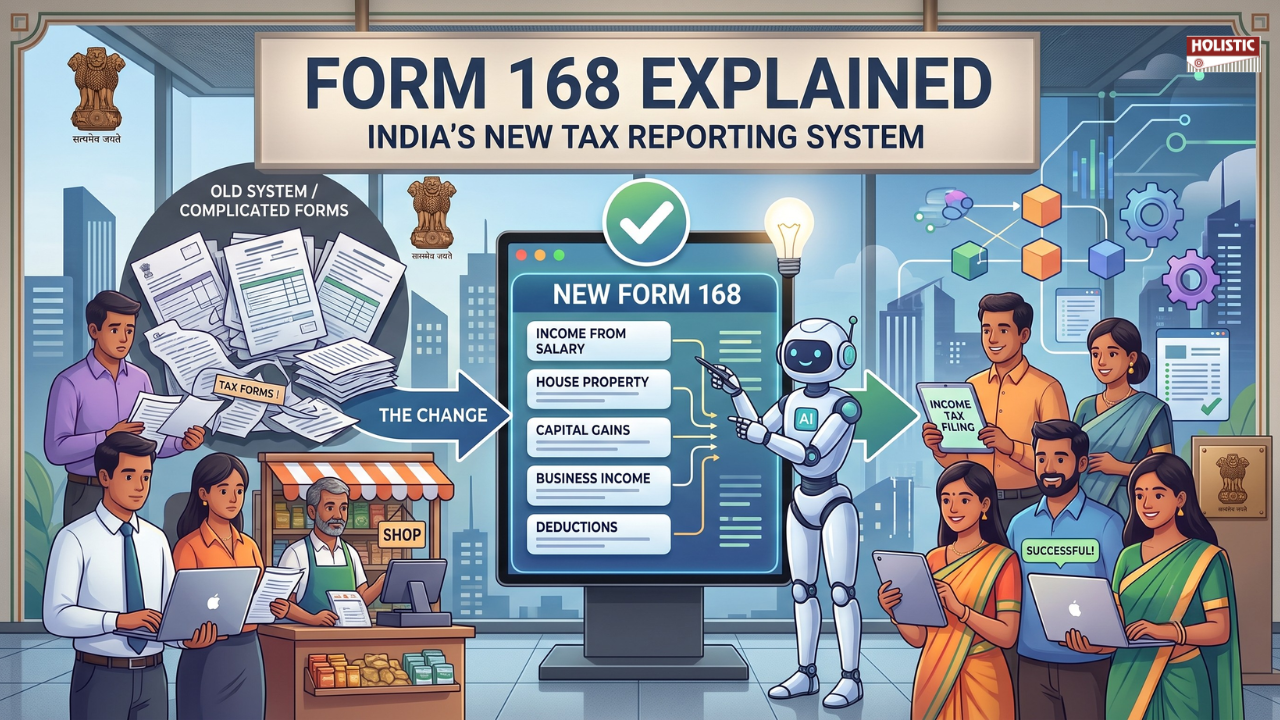
Income tax filing in India has undergone significant changes over the past decade.
What was once a largely manual and document-driven process is steadily evolving into a highly integrated digital ecosystem powered by real-time financial data.
The objective is simple: make tax compliance easier for honest taxpayers while improving the government’s ability to identify errors, omissions, and unreported income.
One of the most important developments in this transformation is the introduction of Form 168.
Replacing the separate functions previously performed by Form 26AS and the Annual Information Statement (AIS), Form 168 aims to provide taxpayers with a consolidated view of their financial and tax-related information in a single report.
At first glance, this may appear to be a simple administrative update.
However, the implications are much broader.
Form 168 has the potential to change how taxpayers review their financial information, verify income sources, and prepare their income tax returns.
For salaried employees, investors, freelancers, and business owners alike, understanding this new form will become an essential part of tax compliance.
So, what exactly is Form 168?
How is it different from Form 26AS and AIS?
More importantly, how can taxpayers use it to avoid mistakes and reduce the chances of receiving an income tax notice?
Let’s explore.
Table of Contents:
- Why the Income Tax Department Is Transforming Tax Reporting
- From Form 26AS and AIS to Form 168: What Has Changed?
- What Is Form 168 and Why Does It Matter?
- Key Information Available in Form 168
- How Form 168 Will Impact Income Tax Return Filing
- Why Taxpayers Can No Longer Afford to Ignore Financial Reporting
- Common Mismatches That Can Trigger Income Tax Notices
- Form 168 and the Rise of Pre-Filled Income Tax Returns
- How Salaried Employees Should Use Form 168 Before Filing ITR
- What Investors Need to Check in Form 168
- High-Value Transactions That Could Appear in Form 168
- How Form 168 Supports India’s Digital Tax Administration
- Best Time to File Your Income Tax Return
- Common Mistakes Taxpayers Should Avoid
- Conclusion
Why the Income Tax Department Is Transforming Tax Reporting
The Indian tax administration has been moving toward a data-driven framework for several years.
Today, banks, mutual fund houses, stockbrokers, employers, insurance companies, registrars, and other financial institutions routinely share transaction information with the Income Tax Department.
This growing network of data allows tax authorities to verify information reported by taxpayers against information reported by financial institutions.
As a result, tax compliance is increasingly based on automated verification rather than manual scrutiny.
The introduction of Form 168 reflects this shift.
Instead of requiring taxpayers to consult multiple documents before filing returns, the government aims to provide a comprehensive statement that captures relevant financial information in one place.
For taxpayers, this means greater transparency and convenience.
For the tax department, it improves the accuracy of reporting and reduces the scope for underreporting income.
From Form 26AS and AIS to Form 168: What Has Changed?
Before understanding Form 168, it is useful to revisit the roles played by its predecessors.
Form 26AS primarily served as a tax credit statement.
It allowed taxpayers to verify taxes deducted at source (TDS), taxes collected at source (TCS), advance tax payments, self-assessment tax payments, and refunds issued by the department.
AIS, on the other hand, provided a much broader financial overview.
It contained details relating to interest income, dividend income, securities transactions, mutual fund investments, foreign remittances, and other reportable financial activities.
While both documents were useful, taxpayers often had to cross-reference multiple statements before filing returns.
This sometimes led to confusion, omissions, and reporting errors.
Form 168 seeks to simplify this process by consolidating tax information and financial reporting into a single unified framework.
What Is Form 168 and Why Does It Matter?
Form 168 can be viewed as a comprehensive financial information statement that combines tax records and reportable financial transactions into one document.
Rather than focusing only on taxes deducted or paid, it provides a broader picture of a taxpayer’s financial footprint during the financial year.
This includes information gathered from various reporting entities across the financial system.
The significance of Form 168 lies in its ability to serve as a central reference point before filing an income tax return.
Instead of relying on multiple reports, taxpayers can review a single document to identify discrepancies, verify reported income, and ensure that all taxable transactions have been properly disclosed.
As the tax administration becomes increasingly automated, Form 168 is likely to become one of the most important documents used during return filing.
Key Information Available in Form 168
Although the exact structure may evolve over time, Form 168 is expected to provide a consolidated view of several important categories of information.
These may include salary-related tax deductions, bank interest income, dividend income, mutual fund transactions, stock market transactions, tax collected at source, advance tax payments, high-value financial transactions, and other reportable financial activities.
The objective is to provide taxpayers with a complete snapshot of financial activity that could potentially have tax implications.
By reviewing this information carefully, taxpayers can ensure that all relevant income sources are accurately reflected in their returns.
How Form 168 Will Impact Income Tax Return Filing
One of the biggest advantages of Form 168 is its role in improving the accuracy of tax return filing.
Historically, many filing errors occurred because taxpayers relied on incomplete information or overlooked certain income sources.
Interest earned from savings accounts, fixed deposits, dividends, capital gains, and other transactions were sometimes omitted unintentionally.
With Form 168 serving as a consolidated information source, taxpayers can more easily verify whether the information reported in their return matches the information available with the tax department.
This reduces the likelihood of mismatches and helps ensure a smoother filing process.
Why Taxpayers Can No Longer Afford to Ignore Financial Reporting
In today’s tax environment, discrepancies are detected far more quickly than in the past.
The Income Tax Department now has access to extensive information reported by banks, financial institutions, stockbrokers, employers, and other entities.
Advanced data analytics can identify inconsistencies between reported income and available financial records.
As a result, failing to disclose an income source—even unintentionally—can trigger inquiries or notices.
Reviewing Form 168 before filing is no longer simply a best practice.
It is becoming an essential compliance step for anyone seeking to file accurate tax returns.
Common Mismatches That Can Trigger Income Tax Notices
Several common mistakes can lead to discrepancies between a taxpayer’s return and the information available with the department.
For example, a taxpayer may forget to report interest earned from fixed deposits, omit dividend income, fail to disclose capital gains from equity investments, or incorrectly report TDS credits.
Similarly, high-value transactions reported by financial institutions may not be adequately explained in the return if supporting disclosures are missing.
Reviewing Form 168 allows taxpayers to identify these issues before submission and significantly reduces the risk of avoidable notices.
Form 168 and the Rise of Pre-Filled Income Tax Returns
The government’s long-term vision is to simplify tax filing through increasingly accurate pre-filled returns.
As more financial information becomes available through integrated reporting systems, taxpayers can expect a larger portion of their return to be automatically populated.
Form 168 supports this objective by acting as a centralized repository of taxpayer information.
The more accurate and comprehensive the data contained within the form, the more reliable pre-filled returns become.
This can save time, reduce filing errors, and improve overall compliance.
How Salaried Employees Should Use Form 168 Before Filing ITR
For salaried individuals, Form 168 should become part of the standard tax filing checklist.
Before submitting a return, taxpayers should compare salary income, TDS credits, interest income, investment-related income, and other reportable transactions against their own records.
It is also advisable to cross-check salary information with Form 130 and other relevant tax documents to ensure consistency.
Even minor discrepancies can create complications later, making verification a worthwhile exercise.
What Investors Need to Check in Form 168
Investors should pay particular attention to transactions involving mutual funds, stocks, dividends, bonds, and other financial assets.
Capital gains reporting remains one of the most common areas where errors occur.
Investors should ensure that all taxable gains, losses, and investment-related income are accurately reflected in their returns.
Form 168 can serve as a useful reference point for validating these details and identifying any transactions that may require additional reporting.
High-Value Transactions That Could Appear in Form 168
The Income Tax Department receives information relating to various high-value transactions through reporting entities.
Depending on applicable reporting requirements, these may include significant bank deposits, property transactions, investment purchases, foreign remittances, and other substantial financial activities.
Taxpayers should not assume that these transactions go unnoticed.
Reviewing Form 168 helps ensure that the tax treatment of such transactions is properly addressed during filing.
How Form 168 Supports India’s Digital Tax Administration
Form 168 represents more than a reporting change. It reflects the broader modernization of India’s tax administration.
By integrating information from multiple sources, the government can improve transparency, reduce compliance gaps, and streamline taxpayer services.
For honest taxpayers, this can lead to faster processing, fewer errors, improved pre-filled returns, and a more efficient filing experience.
For the tax system as a whole, it supports greater accountability and more effective enforcement.
Best Time to File Your Income Tax Return
Many taxpayers rush to file returns as soon as the filing portal opens.
However, filing too early may sometimes result in missing information if financial institutions have not yet completed data reporting.
Allowing sufficient time for banks, employers, brokers, and other reporting entities to update records can help ensure that Form 168 contains complete information before filing.
A careful review of all available tax documents before submission can significantly reduce the chances of future corrections or notices.
Common Mistakes Taxpayers Should Avoid
Taxpayers should avoid filing returns solely based on salary information without reviewing other income sources.
They should also avoid ignoring interest income, dividend income, capital gains, and discrepancies in TDS reporting.
Another common mistake is failing to reconcile information available in tax statements with information reported in the return.
A few extra minutes spent reviewing Form 168 can prevent significant compliance issues later.
Conclusion
The introduction of Form 168 marks an important step in the evolution of India’s digital tax ecosystem.
By consolidating information previously spread across multiple statements, it gives taxpayers a more complete view of their financial and tax records while supporting greater accuracy in return filing.
As tax reporting becomes increasingly data-driven, reviewing Form 168 before filing an income tax return will likely become one of the most important compliance practices for taxpayers.
A proactive approach today can help avoid unnecessary notices, reduce filing errors, and ensure a smoother tax filing experience.
A Certified Financial Planner (CFP) can help you integrate tax planning with your broader investment and wealth-building strategy rather than treating tax filing as a standalone annual exercise.

Leave a Comment