
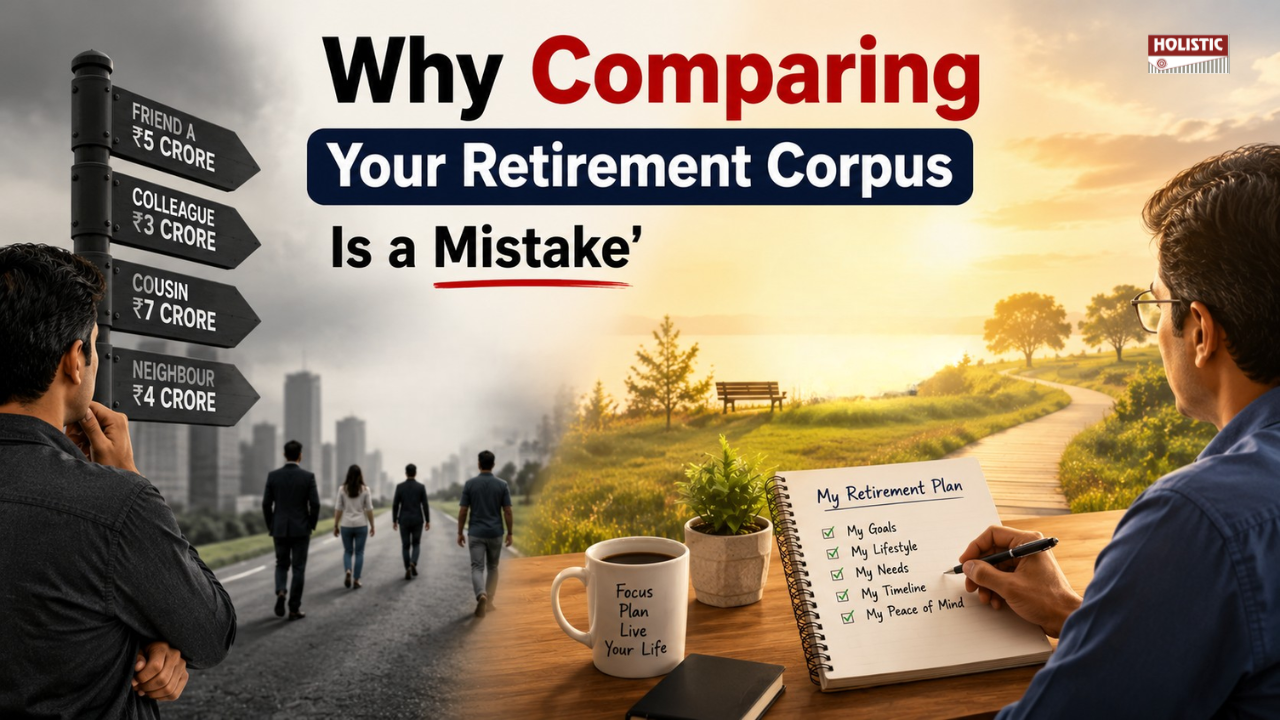
“How much money do I need to retire?”
It’s one of the most common questions asked in personal finance forums.
Someone posts that they have a ₹5 crore retirement corpus, and within minutes, dozens of strangers start offering opinions.
Some say it’s more than enough, while others insist it’s nowhere close to what they need.
But here’s a better question: Can anyone decide if you’re ready for retirement without knowing how you want to live?
The truth is, retirement planning isn’t about competing with someone else’s net worth or chasing a magic number.
It’s about creating a financial plan that supports your lifestyle, responsibilities, and aspirations.
What feels financially secure for one person may feel inadequate—or excessive—for another.
So, instead of asking, “Is ₹5 crores enough?” perhaps we should ask,
“Enough for what?”
In this article, we’ll explore why comparing retirement corpus is misleading, what really determines retirement readiness, and how to build a retirement plan that reflects your life—not someone else’s.
Table of Contents:
- Why Comparing Retirement Corpus Can Be Misleading
- Is There Really a Perfect Retirement Number?
- Your Financial Journey Shapes Your Retirement Goals
- Why Bigger Retirement Corpus Doesn’t Always Mean Better Retirement
- The Three Pillars of a Successful Retirement
- Retirement Planning Is More Than Investment Returns
- Hidden Risks That Can Affect Your Retirement Plan
- Are You Working for Financial Security—or Just a Bigger Number?
- Questions to Ask Before Deciding to Retire
- Practical Steps to Build Your Retirement Plan
- Common Retirement Planning Mistakes
- Final Thoughts
Why Comparing Retirement Corpus Can Be Misleading
It’s natural to compare ourselves with friends, colleagues, or people on social media.
After all, if someone your age has accumulated ₹8 crores while you have ₹4 crores, it’s easy to wonder whether you’re falling behind.
But does that comparison tell the whole story?
Not really.
Retirement planning depends on dozens of personal variables, including:
- Your monthly lifestyle expenses
- City of residence
- Healthcare requirements
- Existing liabilities
- Family responsibilities
- Desired retirement lifestyle
- Expected longevity
- Sources of passive income
Without understanding these factors, comparing retirement corpus is like comparing two houses based only on their size while ignoring the number of people living in them.
Is There Really a Perfect Retirement Number?
Many retirement calculators promise to reveal the “ideal” retirement corpus.
You’ll often hear formulas like:
- 25 times your annual expenses
- 30 times your yearly spending
- The famous 4% withdrawal rule
These guidelines can be useful starting points—but should they become your retirement target?
Probably not.
India has unique challenges, including:
- Rising healthcare inflation
- Longer life expectancy
- Changing family structures
- Uncertain investment returns
- Inflation that may outpace assumptions
That’s why retirement planning should begin with your lifestyle goals rather than a fixed corpus target.
Your Financial Journey Shapes Your Retirement Goals
Money isn’t just numbers on a spreadsheet.
It’s influenced by experiences, habits, emotions, and priorities.
Someone who grew up during financial hardship may naturally prefer a larger safety cushion before retiring.
Another person with stable family support and predictable expenses may feel comfortable retiring with a smaller corpus.
Neither approach is right or wrong.
Your retirement plan should reflect:
A. Your Lifestyle
Do you want a quiet retirement at home?
Or do you dream of travelling across India every year?
B. Your Responsibilities
Will you support elderly parents?
Do you intend to help your children with higher education or buying a house?
C. Your Comfort with Risk
Can you tolerate market volatility during retirement?
Or do you prefer predictable income?
Your answers matter far more than someone else’s retirement corpus.
Why Bigger Retirement Corpus Doesn’t Always Mean Better Retirement
Many people believe accumulating the biggest retirement corpus is the ultimate financial achievement.
But is it?
Imagine two retirees.
Person A
- Retirement Corpus: ₹6 crores
- Travels every year
- Supports hobbies
- Comfortable monthly income
- Sleeps peacefully
Person B
- Retirement Corpus: ₹12 crores
- Rarely spends money
- Constantly worries about markets
- Avoids experiences to “protect” wealth
Who is financially richer?
Retirement success isn’t determined solely by wealth.
It’s determined by how confidently and comfortably that wealth supports your life.
The Three Pillars of a Successful Retirement
1. Financial Clarity
Know exactly why you’re building your retirement corpus.
Every investment should serve a purpose.
For example:
- Monthly living expenses
- Emergency medical fund
- Travel goals
- Family commitments
- Legacy planning
Clear goals lead to better financial decisions.
2. Reliable Income
A retirement portfolio should generate sustainable income.
This may come from:
- Systematic Withdrawal Plans (SWPs)
- Mutual funds
- Rental income
- Fixed-income investments
- Pension income
The objective isn’t just creating wealth—it’s converting wealth into dependable cash flow.
3. Peace of Mind
Perhaps the most overlooked retirement asset is peace.
Financial independence means having confidence that your money can support your chosen lifestyle without constant anxiety.
No calculator can measure this.
Yet it’s often the true goal of retirement.
Retirement Planning Is More Than Investment Returns
Many investors spend years chasing higher returns.
But retirement planning involves much more.
Ask yourself:
- Is my asset allocation appropriate?
- Am I protected against inflation?
- Do I have adequate health insurance?
- Have I planned for emergencies?
- Have I considered longevity risk?
Retirement isn’t just about growing wealth.
It’s about protecting it.
Hidden Risks That Can Affect Your Retirement Plan
Even a large retirement corpus can come under pressure if risks are ignored.
i. Healthcare Inflation
Medical expenses continue to rise faster than general inflation.
A dedicated healthcare fund can prevent unexpected financial stress.
ii. Longevity Risk
People today are living much longer.
Your retirement corpus may need to support 25–35 years of post-retirement life.
iii. Inflation
A comfortable monthly expense today could double or triple over the next two decades.
Ignoring inflation is one of the biggest retirement planning mistakes.
iv. Sequence of Returns Risk
Poor market returns immediately after retirement can significantly impact your portfolio.
Proper asset allocation helps reduce this risk.
Are You Working for Financial Security—or Just a Bigger Number?
Many professionals continue working even after accumulating enough wealth.
Why?
Sometimes it’s necessary.
But sometimes it’s simply because they haven’t defined what “enough” means.
Ask yourself:
- Will another ₹2 crores genuinely improve my retirement?
- Or am I postponing life because I don’t feel emotionally ready?
Retirement planning isn’t about stopping work early.
It’s about having the freedom to choose.
Questions to Ask Before Deciding to Retire
Before setting a retirement date, answer these questions honestly:
- What are my expected monthly expenses?
- Have I accounted for inflation?
- Do I have sufficient emergency reserves?
- Is my healthcare adequately covered?
- How much guaranteed income will I receive?
- Have I planned for unexpected expenses?
- What kind of lifestyle do I truly want?
The answers will provide much greater clarity than comparing your retirement corpus with others.
Practical Steps to Build Your Retirement Plan
Define Your Retirement Lifestyle
Estimate the life you want—not the life others expect you to live.
Calculate Future Expenses
Include:
- Household costs
- Healthcare
- Travel
- Leisure
- Inflation
Build a Diversified Portfolio
Combine:
- Equity mutual funds
- Debt investments
- Cash reserves
- Gold (where appropriate)
Diversification helps balance growth with stability.
Review Your Plan Regularly
Retirement planning isn’t a one-time exercise.
Review your plan every year or whenever major life changes occur.
Common Retirement Planning Mistakes
Avoid these common pitfalls:
- Comparing your retirement corpus with others
- Ignoring inflation
- Underestimating healthcare expenses
- Chasing unrealistic investment returns
- Delaying retirement planning
- Focusing only on wealth accumulation
- Neglecting cash flow planning
- Depending entirely on one asset class
Final Thoughts
Retirement is one of the most personal financial decisions you’ll ever make.
It’s not about reaching someone else’s number.
It’s not about impressing friends with the size of your investment portfolio.
And it’s certainly not about winning a race to accumulate the biggest retirement corpus.
Instead, focus on building a retirement that gives you confidence, flexibility, and peace of mind.
Because at the end of the day, financial independence isn’t measured by how much money you have—it’s measured by how well your money supports the life you truly want to live.
A qualified Certified Financial Planner (CFP) can help you create a personalised retirement strategy that aligns your investments, income needs, and long-term financial goals.

Leave a Comment