
 Listen to this article
If you’ve ever glanced at your payslip and wondered where that 12% deduction actually goes, or why it seems to grow faster than your PPF account, you’re asking the right question.
The Employees’ Provident Fund (EPF) and the Public Provident Fund (PPF) are often mentioned in the same breath — both government-backed, both tax-free, both quietly building retirement wealth in the background.
But their interest rate histories tell two different stories, and understanding both is the fastest way to know which one is actually doing the heavier lifting for your retirement.
In June 2026, the government notified an entirely new EPF Scheme, 2026, replacing the original EPF Scheme of 1952 — so this is also a good moment to understand how EPF interest actually works under the new rules.
Table of Contents:
- What Is EPF, and How Is It Different From PPF?
- EPF Interest Rate History: The Full Year-by-Year Table
- The Golden 12% Era — and Why It Ended
- EPF Interest Rate Today: The 2026 Update
- EPF vs PPF: Interest Rate, Eligibility and Rules Compared
- Which One Should You Actually Rely On?
- Common Mistakes and Misconceptions
- What Would Your EPF Corpus Actually Look Like?
- Final Word
What Is EPF, and How Is It Different from PPF?
The Employees’ Provident Fund is a mandatory retirement savings scheme for salaried employees, governed by the Employees’ Provident Funds and Miscellaneous Provisions Act, 1952, and administered by the Employees’ Provident Fund Organisation (EPFO).
It generally covers establishments with 20 or more employees, though smaller establishments can opt in voluntarily.
Both the employee and employer contribute 12% of the employee’s basic salary plus dearness allowance every month.
On the employer’s side, 8.33% (capped to a wage ceiling of ₹15,000) is diverted to the Employees’ Pension Scheme (EPS), and the remainder flows into the EPF account itself.
PPF, by contrast, is entirely voluntary and open to any resident Indian — salaried, self-employed, or not working at all — with contributions ranging from ₹500 to ₹1.5 lakh a year, entirely at your own discretion.
That single distinction — mandatory and salary-linked versus voluntary and self-directed — explains almost every other difference between the two, including how their interest rates are set.
EPF Interest Rate History: The Full Year-by-Year Table
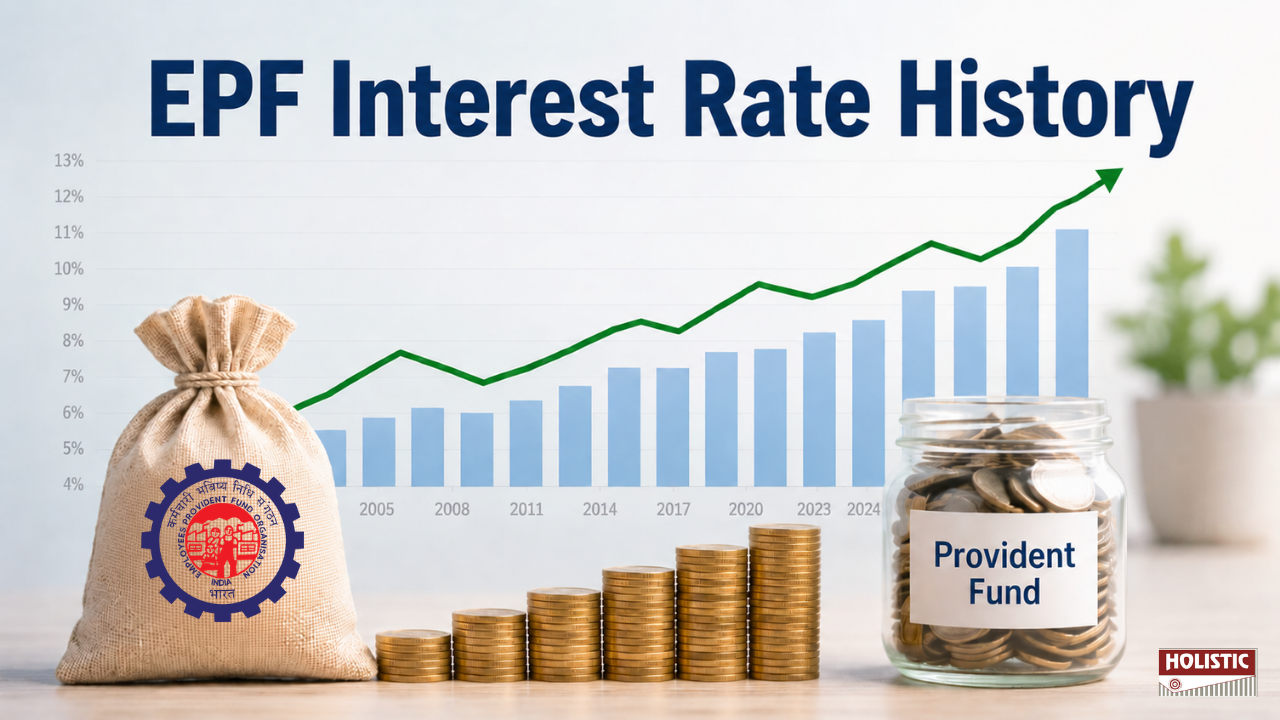
EPF’s interest rate history stretches back to 1952-53, when the scheme first launched at a modest 3% per annum.
Here’s the full trajectory since:
| Period | EPF Interest Rate |
|---|---|
| 1952-53 to 1962-63 | 3.00% – 3.75% |
| 1963-64 to 1976-77 | ~4.00% – 8.00% (gradual increases) |
| 1977-78 to 1985-86 | 8.00% – 8.50% |
| 1986-87 to 1999-2000 | 12.00% (the Golden Era) |
| 2000-01 | 11.00% |
| 2001-02 to 2010-11 | ~9.50% (post-liberalisation decline) |
| 2011-12 | 8.25% |
| 2012-13 | 8.50% |
| 2013-14 | 8.75% |
| 2014-15 | 8.75% |
| 2015-16 | 8.80% |
| 2016-17 | 8.65% |
| 2017-18 | 8.55% |
| 2018-19 | 8.65% |
| 2019-20 | 8.50% |
| 2020-21 | 8.50% |
| 2021-22 | 8.10% (a four-decade low) |
| 2022-23 | 8.15% |
| 2023-24 | 8.25% (a three-year high) |
| 2024-25 | 8.25% |
| 2025-26 | 8.25% |
| 2026-27 | To be announced (typically decided Feb-Mar) |
One statistic stands out: EPF’s rate has never fallen below 8% since 1977-78 — a 47-plus-year streak that survived the 2008 financial crisis, multiple oil-price shocks, and the COVID-19 pandemic. PPF, over the same period, dipped as low as 7.1%.
The Golden 12% Era — and Why It Ended
For 14 years, from 1986-87 through 1999-2000, EPF paid a flat 12% per annum — a rate that, during years of high inflation, still delivered meaningfully positive real returns.
It’s a strikingly similar story to PPF, which held its own 12% rate through almost exactly the same window.
The parallel isn’t a coincidence. Both instruments’ rates were administratively set by the government during an era of tightly controlled interest rates and high government borrowing costs.
When India’s broader interest-rate regime was liberalised through the 2000s and inflation cooled, both PPF and EPF rates were gradually brought down in step with falling government bond yields — the same underlying mechanism that determines both rates even today.
What’s different is how far each fell.
PPF eventually bottomed out at 7.1%, where it has sat since April 2020. EPF’s low point was 8.10% in 2021-22, and it has since recovered to 8.25% — a gap that has held fairly consistently for the last few years.
EPF Interest Rate Today: The 2026 Update
The EPF interest rate for the current financial year, 2025-26, is 8.25% per annum — retained at the same level as 2024-25 and 2023-24, and ratified by the Finance Ministry in June 2026 on the recommendation of EPFO’s Central Board of Trustees (CBT).
The rate for 2026-27 hasn’t been announced yet — the CBT typically meets and recommends a fresh rate towards the end of each financial year, around February or March.
Unlike PPF, where the Finance Ministry sets and reviews the rate directly every quarter, EPF works through an extra layer: the CBT — which includes government, employer, and employee-union representatives — recommends a rate once a year based on EPFO’s actual investment income, and the Finance Ministry then ratifies (or occasionally revises) that recommendation before it’s credited to members’ accounts.
A genuinely new development: the EPF Scheme, 2026
On 29 June 2026, the Ministry of Labour and Employment notified the EPF Scheme, 2026, formally replacing the original EPF Scheme of 1952 that had governed the fund for 74 years.
On interest specifically, the new scheme doesn’t change the substance — interest is still credited annually at the government-decided rate, calculated on a monthly running balance, and rounded to the nearest rupee — but it does restate these rules in a modernised framework.
EPF vs PPF: Interest Rate, Eligibility and Rules Compared
| Feature | EPF | PPF |
|---|---|---|
| Current interest rate | 8.25% p.a. (FY 2025-26) | 7.1% p.a. (Jul-Sep 2026 quarter) |
| Who sets the rate | EPFO’s Central Board of Trustees recommends; Finance Ministry ratifies | Finance Ministry directly, every quarter |
| Revision frequency | Annual | Quarterly |
| Eligibility | Salaried employees in registered firms (20+ workers), mandatory | Any resident Indian, voluntary |
| Contribution | 12% of basic + DA, from both employee and employer | ₹500 to ₹1.5 lakh per year, self-directed |
| Lock-in | Until retirement or 2 months after unemployment (with conditions) | 15 years, extendable in blocks of 5 |
| Tax on interest | Tax-free, but only on contributions up to ₹2.5 lakh/year (excess is taxable) | Fully tax-free, no contribution-linked cap |
That last row is worth pausing on — it’s one of the more commonly missed differences.
EPF interest is tax-free only on the first ₹2.5 lakh of your own contribution in a year (₹5 lakhs if your employer doesn’t contribute); anything above that, typically relevant to high earners doing large Voluntary Provident Fund top-ups, gets taxed.
PPF has no such ceiling — every rupee of interest on your ₹1.5 lakh annual contribution stays tax-free, full stop.
Which One Should You Actually Rely On?
Here’s the honest answer: for most salaried employees, this isn’t really a choice you get to make.
EPF is mandatory the moment you join a covered employer — it’s already happening in the background, whether you think about it or not.
The real question is what you do with the discretionary part of your savings, and that’s where PPF (and other instruments) come in.
EPF’s higher current rate (8.25% vs 7.1%) and 47-year floor of 8% make a reasonable case for topping it up voluntarily through VPF if you want more guaranteed, tax-free exposure — assuming you’re comfortable with the money being locked up until retirement.
PPF’s appeal is flexibility: it’s open to the self-employed, to non-working spouses, to anyone who wants a second tax-free bucket outside their employer’s control, with a defined 15-year horizon rather than “until you retire, whenever that is.”
Neither is a substitute for equity exposure over a multi-decade horizon — both are fixed-income instruments, and fixed income alone rarely outpaces inflation by much once you’re a decade or two into a career.
Mutual fund and equity returns aren’t guaranteed and are subject to market risk — past performance doesn’t indicate future results, and this isn’t a recommendation to invest in any specific product.
Please read all scheme-related documents carefully before investing.
Common Mistakes and Misconceptions
- “EPF and PF are different things.” They’re not — “PF” is simply the common shorthand for EPF. The confusion usually comes from EPF having a linked-but-separate pension component (EPS) and an insurance component (EDLI), which are genuinely different schemes.
- “You can convert your EPF into a PPF account.” You can’t. They’re governed by entirely different Acts, and there’s no legal mechanism to transfer an EPF balance directly into a PPF account — you can only withdraw from one and separately contribute to the other.
- “I can withdraw 100% of my EPF balance any time I want.” Full withdrawal is allowed only on retirement, or after two months of continuous unemployment. Partial withdrawals for specific purposes (medical emergencies, home purchase, education, marriage) are permitted earlier, subject to conditions and caps tied to your years of service.
- “EPF alone can get me to ₹1 crore in 5 years.” For the overwhelming majority of salaried employees, this isn’t realistic — EPF is a steady, guaranteed compounding instrument, not a wealth-multiplication tool. See the worked example below for what’s actually achievable over a realistic time horizon.
What Would Your EPF Corpus Actually Look Like?
Say your combined EPF contribution — yours plus your employer’s — works out to a steady ₹5,000 a month, and the rate stays at today’s 8.25% throughout.
Here’s roughly how that grows:
| After This Many Years | Illustrative Corpus at 8.25%* |
|---|---|
| 10 years | ~₹9.18 lakh |
| 20 years | ~₹29.46 lakh |
| 30 years (a full career) | ~₹74.30 lakh |
*Assumes a constant ₹5,000/month combined contribution and a constant 8.25% p.a., compounded monthly.
This is illustrative, not a forecast — in reality, your contribution rises with every salary increment, and EPF’s rate is reviewed (and can change) every year.
Actual outcomes will differ, likely for the better, since most salaries rise faster than inflation over a career.
What this really shows is the power of EPF’s forced discipline: because contribution is mandatory and automatic, most salaried Indians build a meaningful retirement corpus without ever making an active investment decision — which is either reassuring or a little unsettling, depending on how much you like being in control of your own money.
Final Word
EPF and PPF often get compared as if you’re choosing between them — but for most salaried professionals, EPF isn’t a choice at all, and the real decision is what to do with everything else: how much to voluntarily top up, whether PPF makes sense as a second tax-free bucket, and how much to allocate beyond both toward growth-oriented investments.
That’s a harder question than “which rate is higher,” and it depends entirely on your income, your timeline, and how much of your retirement you’re comfortable leaving on autopilot.
A personalised conversation with a Certified Financial Planner is usually the fastest way to work out that balance — factoring in your actual EPF corpus, your other investments, and what your specific retirement goal actually requires.
Frequently Asked Questions
Q1. Which one is better, EPF or PPF?
Neither is strictly “better” — EPF is mandatory for salaried employees and currently pays a higher rate (8.25% vs 7.1%), while PPF is voluntary and open to everyone, including the self-employed. Most people benefit from both: EPF happens automatically, and PPF adds a flexible, self-directed tax-free bucket alongside it.
Q2. Is EPF better than FD?
For salaried employees, yes, in most cases — EPF’s 8.25% is tax-free and government-backed, while bank fixed deposits typically pay 6-7.5% and that interest is fully taxable at your slab rate, which lowers the effective post-tax return considerably below EPF’s.
Q3. Can I convert my EPF to PPF, or vice versa?
No. EPF and PPF are governed by different Acts and there’s no legal mechanism to directly transfer a balance from one to the other. You can withdraw from one (subject to its own rules) and separately contribute to the other.
Q4. What are the disadvantages of EPF?
The main ones: it’s illiquid until retirement or unemployment (with limited exceptions), the rate is fixed by the government each year so you have no control over it, and interest on contributions above ₹2.5 lakh a year becomes taxable — a real consideration for higher earners doing voluntary top-ups.
Q5. Can I withdraw 100% of my EPF amount?
Only at retirement (58 years) or after two continuous months of unemployment. Before that, only partial withdrawals are allowed, for specific purposes like medical treatment, home purchase, or a child’s education or marriage, subject to service-tenure conditions.
Q6. Is PPF still a good investment in 2026?
Yes, for its intended purpose — a safe, tax-free, government-guaranteed component of a diversified portfolio. At 7.1%, it won’t outpace inflation by much on its own, which is why it works best alongside growth-oriented investments rather than as your only savings vehicle.
Leave a Comment