


 Listen to this article
A company reports record-breaking revenues. Analysts praise its growth story.
Investors rush to buy the stock. Everything looks perfect—until one day, allegations surface, the stock crashes, and years of wealth creation disappear almost overnight.
Sounds familiar?
Corporate fraud isn’t a new phenomenon in the stock market.
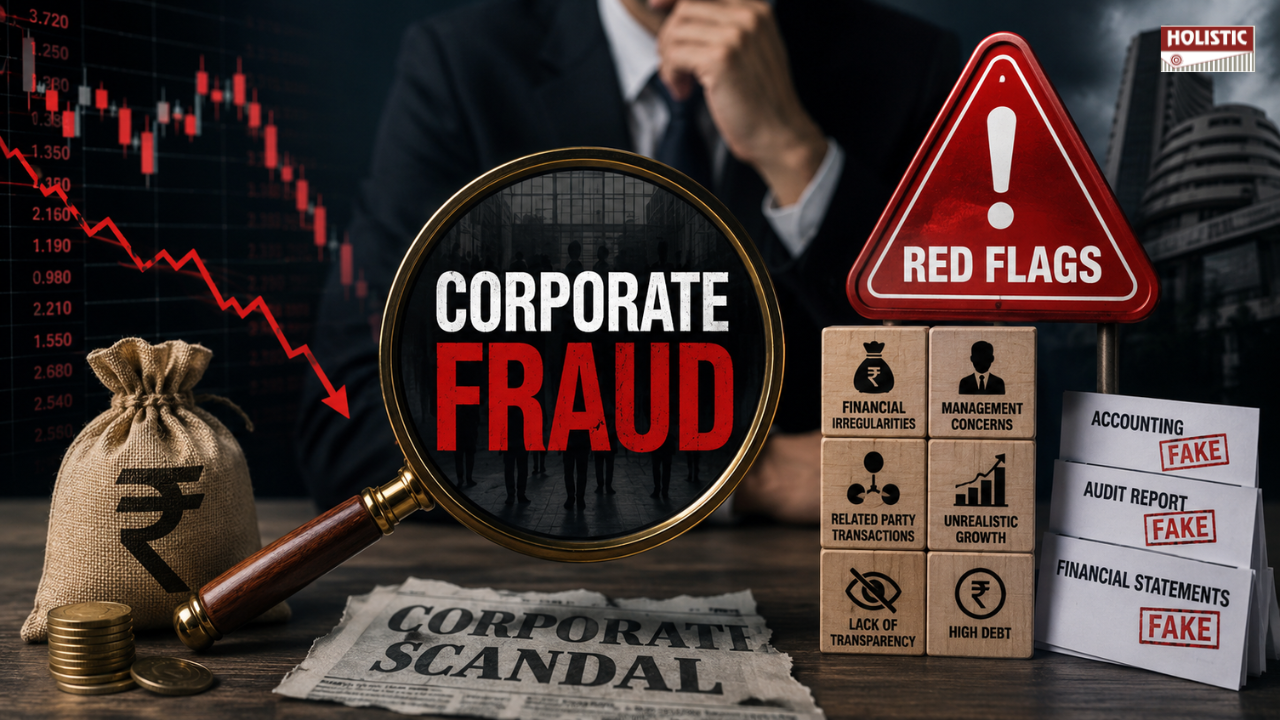
Every few years, another company makes headlines for accounting irregularities, governance failures, or misleading financial reporting.
While every case may be different, the lessons for investors remain remarkably similar.
The biggest mistake investors make isn’t just investing in the wrong company—it’s ignoring the warning signs that were visible long before the crisis unfolded.
So, how can you protect your portfolio?
More importantly, how do you identify red flags before they become headline news?
This guide explores the common characteristics of companies that eventually run into serious trouble and the practical steps investors can take to reduce the risk of falling into similar traps.
Table of Contents:
- Why Corporate Fraud Keeps Repeating
- Why Revenue Alone Doesn’t Make a Great Company
- Red Flag #1: High Sales, Tiny Profits
- Red Flag #2: Receivables Keep Rising
- Red Flag #3: Strong Revenue, Weak Cash Flow
- Red Flag #4: Complex Business Structures
- Red Flag #5: Poor Corporate Governance
- Other Warning Signs Investors Often Miss
- A Simple Financial Checklist Before Buying Any Stock
- How to Protect Yourself from Corporate Frauds
- Frequently Asked Questions
- Final Thoughts
Why Corporate Fraud Keeps Repeating
History has shown that corporate frauds are not isolated incidents.
Whenever markets become overly optimistic, investors often focus on exciting growth stories while overlooking basic financial fundamentals.
Companies may report impressive revenue growth, announce ambitious expansion plans, or highlight global operations. But beneath the surface, the quality of those numbers may tell a very different story.
This is why successful investing is not just about finding exceptional businesses—it is equally about avoiding businesses with weak financial foundations.
Why Revenue Alone Doesn’t Make a Great Company
Many investors assume that bigger revenue automatically means a better company.
But is that always true?
Not necessarily.
Revenue only tells you how much a company sells.
It doesn’t tell you:
- Whether those sales are profitable
- Whether customers actually pay on time
- Whether the business generates cash
- Whether shareholders are creating wealth
A company can report thousands of crores in revenue and still destroy shareholder value if its business model is fundamentally weak.
Instead of getting impressed by sales figures, investors should ask:
“How much of those sales actually become profits and cash?”
Red Flag #1: High Sales, Tiny Profits
One of the earliest warning signs is consistently low profit margins despite enormous revenue.
Imagine a company generating massive sales every year but barely earning meaningful profits.
Shouldn’t that raise questions?
Low profitability may indicate:
- Intense pricing pressure
- Poor operational efficiency
- Aggressive accounting
- Unsustainable business practices
While certain industries naturally operate on thin margins, investors should understand whether those margins are normal for that industry or unusually weak compared to competitors.
Always compare:
- Gross Margin
- Operating Margin
- Net Profit Margin
with industry averages before investing.
Red Flag #2: Receivables Keep Rising
One of the simplest yet most overlooked financial indicators is trade receivables.
Receivables represent money customers owe the company.
Here’s an important question:
If sales are increasing rapidly, why isn’t the company collecting its cash?
A continuous increase in receivables may indicate:
- Customers are delaying payments
- Sales quality is deteriorating
- Revenue recognition may be aggressive
- Working capital is becoming stressed
Receivables growing much faster than revenue deserve careful investigation.
Healthy businesses eventually convert sales into cash.
Red Flag #3: Strong Revenue, Weak Cash Flow
Many experienced investors believe one principle above everything else:
Cash flow is harder to manipulate than accounting profits.
Companies can report impressive earnings.
But generating actual cash is much more difficult.
Before investing, compare:
- Revenue
- Net Profit
- Operating Cash Flow
- Free Cash Flow
If profits consistently grow while cash flow remains weak, investors should investigate further.
Strong businesses generally convert accounting profits into real cash over time.
Red Flag #4: Complex Business Structures
Global expansion is often viewed positively.
However, excessive complexity deserves attention.
Some companies operate through dozens—or even hundreds—of subsidiaries spread across multiple countries.
While international operations aren’t inherently problematic, they make independent verification more challenging.
Investors should understand:
- Where revenue originates
- Which subsidiaries generate profits
- How transparent the disclosures are?
- Whether related-party transactions are significant
The more difficult a business is to understand, the greater the need for caution.
As legendary investor Warren Buffett often emphasizes, investing within your circle of competence matters.
Red Flag #5: Poor Corporate Governance
Financial statements reveal only part of the story.
Management quality often determines the rest.
Ask yourself:
- Does management communicate openly?
- Are investor concerns addressed clearly?
- Are disclosures timely?
- Have governance controversies become frequent?
Repeated controversies don’t automatically imply fraud.
However, persistent governance concerns deserve closer scrutiny.
Trust should be earned through transparency—not marketing presentations.
Other Warning Signs Investors Often Miss
Apart from financial ratios, several qualitative indicators deserve attention.
i. Frequent Auditor Changes
Regular changes in auditors may indicate deeper governance concerns.
While not always a warning sign, frequent changes warrant investigation.
ii. Qualified Audit Opinions
Many investors skip the auditor’s report entirely.
That can be a costly mistake.
Sections worth reading include:
- Auditor Qualifications
- Key Audit Matters
- Emphasis of Matter
These sections often highlight risks hidden behind impressive financial numbers.
iii. Sudden Debt Growth
Ask yourself:
Why is debt increasing faster than business growth?
Borrowing to expand may be reasonable.
Borrowing simply to survive is another story altogether.
iv. Aggressive Expansion Stories
Companies promising extraordinary growth every year should invite healthy skepticism.
Businesses usually grow gradually.
When projections sound too good to be true, they often deserve additional verification.
v. Constant Regulatory Issues
Repeated investigations, penalties, delayed disclosures, or governance concerns should never be ignored.
Even if allegations are eventually resolved, investors should understand the associated risks before committing capital.
A Simple Financial Checklist Before Buying Any Stock
Before investing in any company, review the following:
✔ Is revenue translating into profits?
✔ Are profits generating operating cash flow?
✔ Are receivables increasing faster than sales?
✔ Is debt under control?
✔ Are profit margins stable?
✔ Does management communicate transparently?
✔ What do the auditor’s observations say?
✔ Have credit rating agencies raised concerns?
✔ Are annual reports easy to understand?
✔ Does the business model make sense?
If several answers create doubts, it may be wiser to stay away.
Remember:
Sometimes, the best investment decision is choosing not to invest.
How to Protect Yourself from Corporate Frauds
No investment strategy can completely eliminate risk.
However, disciplined research can significantly reduce it.
Some practical habits include:
A. Read Annual Reports
Don’t rely solely on social media opinions or television discussions.
Annual reports provide valuable insights into business operations, financial performance, and management commentary.
B. Review Quarterly Financials
Look beyond headline earnings.
Compare:
- Revenue growth
- Cash flow
- Receivables
- Debt
- Margins
Consistency matters more than one exceptional quarter.
C. Monitor Credit Rating Reports
Credit rating agencies often highlight governance, liquidity, and debt-related concerns before markets fully react.
Reading these reports can provide additional perspective.
D. Diversify Your Portfolio
Even the best investors occasionally make mistakes.
Diversification prevents a single corporate failure from significantly damaging your overall wealth.
E. Stay Skeptical
Healthy skepticism isn’t pessimism.
It simply means verifying claims before believing them.
Never invest solely because everyone else appears optimistic.
Frequently Asked Questions
Q1. Can corporate fraud be identified in advance?
Not always. However, many frauds are preceded by financial and governance warning signs that careful investors may identify through disciplined research.
Q2. Is revenue growth enough to evaluate a company?
No. Revenue should always be analysed alongside profitability, cash flow, debt levels, receivables, and corporate governance.
Q3. Why is cash flow more important than profits?
Cash flow reflects the actual cash generated by the business. Unlike accounting profits, it is generally more difficult to manipulate over long periods.
Q4. Should investors avoid every company facing regulatory scrutiny?
Not necessarily. Regulatory investigations do not automatically prove wrongdoing. Investors should carefully evaluate the facts, disclosures, and potential risks before making investment decisions.
Final Thoughts
Corporate frauds may change names, industries, and circumstances, but the warning signs often look surprisingly similar.
Successful investing isn’t about chasing every fast-growing company or believing every compelling growth story.
It’s about asking difficult questions, analysing financial statements carefully, and recognising risks before they become obvious to everyone else.
A disciplined investor focuses not only on identifying opportunities but also on protecting capital.
By paying close attention to cash flows, receivables, corporate governance, audit observations, and business transparency, you can significantly improve the quality of your investment decisions.
After all, preserving wealth is just as important as creating it.
Before making significant investment decisions, consider consulting a Certified Financial Planner (CFP) who can help evaluate opportunities within the context of your overall financial goals and risk profile.


Leave a Reply