

Can the HDFC Life Systematic Income Plan truly provide a dependable stream of income, or is it just another insurance plan with limited wealth-creation potential?
Does the HDFC Life Systematic Income Plan offer the financial certainty you are looking for, or are there better ways to generate regular income?
Is the HDFC Life Systematic Income Plan a smart choice for predictable future income, or do its benefits come at the cost of lower returns?
In this article, we examine the plan’s features, annuity options, and potential returns. We also compare it with other investment avenues that can help you create a regular and sustainable income during retirement.
Table of Contents:
What is the HDFC Life Systematic Income Plan?
What are the features of the HDFC Life Systematic Income Plan?
Who is eligible for the HDFC Life Systematic Income Plan?
What are the annuity options and their benefits in the HDFC Life Systematic Income Plan?
Grace Period, Discontinuance and Revival of the HDFC Life Systematic Income Plan
Free Look Period for the HDFC Life Systematic Income Plan
Surrendering the HDFC Life Systematic Income Plan
What are the advantages of the HDFC Life Systematic Income Plan?
What are the disadvantages of the HDFC Life Systematic Income Plan?
Research Methodology of HDFC Life Systematic Income Plan
Benefit Illustration – IRR Analysis of HDFC Life Systematic Income Plan
HDFC Life Systematic Income Plan Vs. Other Investments
HDFC Life Systematic Income Plan Vs. Fixed-Income Instruments
HDFC Life Systematic Income Plan Vs. Inflation-Adjusted Income
Final Verdict on the HDFC Life Systematic Income Plan
What is the HDFC Life Systematic Income Plan?
HDFC Life Systematic Income Plan is a Non-Participating, Non-Linked, General Annuity, Individual, Savings Plan that provides lifetime income, offering stability along with the potential to maximise your income through exposure to the NIFTY 50 Benchmark.
What are the features of the HDFC Life Systematic Income Plan?
- Guaranteed Income for Life with Market-Linked Upside: Receive a guaranteed income for life, with the potential for additional returns linked to the Nifty 50, under the Variable Annuity with Return of Purchase Price option.
- Flexibility in Variable Payout: Choose the payout structure that suits your needs—either a lump-sum payout or a lifetime annuity.
- Simple and Transparent: There are no complex investment funds to manage and no need to monitor or switch between funds.
- Single or Joint Life Cover: The plan can cater to both single-life and joint-life requirements, making it suitable for individual as well as couple-based retirement planning.
- Three Annuity Options: Select from three different annuity options based on your desired level of income, protection, and benefit structure.
Who is eligible for the HDFC Life Systematic Income Plan?
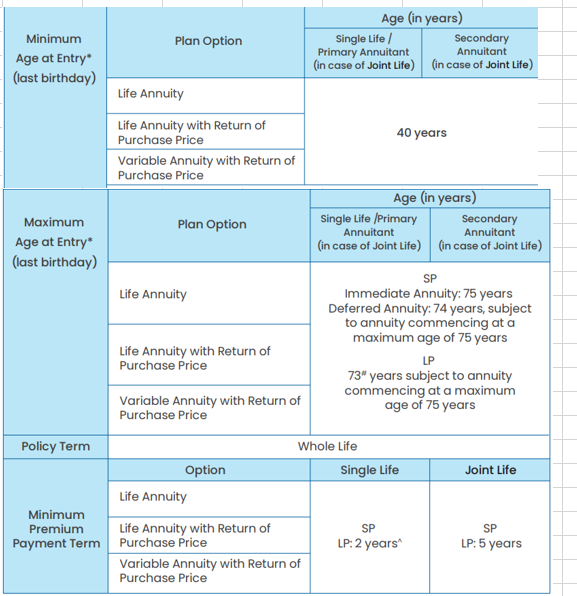
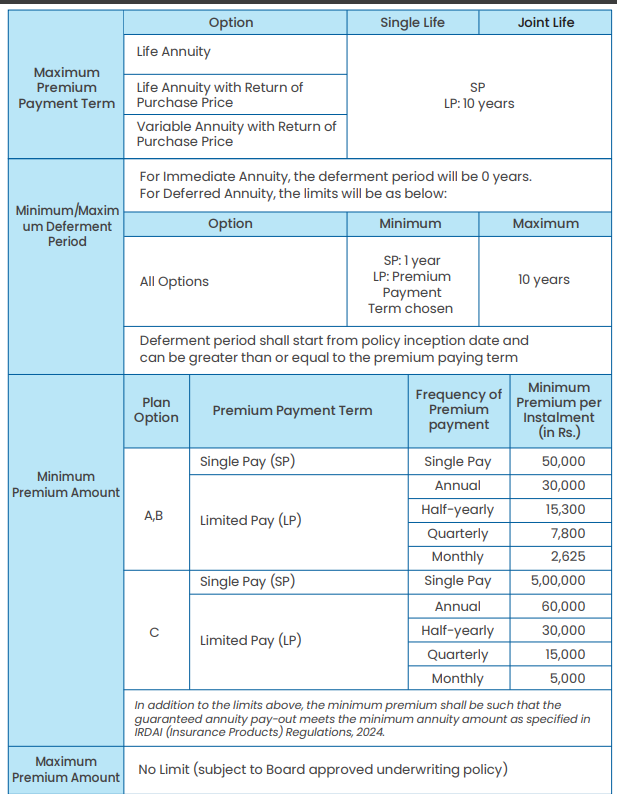
What are the annuity options and their benefits in the HDFC Life Systematic Income Plan?
| Plan Option | Name | Premium Payment Option | Single Life /Joint Life |
| A | Life Annuity | Single Pay/Limited Pay | Single Life/Joint Life |
| B | Life Annuity with Return of Purchase Price | Single Pay/Limited Pay | Single Life/Joint Life |
| C | Variable Annuity with Return of Purchase Price | Single Pay/Limited Pay | Single Life/Joint Life |
1. Survival benefit
Option A: Life Annuity and Option B: Life Annuity with Return of Purchase Price
The annuity will be paid in arrears post deferment period (if any), as per the payment frequency chosen by the HDFC Life Systematic Income Plan policyholder, as long as the annuitant(s) is/are alive.
- Single Pay: Annuity Rate * Single Premium
- Limited Pay: Guaranteed Annuity Pay-out = Purchase Price * Annuity Rate
Option C: Variable Annuity with Return of Purchase Price
Under this option, the annuitant will receive a lifetime guaranteed annuity payout, at a minimum guaranteed annuity rate, as prescribed in the regulatory provisions, along with the variable annuity payouts linked to a publicly available benchmark.
Here, the guaranteed annuity proportion is 60% of the Purchase Price.
- Single Pay: The annuity payout shall be equal to the sum of the following: Guaranteed Annuity Pay-out = Guaranteed Annuity Proportion * Annuity Rate * Single Premium, and Variable Annuity Pay-out
- Limited Pay: The annuity pay-out shall be equal to the sum of the following: Guaranteed Annuity Pay-out = Guaranteed Annuity Proportion * Annuity Rate *Purchase Price, and Variable Annuity Pay-out
2. Death benefit
Option A: Life Annuity
Payable as a lump sum, on the death of the annuitant in case of Single Life and on later of the deaths of the two annuitants in case of Joint Life.
Immediate Annuity – Nil
Deferred Annuity During deferment period Higher of:
- Premiums Paid accumulated at 4% p.a. till date of death
- 105% of the Total Premiums Paid
- Surrender Value on date of death
After deferment period Nil
Option B: Life Annuity with Return of Purchase Price
Payable as a lump sum, on the death of the annuitant in case of Single Life and on the later of the deaths of the two annuitants in case of Joint Life.
Immediate Annuity – 100% of the Total Premiums Paid
Deferred Annuity During deferment period Higher of:
- Premiums Paid accumulated at 4% p.a. till date of death
- 105% of the Total Premiums Paid
- Surrender Value on date of death
After deferment period Higher of:
- Premiums Paid accumulated at 4% p.a. till end of deferment period less Guaranteed Annuity Pay-outs made till date of death
- 100% of the Total Premiums Paid.
- Surrender Value on date of death
Option C: Variable Annuity with Return of Purchase Price
Immediate Annuity – Sum of
- 100% of the Total Premiums Paid
- Variable Pay-out Death Benefit, if any
Deferred Annuity During deferment period Higher of:
- Surrender Value on date of death
- Sum of: a) Higher of Premiums Paid accumulated at 4% p.a. till date of death or 105% of the Total Premiums Paid, and b) Variable Pay-out Death Benefit, if any
After deferment period, higher of
- Surrender Value on date of death
- Sum of: a) Higher of: a. Premiums Paid accumulated at 4% p.a. till end of deferment period less Guaranteed Annuity Pay-outs made till date of death, b. 100% of the Total Premiums Paid, and b) Variable Pay-out Death Benefit, if any
Grace Period, Discontinuance and Revival of the HDFC Life Systematic Income Plan
Grace Period
The grace period shall be 30 days for yearly, half-yearly and quarterly modes of premium payment and 15 days for monthly mode of premium payment.
Discontinuance
The Policy shall lapse if premium payment is discontinued before payment of one full year’s premiums and all benefits shall extinguish.
In case the lapsed policy is not revived by the end of Revival Period, the HDFC Life Systematic Income Plan policy shall terminate, and no benefits will be payable
For Limited Premium policies, if at least the first full year’s Premium has been paid and no further Premiums are paid and the Policy is not surrendered, the Policy will acquire the status of Reduced Paid Up on the date of expiry of Grace Period up till the Policy is revived for full Benefits.
Revival
The Policy, if lapsed, may be revived for full Benefits within five years from the due date for payment of the first unpaid Premium but before the end of the deferment period.
Free Look Period for the HDFC Life Systematic Income Plan
In case the insured is not agreeable to any HDFC Life Systematic Income Plan policy terms and conditions under this product, the insured shall have the option of returning the policy stating the reasons thereof, within 30 days from the date of receipt of the policy whether received electronically or otherwise.
Surrendering the HDFC Life Systematic Income Plan
Surrender value payable will be equal to the higher of Guaranteed Surrender Value (GSV) and Special Surrender Value (SSV).
Upon payment of the surrender benefit, the policy shall terminate, and all other benefits shall cease.
What are the advantages of the HDFC Life Systematic Income Plan?
- Higher Premium Benefit: The plan offers an enhanced benefit based on the premium paid, providing an additional advantage to policyholders.
- Lump-Sum Option for Major Needs: The Annuity Advance option (under Option B and Option C) allows the policyholder to receive a lump sum to meet significant financial needs, such as major life events or unexpected emergencies.
- Flexible Death Benefit: Under the Smart Legacy option, the nominee can choose to receive the death benefit in instalments rather than as a single lump-sum payment, helping provide a more structured flow of income.
- Loan Facility: A loan can be availed under Option B and Option C, subject to the terms and conditions of the policy.
What are the disadvantages of the HDFC Life Systematic Income Plan?
- Income Not Fully Guaranteed: Under Option C, the annual income is not guaranteed because a portion of the corpus is invested in market-linked assets. The income may therefore vary depending on market performance.
- No Flexibility to Change the Annuity Option: The annuity option selected at the time of policy inception cannot be changed during the policy term. This limits flexibility if your retirement income needs change later.
- Annuity Income Is Fully Taxable: The annuity income received is taxable as per the applicable income-tax laws, reducing the amount of income available for your actual expenses.
- No Inflation-Linked Increase: The plan does not offer a yearly step-up in annuity income. As inflation rises over the years, the purchasing power of a fixed annuity income can gradually decline.
Research Methodology of HDFC Life Systematic Income Plan
A guaranteed annuity income may sound reassuring, but the amount of income alone does not tell you whether the HDFC Life Systematic Income Plan is a good retirement investment.
To assess its actual value, it is important to look at the Internal Rate of Return (IRR) and compare it with other investment options.
Benefit Illustration – IRR Analysis of HDFC Life Systematic Income Plan
Let’s consider an illustration from the policy brochure. A 60-year-old male invests a single premium of ₹10 lakh under Option B: Life Annuity with Return of Purchase Price, with annual annuity payouts. (Assumed life expectancy – 85 years)
| Male | 60 years |
| Purchase Price | ₹ 10 Lakhs |
| Life Expectancy | 85 years |
| Annuity (per annum) | ₹ 62,200 |
He receives an annual annuity of ₹62,200, and at age 85, the original purchase price of ₹10 lakh is returned to the nominee.
When these cash flows are considered, the investment generates an IRR of only 6.11% as per the HDFC Life Systematic Income Plan maturity calculator.
| Age | Life Annuity with Return of Purchase Price |
| 60 | -10,00,000 |
| 61 | 62,200 |
| 62 | 62,200 |
| 63 | 62,200 |
| 64 | 62,200 |
| 65 | 62,200 |
| 66 | 62,200 |
| 67 | 62,200 |
| 68 | 62,200 |
| 69 | 62,200 |
| 70 | 62,200 |
| 71 | 62,200 |
| 72 | 62,200 |
| 73 | 62,200 |
| 74 | 62,200 |
| 75 | 62,200 |
| 76 | 62,200 |
| 77 | 62,200 |
| 78 | 62,200 |
| 79 | 62,200 |
| 80 | 62,200 |
| 81 | 62,200 |
| 82 | 62,200 |
| 83 | 62,200 |
| 84 | 62,200 |
| 85 | 10,00,000 |
| IRR | 6.11% |
Although the plan provides a guaranteed income, there is an important trade-off: the capital remains committed for life.
In comparison, a bank Fixed Deposit (FD) may offer comparable or potentially better returns while giving you greater flexibility to access your money when required.
Therefore, the plan may provide the comfort of guaranteed income, but it falls short when evaluated on both returns and liquidity.
Let’s now look at alternative investment options that can provide regular retirement income with greater flexibility and potentially better returns.
HDFC Life Systematic Income Plan Vs. Other Investments
Retirement planning is not just about building a large corpus.
The real challenge is turning that corpus into a steady stream of income while ensuring your money continues to work for you.
A well-structured investment strategy can provide regular cash flows, protect against inflation, and give you greater control over your capital.
HDFC Life Systematic Income Plan Vs. Fixed-Income Instruments
For retirees looking for relatively low-risk options, some commonly considered avenues include:
- Bank Fixed Deposits (FDs): A simple and familiar option that offers predictable returns and the choice of regular interest payouts.
- Senior Citizen Savings Scheme (SCSS): A government-backed scheme designed for senior citizens, offering regular quarterly interest income with relatively low risk.
- RBI Floating Rate Savings Bonds: These government-backed bonds offer interest rates that are linked to prevailing market rates, providing the possibility of higher income when interest rates rise. However, the interest rate can also fluctuate.
| Investment Option | Expected Returns |
| Bank Fixed Deposit (FD) | 6-7% annually |
| Senior Citizen Savings Scheme (SCSS) | 8.20% annually |
| RBI Floating Rate Savings Bond | 8.05% annually |
Unlike annuities, these investments generally provide greater access to your capital.
However, they have one significant limitation: their returns may not be sufficient to keep pace with inflation over long periods.
As the cost of living rises, a fixed income can gradually lose its purchasing power.
HDFC Life Systematic Income Plan Vs. Inflation-Adjusted Income
Let’s revisit the ₹10 lakh corpus used in the HDFC Life Systematic Income Plan illustration. Instead of committing the entire amount to an annuity, consider a portfolio-based approach that combines growth and stability.
The strategy uses a 60:40 asset allocation:
- 60% in equity: ₹6 lakh is invested in equity to provide long-term growth potential.
- 40% in debt: ₹4 lakh is invested in debt to provide stability and meet near-term income requirements.
From this portfolio, an annual withdrawal of ₹62,200 is made.
To account for rising living costs, the withdrawal is increased by 6% every five years.
| Age | Equity Portion | Shift from Equity to Debt | Debt Portion | ||||
| Opening Balance | Yearly withdrawal | Closing Balance | Opening Balance | Yearly withdrawal | Closing Balance | ||
| 61 | 6,00,000 | 0 | 6,72,000 | 0 | 4,00,000 | 62,200 | 3,58,068 |
| 62 | 6,72,000 | 0 | 7,52,640 | 0 | 3,58,068 | 62,200 | 3,13,620 |
| 63 | 7,52,640 | 0 | 8,42,957 | 0 | 3,13,620 | 62,200 | 2,66,505 |
| 64 | 8,42,957 | 0 | 9,44,112 | 0 | 2,66,505 | 62,200 | 2,16,564 |
| 65 | 9,44,112 | 0 | 10,57,405 | 0 | 2,16,564 | 62,200 | 1,63,625 |
| 66 | 10,57,405 | 5,00,000 | 6,24,294 | 5,00,000 | 6,63,625 | 65,932 | 6,33,555 |
| 67 | 6,24,294 | 0 | 6,99,209 | 0 | 6,33,555 | 65,932 | 6,01,680 |
| 68 | 6,99,209 | 0 | 7,83,114 | 0 | 6,01,680 | 65,932 | 5,67,893 |
| 69 | 7,83,114 | 0 | 8,77,088 | 0 | 5,67,893 | 65,932 | 5,32,079 |
| 70 | 8,77,088 | 0 | 9,82,338 | 0 | 5,32,079 | 65,932 | 4,94,116 |
| 71 | 9,82,338 | 9,82,338 | 0 | 9,82,338 | 14,76,454 | 69,888 | 14,90,960 |
| 72 | 0 | 0 | 0 | 0 | 14,90,960 | 69,888 | 15,06,336 |
| 73 | 0 | 0 | 0 | 0 | 15,06,336 | 69,888 | 15,22,635 |
| 74 | 0 | 0 | 0 | 0 | 15,22,635 | 69,888 | 15,39,912 |
| 75 | 0 | 0 | 0 | 0 | 15,39,912 | 69,888 | 15,58,226 |
| 76 | 0 | 0 | 0 | 0 | 15,58,226 | 74,081 | 15,73,193 |
| 77 | 0 | 0 | 0 | 0 | 15,73,193 | 74,081 | 15,89,059 |
| 78 | 0 | 0 | 0 | 0 | 15,89,059 | 74,081 | 16,05,876 |
| 79 | 0 | 0 | 0 | 0 | 16,05,876 | 74,081 | 16,23,703 |
| 80 | 16,23,703 | 74,081 | 16,42,599 | ||||
| 81 | 16,42,599 | 78,526 | 16,57,917 | ||||
| 82 | 16,57,917 | 78,526 | 16,74,155 | ||||
| 83 | 16,74,155 | 78,526 | 16,91,366 | ||||
| 84 | 16,91,366 | 78,526 | 17,09,611 | ||||
| 85 | 17,09,611 | 78,526 | 17,28,950 | ||||
The portfolio is also rebalanced every five years. Equity gains are transferred to the debt portion to replenish the income pool and ensure that withdrawals can continue without having to sell equity during unfavourable market conditions.
The final transfer from equity to debt is made at age 71 to provide greater stability during the later retirement years.
The exact allocation and withdrawal strategy can, of course, be adjusted based on an individual’s risk tolerance, retirement needs, and financial goals.
How Does It Compare?
Under this illustration, the corpus available at age 85 is ₹17.09 lakh, compared with the ₹10 lakh purchase price returned under the HDFC Life annuity option.
More importantly, the cash flows from this strategy result in an IRR of 7.64%, compared with just 6.11% for the annuity plan. This is achieved even after making inflation-adjusted withdrawals throughout the retirement period.
Key Advantages
A well-planned equity-and-debt strategy can offer several advantages over a traditional annuity:
- Potentially higher returns: Equity provides long-term growth potential.
- Greater flexibility: You retain access to your corpus and can adjust your withdrawals or investments as your needs change.
- Better inflation protection: Increasing withdrawals periodically can help maintain purchasing power.
- Potential for corpus longevity: A portion of the corpus remains invested for growth, increasing the possibility of sustaining income over a longer retirement period.
Final Verdict on the HDFC Life Systematic Income Plan
The HDFC Life Systematic Income Plan offers a steady stream of income for life, with the flexibility to start receiving payouts immediately or after a deferment period.
It provides three annuity options, including variants with or without the return of purchase price, as well as Single Life and Joint Life options.
You can also choose the payout frequency—monthly, quarterly, half-yearly, or annually—based on your income requirements.
However, there are important limitations to consider. Only Options A and B provide a guaranteed fixed income, while Option C invests a portion of the corpus in the market, making the income non-guaranteed.
Moreover, once you commit your corpus to the annuity, your funds remain locked in, and the income does not increase periodically to keep pace with inflation and it also has a high agent commission.
You also lose the flexibility to redeploy the corpus if interest rates or market opportunities become more attractive.
A closer look at the returns further highlights the concern. Compared with other retirement strategies, the plan offers relatively modest returns.
Relying entirely on this annuity for your retirement income could leave you financially vulnerable over the long term, particularly as inflation gradually reduces the purchasing power of a fixed income.
A good retirement plan should balance five critical factors—income, growth, inflation protection, liquidity, and longevity.
Retirement planning should therefore be based on your individual financial needs rather than relying solely on a standard annuity product.
A diversified strategy that combines equity for long-term growth and debt for stability and regular income can provide greater flexibility and the potential for inflation-adjusted cash flows.
Do Quora, Facebook, and Twitter have the final say when it comes to financial advice?
For a personalised and sustainable retirement strategy, consider consulting a Certified Retirement Planner who can align your investments with your income needs, risk profile, and long-term goals.

Leave a Comment