
 Listen to this article
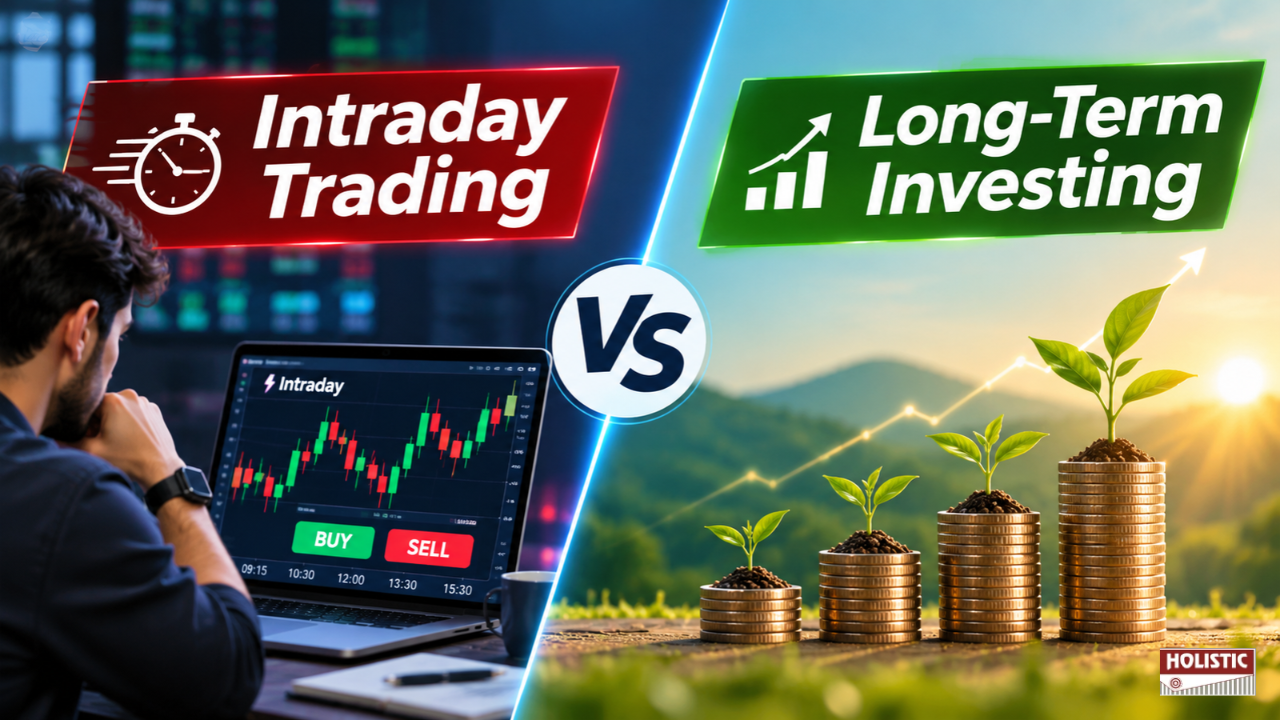
Two colleagues sit at the same office canteen table every afternoon.
Karthik has a trading app open on his phone.
Between bites, he buys a stock at 1:10 pm and sells it at 2:45 pm.
Some days he makes ₹1,200. Some days he loses ₹2,000. He is always a little tense.
Meena hasn’t opened her investment app in three weeks. Her money goes in on the 5th of every month, and she reviews it once a quarter.
She is usually the calmer of the two.
Both of them are “in the stock market”. But they are playing two completely different games, with different rules, different costs, different taxes and very different odds of winning.
This article will help you see both games clearly, so you can decide which one actually suits you.
The short answer
For most people with a job, a family and long-term goals, long-term investing suits far better than intraday trading.
It needs less time, costs less, is taxed more gently and has much better odds.
Intraday trading can suit a small group of people who treat it as a full-time profession, have tested skills and use only money they can afford to lose.
Everyone else is usually better off as an investor, not a trader.
What this article covers
- What intraday trading really is
- What long-term investing really is
- Intraday vs long-term investing: core differences at a glance
- Money rotated vs money generated: the idea that changes everything
- How many intraday traders actually make money?
- The hidden toll booth: intraday charges vs long-term charges
- Tax: intraday profits vs long-term gains
- The compounding side of the story
- Which suits you? A simple self-check
- Day trading vs swing trading vs long-term investing
- Can you do both? The core-and-satellite approach
- Your Time Horizon Is Your Real Edge
- Frequently asked questions
1. What Intraday Trading Really Is
Intraday trading, also called day trading, means buying and selling the same shares on the same trading day.
Every position is closed before the market shuts at 3:30 pm.
You never actually own the shares overnight. If you don’t close the position yourself, your broker squares it off automatically a few minutes before the close.
Most broker apps make this choice right at the order screen. An intraday order (often labelled MIS) is closed the same day.
A delivery order (often labelled CNC) moves the shares into your Demat account, where you can hold them for as long as you like.
The double-edged sword called leverage
Brokers allow intraday traders to take positions larger than their capital, up to about five times for most stocks.
So ₹1 lakh can control a ₹5 lakh position.
That sounds exciting until you do the maths in reverse.
A 2% fall on a ₹5 lakh position wipes out ₹10,000, which is 10% of your actual money, in a single afternoon.
Leverage doesn’t make you a better trader. It only makes your mistakes bigger, faster.
So if intraday is about catching small moves in a single day, what does the other side of the table look like?
2. What Long-Term Investing Really Is
Long-term investing means buying a share of a business, or a fund that owns many businesses, and staying invested for years.
For equity, “long term” realistically means seven years or more, because a full business cycle can take five to seven years to play out.
A long-term investor asks a very different question. Not “where will this price be at 3 pm?” but “will this business earn more five or ten years from now?”
Returns come from three sources: growth in the company’s profits, dividends along the way, and compounding, which is growth earning further growth over time.
Here is a simple way to picture the difference. An intraday trader is like a fisherman who must catch, sell and get home before sunset, every single day.
A long-term investor is more like someone who plants a mango orchard.
Nothing much happens in the first season, but once the trees mature, they keep bearing fruit year after year.
3. Intraday vs Long-Term Investing: Core Differences at a Glance
| Feature | Intraday trading | Long-term investing |
|---|---|---|
| Time horizon | Same day; positions closed before 3:30 pm | 7 years or more |
| Primary goal | Profit from small, quick price moves | Build wealth through business growth and compounding |
| Analysis style | Technical analysis: charts, trends, indicators, volumes | Fundamental analysis: earnings, balance sheet, management |
| Time needed | Several hours every trading day | A few hours a year for review |
| Leverage | Commonly up to about 5 times | Usually none |
| Costs | Paid on every trade, every day | Paid once when buying and once when selling |
| Tax on profits | Speculative business income, taxed at your slab rate | 12.5% on gains above ₹1.25 lakh a year (if held over 12 months) |
| Stress level | High; constant decisions under pressure | Low to moderate; occasional volatility |
| What decides results | Timing, discipline, speed and costs | Quality of business, patience and time |
| Odds for individuals | About 7 in 10 lose money | Historically favourable over long periods, though not guaranteed |
| Best suited for | Full-time traders with tested skills and risk capital | Salaried people, professionals, business owners, retirees |
Tax rates as applicable for the financial year 2026-27.
The table shows how the two differ. But it doesn’t yet explain why the odds are so different.
That comes down to one simple idea most people never think about.
4. Money Rotated vs Money Generated: The Idea That Changes Everything
Ask yourself a simple question. When you make ₹500 on an intraday trade, where does that ₹500 come from?
It comes from the person on the other side of your trade.
Someone sold to you at ₹980 and watched the price rise. Someone bought from you at ₹1,000 and watched it fall.
Within a single day, the business itself hasn’t changed. It hasn’t sold more products or earned more profit.
Money has simply moved from one pocket to another.
Intraday is a zero-sum game before costs, and a negative-sum game after
For every rupee one trader gains, another trader loses a rupee.
Then the broker, the exchange and the government take their share on every trade, win or lose.
So the group of traders as a whole always ends up with less than it started with.
To win, you don’t just need to be good.
You need to be better than the person across the table, often a professional desk or an algorithm, and good enough to cover costs too.
Long-term investing is a positive-sum game
Now think of an investor who held a well-run company for ten years.
During that decade, the company sold more, earned more and grew in value.
That investor’s gain didn’t come out of anyone else’s pocket.
The business created new wealth, and every shareholder who stayed on board shared in it.
The buyer can win, the seller can win, and the company can win, all at once.
Traders compete for a fixed pie. Investors own a share of a pie that keeps growing.
Once you see this, the loss statistics in the next section stop looking surprising. They start looking inevitable.
5. How Many Intraday Traders Actually Make Money?
In the financial year 2022-23, about 7 out of 10 individual intraday traders in India’s equity cash segment lost money.
A few more findings from the same data are worth slowing down for:
- Among those who traded very frequently, with more than 500 trades a year, about 8 out of 10 made losses.
- Among traders under 30, about 76% were loss-makers, and this age group now makes up nearly half of all intraday traders.
- For loss-makers, trading costs added a further 57% on top of their trading losses. Costs didn’t just reduce their profit; they deepened the hole.
In futures and options, the picture is harsher still.
In 2024-25, about 91% of individual F&O traders lost money, and their combined net losses crossed ₹1 lakh crore in that one year.
Myth vs reality
| Myth | Reality |
|---|---|
| “If I learn enough chart patterns, I will be in the profitable 30%.” | Many loss-makers also studied charts. The deciding factors are usually discipline, costs and the skill of the person on the other side. |
| “More trades means more chances to win.” | The data shows the opposite. Very frequent traders had the highest share of loss-makers. |
| “I’ll trade a little to learn, then scale up.” | Small early wins often come from luck, which gives false confidence just before bigger capital goes in. |
| “Long-term investing is too slow to make real money.” | Slow is exactly how compounding works. Its power is invisible in year two and obvious by year fifteen. |
If most traders lose, a natural question follows: what exactly is eating their money, even on days they get the direction right?
6. The Hidden Toll Booth: Intraday Charges Vs Long-Term Charges
Imagine driving on a highway with a toll booth every kilometre.
Even if the road is smooth, the tolls alone can cost more than the fuel.
That is what charges feel like for an active intraday trader.
A simple worked example
Suppose you trade ₹1 lakh worth of shares once a day: you buy in the morning and sell by afternoon.
Using typical discount-broker charges, here is roughly what one round trip costs.
| Charge (one buy + one sell of ₹1 lakh) | Approximate cost |
|---|---|
| Brokerage (₹20 per order × 2) | ₹40 |
| Securities Transaction Tax (0.025% on the sell side) | ₹25 |
| Exchange transaction charges (both sides) | ₹6 |
| Stamp duty (buy side) | ₹3 |
| GST (18% on brokerage and exchange charges) | ₹8 |
| Total per trading day | About ₹82 |
Illustrative only. Charges vary by broker and are revised from time to time.
₹82 a day sounds harmless. But over about 245 trading days in a year, it adds up to roughly ₹20,000, or about one-fifth of your ₹1 lakh capital, before you have made a single rupee of profit.
In other words, you need to earn around 20% a year just to stand still. And that’s for one trade a day. Many traders do several.
Now compare that with a long-term investor who buys ₹1 lakh of shares for delivery and holds them for ten years.
Securities Transaction Tax of 0.1% on the buy and again on the sell, plus stamp duty and a small depository charge when selling, comes to roughly ₹250 in total. Once, not every day.
What changes when you sell: intraday vs delivery selling
When you sell an intraday position, you are simply closing a trade opened earlier that day. No shares ever reach your Demat account.
When you sell shares held for delivery, they leave your Demat account, and the depository charges a small fee per stock sold.
You also pay STT at the higher delivery rate. But you pay these once, after years of holding, not every afternoon.
Costs aren’t the only thing that treats the two games differently. The tax department does too.
7. Tax: Intraday Profits vs Long-Term Gains
| Type of gain | How it is treated | Tax rate |
|---|---|---|
| Intraday trading profit | Speculative business income | Your income tax slab rate (up to 30% plus cess) |
| Shares held 12 months or less (delivery) | Short-term capital gain | 20% |
| Shares held more than 12 months | Long-term capital gain | Nil up to ₹1.25 lakh a year; 12.5% above that |
| Intraday trading loss | Speculative loss | Can be set off only against speculative income; carried forward up to 4 years |
Tax rates as applicable for the financial year 2026-27. They can change in future Budgets.
Notice the asymmetry. A trader in the 30% bracket pays tax at that rate on intraday profits, while an intraday loss can’t be used to reduce tax on salary or long-term gains.
A long-term investor, on the other hand, gets the first ₹1.25 lakh of gains every year tax-free and pays 12.5% beyond that. The tax law itself quietly rewards patience.
Intraday traders also usually need to file a more detailed return as business income, which often means extra paperwork and, in many cases, professional help.
8. The Compounding Side of the Story
Here is what patience can look like in numbers.
Assume ₹1 lakh is invested once and grows at 12% a year.
| Years invested | Value of ₹1 lakh at 12% a year |
|---|---|
| 5 | ₹1.76 lakh |
| 10 | ₹3.11 lakh |
| 15 | ₹5.47 lakh |
| 20 | ₹9.65 lakh |
| 25 | ₹17.00 lakh |
These figures are illustrative, based on an assumed 12% annual return, and are not a guarantee. Equity and mutual fund returns are market-linked and subject to market risks; actual returns can be higher or lower, and some years will be negative.
Look closely at the last two rows. The money grows by about ₹7.35 lakh between year 20 and year 25, far more than in the entire first ten years.
Compounding does its best work at the end, which is exactly the part impatient money never sees.
Wealth is rarely built in a day. It is built by not undoing yesterday’s good decisions.
So far, the case for long-term investing looks strong.
But you’re not “most people”. You’re you. So let’s make this personal.
9. Which Suits You? A Simple Self-Check
Long-term investing is likely to suit you if…
- You have a job, a business or a busy schedule. You can’t watch screens from 9:15 am to 3:30 pm, and you shouldn’t have to.
- You have real goals with real dates: a child’s education, a home, retirement.
- You want lower stress. You’d rather review your money once a quarter than worry about it every hour.
- You prefer understanding businesses over predicting tomorrow’s price.
Intraday trading may suit you only if all of these are true
- You can commit several hours every trading day, without it affecting your job or family.
- You have tested a written strategy over months, ideally first through paper trading without real money.
- You follow strict stop-losses and position limits, even when your emotions disagree.
- You can accept frequent losses without trying to “win it back” the same day.
- The money you trade with is money you can genuinely afford to lose, never borrowed money and never your emergency fund.
If even one of those five isn’t true for you, the honest answer is that intraday trading doesn’t suit you right now.
That isn’t a judgement about intelligence. It’s about matching the game to your life.
Common mistakes to avoid
- Starting intraday trading after a friend’s big win, without seeing their losses.
- Using leverage before having a single month of consistent results.
- Converting a losing intraday trade into a “long-term investment” just to avoid booking the loss.
- Following stock tips from WhatsApp or Telegram groups that promise sure-shot calls.
- Ignoring costs and tax when calculating whether trading is “working”.
10. Day Trading Vs Swing Trading Vs Long-Term Investing
Many people looking for intraday vs long term also wonder where swing trading fits.
Here is a quick comparison.
| Feature | Day (intraday) trading | Swing trading | Long-term investing |
|---|---|---|---|
| Holding period | Same day | A few days to a few weeks | 7 years or more |
| Overnight risk | None | Yes, including news gaps | Yes, but diluted over time |
| Time needed | Very high | Moderate to high | Low |
| Tax on profit | Slab rate (speculative) | 20% (short-term capital gain) | 12.5% above ₹1.25 lakh a year |
| Main driver | Price momentum | Short-term trends | Business growth |
Tax rates as applicable for the financial year 2026-27.
Swing trading sits in the middle.
It needs less screen time than intraday, but it still relies on predicting short-term price moves, and most of the same risks apply.
11. Can You Do Both? The Core-and-Satellite Approach
Some people genuinely enjoy the markets and want to trade a little. That’s fine, as long as the trading never puts your real goals at risk.
Think of your money as a house. The foundation and walls are your long-term investments: built carefully, rarely disturbed.
Trading is the paint on one small wall. You can experiment with it, but you never let it touch the foundation.
A few sensible guardrails
- Keep the core, the vast majority of your investments, in long-term holdings aligned to your goals.
- Limit the satellite for active trading to a small slice, say 5–10% of your investable money, that you can afford to lose fully.
- Keep the trading money in a separate account, so losses never quietly spill into your core.
- Never top up the trading account from the core after a loss.
- Review the satellite honestly every quarter, including costs and tax. If it is losing money, shrink it or stop.
The market rewards patience generously and punishes impatience precisely.
The core-and-satellite structure lets you enjoy the second without paying for it with the first.
Your Time Horizon Is Your Real Edge
Go back to Karthik and Meena at that canteen table.
Karthik is competing every afternoon against professionals, algorithms and his own nerves, while paying a toll on every trade.
Meena is quietly letting businesses grow, with time and compounding on her side.
Neither is “right” for everyone. But for most people who have a job, a family and long-term goals, Meena’s approach isn’t the boring choice.
It is the one with the better odds.
The harder question is usually not “trading or investing?” but “which of my money is for what, and for how long?”
That is where most people go wrong, by mixing short-term needs, long-term goals and speculative money in one pot.
At Holistic, we follow a simple principle: Investment Process First, Products Next.
We start with your goals, your timelines and how much risk you can genuinely carry, and only then look at where equity and other investments fit.
If you’d like a second opinion on how your money is set up, you can book an Initial Guidance Call (No Cost) with a Certified Financial Planner at Holistic.
Book your call: www.holisticinvestment.in/appointment-1/
Call or WhatsApp: +91 93444 51150 or +91 98407 64541
Frequently Asked Questions
Q1. Which is better for me, intraday trading or long-term investing?
For most people with a job, family and long-term goals, long-term investing is the better fit. It needs less time, costs less, is taxed more favourably and has historically offered better odds.
Intraday trading may suit only those who can trade full-time, follow a tested strategy with strict discipline, and use money they can afford to lose.
Q2. Is it true that 97% of day traders lose money?
The 97% figure comes from a widely quoted study of Brazilian day traders who kept trading for more than 300 days.
In India, about 7 out of 10 individual intraday traders in the equity cash segment lost money in 2022-23, and about 91% of individual F&O traders lost money in 2024-25. The exact number varies, but the direction is the same: most individual traders lose.
Q3. What is Warren Buffett’s 70/30 rule?
There is no verified “70/30 rule” from Warren Buffett. The 70/30 split is a popular asset allocation idea, with 70% in equity and 30% in debt.
What Buffett has actually described is a 90/10 approach for his own family’s trust: 90% in a low-cost index fund and 10% in short-term government bonds. Either way, the right split depends on your goals, age and risk capacity, not on a celebrity rule.
Q4. Is Rakesh Jhunjhunwala a trader or an investor?
He was both. He started in 1985 with about ₹5,000 and made his early money trading. But his lasting wealth came from long-term holdings, most famously Titan, which he held for decades.
He himself spoke of trading and investing as two different disciplines. Notably, it was the long-term investments that made him one of India’s best-known investors.
Q5. Trading vs investing: which is more profitable?
For a small minority of skilled, disciplined, full-time traders, trading can be profitable. For most individuals, the data shows trading leads to losses once costs and taxes are counted.
Long-term investing in quality businesses or diversified funds has historically rewarded patient investors, though returns are never guaranteed.
Q6. Is intraday trading good for beginners?
Generally, no. Beginners face professional traders and algorithms on the other side, high daily costs and the risk of leverage, all before they have a tested strategy.
If you’re curious, start with paper trading, which means practising with virtual money, before risking real capital.
Q7. Can I convert an intraday position into a long-term holding?
Most brokers allow you to convert an intraday position to delivery before the auto square-off, provided you have the full amount needed to pay for the shares.
But do this only if the stock genuinely fits your long-term plan. Converting a losing trade just to avoid booking a loss is one of the most common and costly mistakes.
Q8. How are intraday profits taxed in India?
Intraday profits are treated as speculative business income and taxed at your income tax slab rate. Intraday losses can be set off only against speculative income and carried forward for up to four years.
By contrast, long-term gains on listed shares held for more than 12 months are tax-free up to ₹1.25 lakh a year and taxed at 12.5% beyond that, as applicable for the financial year 2026-27.
Disclaimer: This article is for educational purposes only and is not a recommendation to buy, sell or trade any security. Stock market and mutual fund investments are subject to market risks; past performance is not indicative of future returns, and illustrative figures are not guaranteed. Tax rates are as applicable for the financial year 2026-27 and may change. Holistic Financial Services is an AMFI-registered Mutual Fund Distributor (ARN-4188) and APMI-registered PMS Distributor.
Leave a Comment