

 Listen to this article
Can the LIC New Jeevan Dhara II Plan truly provide a dependable retirement income for life, or do its returns and policy conditions deserve closer scrutiny?
Does the LIC New Jeevan Dhara II Plan offer the financial security retirees expect, or could inflation gradually reduce the value of its regular payouts?
Is the LIC New Jeevan Dhara II Plan a smart retirement planning solution, or could alternative investment strategies offer better flexibility, liquidity, and long-term value?
This article examines the plan’s features, benefits, and limitations to assess whether it is an effective retirement planning solution.
Table of Contents:
What is the LIC New Jeevan Dhara II?
What are the features of the LIC New Jeevan Dhara II?
Who is eligible for the LIC New Jeevan Dhara II?
What are the plan options and benefits of the LIC New Jeevan Dhara II?
Grace Period, Discontinuance and Revival of the LIC New Jeevan Dhara II
Free Look Period for the LIC New Jeevan Dhara II
Surrendering the LIC New Jeevan Dhara II
What are the advantages of the LIC New Jeevan Dhara II?
What are the disadvantages of the LIC New Jeevan Dhara II?
Research Methodology of LIC New Jeevan Dhara II
Benefit Illustration – IRR Analysis of New Jeevan Dhara II
LIC New Jeevan Dhara II Vs. Other Investments
LIC New Jeevan Dhara II Vs. PPF/Equity Mutual Fund
Final Verdict on LIC New Jeevan Dhara II
What is the LIC New Jeevan Dhara II?
LIC New Jeevan Dhara II is a Non-Par, Non-linked, Individual, Savings, Deferred Annuity plan.
The annuity rates are guaranteed at the inception of the policy, and annuities are payable post-deferment period in arrears throughout the lifetime of the annuitant (s).
What are the features of the LIC New Jeevan Dhara II?
- A wide range of annuity options to meet different retirement needs
- Top-up Annuity: Allows you to increase your annuity by paying an additional premium during the deferment period.
- Flexible Death Benefit Payout: Provides the option to receive the death benefit as a lump sum, convert it into an annuity, or receive it in instalments.
- Liquidity Option: Allows you to receive a lump-sum amount in exchange for a reduction in future annuity payments and other applicable benefits.
- Withdrawal Option for Surviving Annuitant: Under Joint Life Annuity Options with Return of Premium, the surviving annuitant can withdraw the discounted value of the annuity payable as a lump sum.
Who is eligible for the LIC New Jeevan Dhara II?
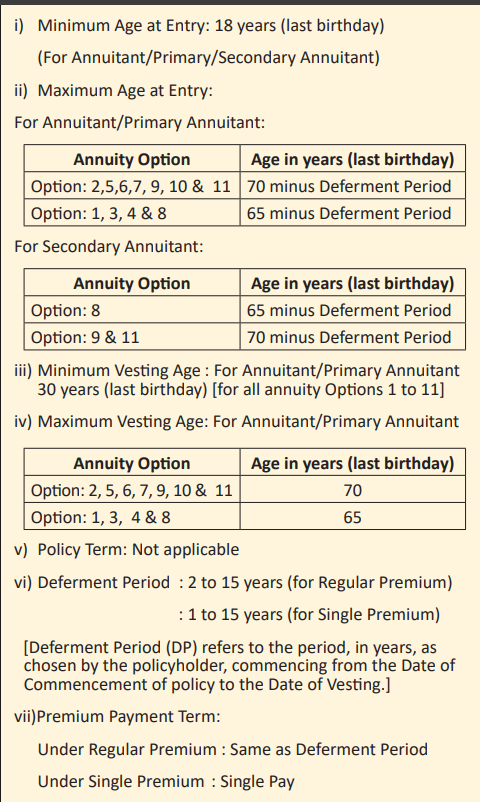
What are the plan options and benefits of the LIC New Jeevan Dhara II?
The Annuity Option should be chosen carefully depending on your specific needs, as the annuity rates & benefits under the LIC New Jeevan Dhara II Plan shall vary as per the option chosen and the same shall not be altered later.
In case of Joint Life Annuity Options, the Primary Annuitant shall be the primary person to receive the annuity payments, and the Secondary Annuitant shall receive the same annuity only in the event of the death of the Primary Annuitant.
|
Premium Payment |
Annuity Type |
Annuity Options |
|
|
Regular Premium |
Single Life Annuity |
Option 1 | Life Annuity for Single Life |
| Option 2 |
Life Annuity with Return of Premium for single life |
||
|
Option 3 |
Life Annuity with 50% Return of Premium after attaining age 75 years for single life | ||
| Option 4 |
Life Annuity with 100% Return of Premium after attaining age 75 years for single life |
||
|
Option 5 |
Life Annuity with 50% Return of Premium after attaining age 80 years for single life | ||
|
Option 6 |
Life Annuity with 100% Return of Premium after attaining age 80 years for single life | ||
| Option 7 |
Life Annuity with 5% Return of Premium after attaining age 76 years to 95 years for single life |
||
|
Joint Life Annuity |
Option 8 | Life Annuity for Joint Life | |
| Option 9 |
Life Annuity with Return of premium for Joint life |
||
|
Single Premium |
Single Life Annuity | Option 10 | Life Annuity with Return of premium for single life |
| Joint Life Annuity | Option 11 |
Life Annuity with Return of premium for Joint life |
|
|
Annuity Option |
During Deferment period | After Deferment Period | |
| Annuity payable |
Death benefit |
||
|
Option 1: Life Annuity for Single life |
Survival benefit – NIL Death benefit- 105% of total premiums paid |
As long as the annuitant is alive | NIL |
| Option 2: Life Annuity with Return of premium for single life | Survival benefit – NIL Death benefit- 105% of total premiums paid |
As long as the annuitant is alive |
100% of total premiums paid |
|
Option 3: Life Annuity with 50% Return of Premium after attaining age 75 years for single life |
Survival benefit – NIL Death benefit- 105% of total premiums paid |
As long as the annuitant is alive 50% of purchase price at 75 years of age |
100% of total premiums paid (Less) Sum of early return of premium |
| Option 4: Life Annuity with 100% Return of Premium after attaining age 75 years for single life |
Survival benefit – NIL |
As long as the annuitant is alive 100% of purchase price at 75 years of age |
100% of total premiums paid (Less) Sum of early return of premium |
|
Option 5: Life Annuity with 50% Return of Premium after attaining age 80 years for single life |
Survival benefit – NIL Death benefit- 105% of total premiums paid |
As long as the annuitant is alive 50% of purchase price at 80 years of age |
100% of total premiums paid (Less) Sum of early return of premium |
| Option 6: Life Annuity with 100% Return of Premium after attaining age 80 years for single life | Survival benefit – NIL Death benefit- 105% of total premiums paid |
As long as the annuitant is alive 100% of purchase price at 80 years of age |
100% of total premiums paid (Less) Sum of early return of premium |
|
Option 7: Life Annuity with 5% Return of Premium after attaining age 76 years to 95 years for single life |
Survival benefit – NIL Death benefit- 105% of total premiums paid |
As long as the annuitant is alive 5% of purchase price on each policy anniversary from 76 to 95 years of age |
100% of total premiums paid (Less) Sum of early return of premium |
| Option 8: Life Annuity for Joint life | Survival benefit – NIL Death benefit- 105% of total premiums paid |
As long as the last survivor is alive |
NIL |
|
Option 9: Life Annuity with Return of premium for Joint life |
Survival benefit – NIL Death benefit- 105% of total premiums paid (on death of last survivor) |
As long as the last survivor is alive | 100% of total premiums paid (Less) Sum of early return of premium (On death of last survivor) |
| Option 10: Life Annuity with Return of premium for single life | Survival benefit – NIL Death benefit- 105% of total premiums paid |
As long as the annuitant is alive |
100% of total premiums paid |
|
Option 11: Life Annuity with Return of premium for Joint life |
Survival benefit – NIL Death benefit- 105% of total premiums paid (on death of last survivor) |
As long as the last survivor is alive |
100% of total premiums paid (Less) Sum of early return of premium (On death of last survivor) |
Grace Period, Discontinuance and Revival of the LIC New Jeevan Dhara II
Grace Period
A grace period of 30 days will be allowed for payment of yearly, half-yearly or quarterly premiums and 15 days for monthly premiums from the date of First Unpaid Premium.
Discontinuance
If less than one full year’s premiums have been paid and any subsequent premium is not duly paid, all the benefits under the LIC New Jeevan Dhara II Plan policy shall cease after the expiry of the grace period from the date of First Unpaid Premium, and nothing shall be payable.
For a Premium Paying Term less than 5 years, if, after at least one full year’s premium has been paid and any subsequent premium is not duly paid, the policy shall not be wholly void, but shall subsist as a Paid-up policy.
For a Premium Paying Term equal to or greater than 5 years, if, after at least one full year’s premium has been paid and any subsequent premium is not duly paid, on completion of the first policy year, the policy shall not be wholly void, but shall subsist as a Paid-up policy till the end of the LIC New Jeevan Dhara II Plan Policy Term.
Revival
If the due premium is not paid before the expiry of the days of grace, the policy lapses.
The lapsed policy may be revived during the lifetime of the Annuitant(s) but within a period of 5 consecutive complete years from the date of First Unpaid Premium.
Free Look Period for the LIC New Jeevan Dhara II
If the Policyholder is not satisfied with the “Terms and Conditions” of the policy, the policy may be returned to the Corporation within 30 days from the date of receipt of the electronic or physical mode of the Policy Bond, whichever is earlier, stating the reasons for the objections.
Surrendering the LIC New Jeevan Dhara II
During the deferment period: Surrender shall be allowed under all the Annuity Options.
After the deferment period: Surrender shall be allowed only under the Annuity Options with Return of Premiums/Purchase Price (i.e. Option: 2, 3, 4, 5, 6, 7, 9, 10 and 11).
On surrender of the policy after the deferment period, nothing shall be payable under Option-1 and Option-8.
Single Premium Policies:
Single Premium Policies can be surrendered by the LIC New Jeevan Dhara II Plan policyholder at any time on payment of the Purchase Price.
Regular Premium Policies:
Regular Premium Policies with a Premium Paying Term of less than 5 years can be surrendered by the policyholder at any time during or after the Deferment Period, provided premium(s) have been paid for at least one full year.
Regular Premium Policies with Premium Paying Term equal to or greater than 5 years can be surrendered by the policyholder after completion of the first Policy Year, provided premium(s) have been paid for at least one full year.
On surrender of the policy, the Surrender Value payable shall be the higher of the Guaranteed Surrender Value (GSV) and Special Surrender Value (SSV).
What are the advantages of the LIC New Jeevan Dhara II?
- Top-up Annuity: Allows you to increase the annuity under the policy by paying an additional single premium.
- Liquidity Option: Provides the flexibility to receive a lump-sum amount in exchange for a reduction in future annuity payments.
- Special Incentives: Offers incentives for higher premiums/purchase prices and to existing LIC policyholders, nominees, and beneficiaries.
- Flexible Death Benefit Options: Allows the death benefit to be received as a lump sum, converted into an annuity, or paid in instalments.
- Provision for Divyangjan: Allows you to purchase the plan for the benefit of a dependent person with a disability.
- QROPS Facility: The plan can also be purchased under the Qualifying Recognised Overseas Pension Scheme (QROPS).
What are the disadvantages of the LIC New Jeevan Dhara II?
- Limited Loan Facility: The loan facility is available only under annuity options that offer a return of purchase price.
- Restricted Surrender Facility: After the deferment period, surrender is permitted only under annuity options with a Return of Purchase Price.
- Taxable Annuity Income: The annuity payments received are fully taxable as per your applicable income tax slab.
- Limited Flexibility: Once the deferment period ends, you cannot withdraw or utilise the accumulated corpus freely according to your financial needs.
Research Methodology of LIC New Jeevan Dhara II
LIC New Jeevan Dhara II has two distinct phases: the Accumulation Phase and the Distribution Phase. You pay premiums for a specified period during the accumulation phase and start receiving annuity payments after the deferment period.
To determine whether this plan deserves a place in your retirement portfolio, let us evaluate its returns through a benefit illustration and understand the cash flow pattern.
Benefit Illustration – IRR Analysis of New Jeevan Dhara II
Consider a 45-year-old male who wishes to build a retirement corpus through LIC New Jeevan Dhara II. He invests ₹50,000 annually for 15 years.
On completion of the premium payment period, he starts receiving a lifelong annuity. He opts for Option 2 – Life Annuity with Return of Purchase Price (Single Life).
|
Male |
45 years |
| Premium paying term | 15 years |
| Annualised premium |
50,000 |
|
Deferment period |
15 years |
Under this option, he receives an annual annuity of ₹83,100 throughout his lifetime. For illustration purposes, let us assume his life expectancy is 85 years. On his death, the purchase price is returned to the nominee.
|
Age |
Year | Annualised premium / Maturity benefit |
| 45 | 1 |
-50,000 |
|
46 |
2 | -50,000 |
| 47 | 3 |
-50,000 |
|
48 |
4 | -50,000 |
| 49 | 5 |
-50,000 |
|
50 |
6 | -50,000 |
| 51 | 7 |
-50,000 |
|
52 |
8 | -50,000 |
| 53 | 9 |
-50,000 |
|
54 |
10 | -50,000 |
| 55 | 11 |
-50,000 |
|
56 |
12 | -50,000 |
| 57 | 13 |
-50,000 |
|
58 |
14 | -50,000 |
| 59 | 15 |
-50,000 |
|
60 |
16 | 83,100 |
| 61 | 17 |
83,100 |
|
62 |
18 | 83,100 |
| 63 | 19 |
83,100 |
|
64 |
20 | 83,100 |
| 65 | 21 |
83,100 |
|
66 |
22 | 83,100 |
| 67 | 23 |
83,100 |
|
68 |
24 | 83,100 |
| 69 | 25 |
83,100 |
|
70 |
26 | 83,100 |
| 71 | 27 |
83,100 |
|
72 |
28 | 83,100 |
| 73 | 29 |
83,100 |
|
74 |
30 | 83,100 |
| 75 | 31 |
83,100 |
|
76 |
32 | 83,100 |
| 77 | 33 |
83,100 |
|
78 |
34 | 83,100 |
| 79 | 35 |
83,100 |
|
80 |
36 | 83,100 |
| 81 | 37 |
83,100 |
|
82 |
38 | 83,100 |
| 83 | 39 |
83,100 |
|
84 |
40 | 83,100 |
| 85 |
7,50,000 |
|
|
|
IRR |
6.28% |
Based on the above cash flows, the Internal Rate of Return (IRR) works out to 6.28% as per the LIC New Jeevan Dhara II Plan maturity calculator.
This represents an average annualised return over the assumed period. Comparable fixed-income instruments may offer returns in the range of 6%–7% p.a., depending on the prevailing interest rates and investment tenure.
A guaranteed annuity and a seemingly reasonable IRR may make LIC New Jeevan Dhara II appear attractive.
However, the bigger concern is the impact of inflation. Since the annuity remains fixed, its purchasing power gradually declines.
Consequently, the income may prove inadequate to meet your retirement expenses in the later years.
During the accumulation phase, your invested money remains committed to the policy. Once the distribution phase begins, you receive the annuity as per the chosen option, with limited flexibility to access the accumulated purchase price.
While the plan offers a guaranteed lifelong income, its returns and liquidity are not particularly attractive. The fixed annuity, erosion of purchasing power due to inflation, and limited access to your accumulated corpus make LIC New Jeevan Dhara II a less compelling choice for building your retirement kitty.
LIC New Jeevan Dhara II Vs. Other Investments
To evaluate LIC New Jeevan Dhara II more effectively, let us compare it with alternative investment options.
We will retain the same investment amount and tenure as in the earlier illustration but use a different approach for the accumulation and distribution phases.
LIC New Jeevan Dhara II Vs. PPF/Equity Mutual Fund
During the accumulation phase, the investor can choose an investment option based on his risk appetite. Let us consider two scenarios:
- Debt Investment – PPF: An annual investment of ₹50,000 for 15 years in a PPF account.
- Equity Investment – Mutual Fund: An annual investment of ₹50,000 for 15 years in an Equity Mutual Fund.
The accumulated corpus is then shifted to an instrument offering a 7% annual return, from which the investor withdraws ₹83,100 every year, matching the annuity received under LIC New Jeevan Dhara II.
|
Age |
Year | PPF | Equity Mutual Fund |
| 45 | 1 | -50,000 |
-50,000 |
|
46 |
2 | -50,000 | -50,000 |
| 47 | 3 | -50,000 |
-50,000 |
|
48 |
4 | -50,000 | -50,000 |
| 49 | 5 | -50,000 |
-50,000 |
|
50 |
6 | -50,000 | -50,000 |
| 51 | 7 | -50,000 |
-50,000 |
|
52 |
8 | -50,000 | -50,000 |
| 53 | 9 | -50,000 |
-50,000 |
|
54 |
10 | -50,000 | -50,000 |
| 55 | 11 | -50,000 |
-50,000 |
|
56 |
12 | -50,000 | -50,000 |
| 57 | 13 | -50,000 |
-50,000 |
|
58 |
14 | -50,000 | -50,000 |
| 59 | 15 | -50,000 |
-50,000 |
|
60 |
16 | 83,100 | 83,100 |
| 61 | 17 | 83,100 |
83,100 |
|
62 |
18 | 83,100 | 83,100 |
| 63 | 19 | 83,100 |
83,100 |
|
64 |
20 | 83,100 | 83,100 |
| 65 | 21 | 83,100 |
83,100 |
|
66 |
22 | 83,100 | 83,100 |
| 67 | 23 | 83,100 |
83,100 |
|
68 |
24 | 83,100 | 83,100 |
| 69 | 25 | 83,100 |
83,100 |
|
70 |
26 | 83,100 | 83,100 |
| 71 | 27 | 83,100 |
83,100 |
|
72 |
28 | 83,100 | 83,100 |
| 73 | 29 | 83,100 |
83,100 |
|
74 |
30 | 83,100 | 83,100 |
| 75 | 31 | 83,100 |
83,100 |
|
76 |
32 | 83,100 | 83,100 |
| 77 | 33 | 83,100 |
83,100 |
|
78 |
34 | 83,100 | 83,100 |
| 79 | 35 | 83,100 |
83,100 |
|
80 |
36 | 83,100 | 83,100 |
| 81 | 37 | 83,100 |
83,100 |
|
82 |
38 | 83,100 | 83,100 |
| 83 | 39 | 83,100 |
83,100 |
|
84 |
40 | 83,100 | 83,100 |
| 85 | 17,36,062 |
48,84,035 |
|
|
|
IRR | 7.04% |
8.58% |
Accumulation and Distribution – Investment Outcomes
- PPF: The accumulated corpus after 15 years is ₹13.56 lakh.
- Equity Mutual Fund: The maturity value is ₹20.87 lakh. After accounting for capital gains tax, the post-tax corpus works out to ₹19.63 lakh.
The respective accumulated corpus is invested in a 7% return instrument during the distribution phase. The investor withdraws ₹83,100 annually, similar to the LIC annuity.
By the assumed age of 85, the entire investment corpus is exhausted, replicating the return-of-purchase-price feature under LIC New Jeevan Dhara II.
The resulting IRR works out to:
- PPF investment with annual withdrawals: 7.04%
- Equity Mutual Fund investment with annual withdrawals: 8.58%
| Equity Mutual Fund Tax Calculation | |
|
Maturity value after 15 years |
20,87,664 |
| Purchase price |
7,50,000 |
|
Long-Term Capital Gains |
13,37,664 |
| Exemption limit |
1,25,000 |
|
Taxable LTCG |
12,12,664 |
| Tax paid on LTCG |
1,51,583 |
|
Maturity value after tax |
19,36,081 |
The alternative investment strategies offer better returns than LIC New Jeevan Dhara II, along with greater flexibility and liquidity.
During the distribution phase, you retain control over your accumulated corpus.
You can utilise the money for other financial goals, withdraw a higher or lower amount depending on your requirements, or shift your investment to other instruments if interest rates become more attractive.
These advantages are missing in LIC New Jeevan Dhara II, where the purchase price remains committed to the annuity arrangement and your income is largely determined by the option selected at inception.
The key advantage of investing independently is that you retain control over both your retirement corpus and its withdrawals, without compromising on the flexibility to adapt to changing financial needs.
Final Verdict on LIC New Jeevan Dhara II
LIC New Jeevan Dhara II is a long-term commitment in which your savings remain tied to the policy.
You invest during your working years and, after the deferment period, receive a regular annuity throughout your lifetime. However, our analysis highlights several limitations that need careful consideration.
The annuity remains fixed throughout your lifetime, leaving you with little flexibility to adjust your income to changing financial needs.
More importantly, the returns are relatively low and may fail to keep pace with inflation and it also has a high agent commission.
Since retirement planning is a long-term exercise, your investments must generate returns that help preserve and grow your purchasing power. Otherwise, inflation will gradually erode the value of your retirement savings.
Your hard-earned money deserves a better investment strategy that can support a comfortable retirement lifestyle. To combat inflation, consider building a diversified retirement portfolio and rebalancing it periodically.
Equity provides the potential for long-term capital appreciation, while the debt component can help generate stability and meet regular withdrawal requirements.
Do Quora, Facebook, and Twitter have the final say when it comes to financial advice?
Seeking guidance from a financial advisor can help you develop a personalised retirement strategy suited to your financial goals and risk appetite.
Remember, starting early, investing wisely, and maintaining financial discipline are essential to building a robust retirement corpus.

Leave a Comment