



 Listen to this article
Can the PNB MetLife RISE Plan truly help you build a financially secure future, or is it just another insurance plan with limited wealth-creation potential?
Does the PNB MetLife RISE Plan offer the right balance between financial protection and savings, or are there better alternatives available?
Is the PNB MetLife RISE Plan a smart choice for achieving your long-term financial goals, or do its benefits come with compromises you should consider?
This article provides an in-depth analysis of the plan’s features, benefits, and limitations, helping you understand whether it is a suitable choice for your financial goals and long-term security.
Table of Contents:
What is the PNB MetLife RISE Plan?
What are the features of the PNB MetLife RISE Plan?
Who is eligible for the PNB MetLife RISE Plan?
What are the benefits of the PNB MetLife RISE Plan?
Grace Period, Discontinuance and Revival of the PNB MetLife RISE Plan
Free Look Period for the PNB MetLife RISE Plan
Surrendering the PNB MetLife RISE Plan
What are the advantages of the PNB MetLife RISE Plan?
What are the disadvantages of the PNB MetLife RISE Plan?
Research Methodology of PNB MetLife RISE Plan
Benefit Illustration – IRR Analysis of PNB MetLife RISE Plan
PNB MetLife RISE Plan Vs. Other Investments
PNB MetLife RISE Plan Vs. Pure-term + Equity Mutual Fund
Final Verdict on the PNB MetLife RISE Plan
What is the PNB MetLife RISE Plan?
PNB MetLife RISE Plan is an Individual, Non-linked, Non-Participating, Savings, Life Insurance Product.
This plan allows individuals to enjoy immediate liquidity along with guaranteed regular income, ensuring that the family’s financial needs are met in the event of a misfortune.
What are the features of the PNB MetLife RISE Plan?
- Combines savings with life insurance protection.
- Offers an Instant Cashback benefit upon policy issuance.
- Provides a guaranteed lump sum benefit at the end of the policy term.
- Includes life insurance coverage throughout the policy term.
- Offers guaranteed income payout options based on the selected plan variant.
- Allows policyholders to tailor income payouts to their financial goals.
- Provides the option to accumulate survival benefits and withdraw them later, offering flexibility in cash flow management.
Who is eligible for the PNB MetLife RISE Plan?
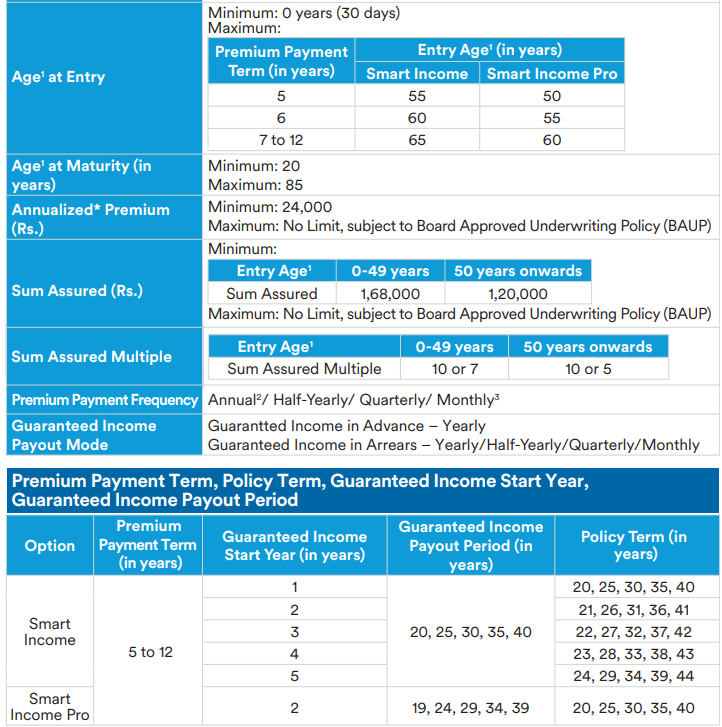
What are the benefits of the PNB MetLife RISE Plan?
1. Survival Benefit
Smart Income Plan Option:
You will receive Guaranteed Income from the selected Guaranteed Income Start Year until the date of maturity, as per the chosen Guaranteed Income Mode.
And at the end of the PNB MetLife RISE Plan Policy Term, you will also receive a lump sum Maturity Benefit, i.e. Return of Premiums.
Smart Income Pro Plan Option:
Enjoy a cashback ranging from 5% to 50% of the first-year annualised premium (in multiples of 5%), payable within 30 days from the date of realisation of the first-year premium by the Company post policy issuance.
Furthermore, you will receive Guaranteed Income starting from the second policy year and continuing until the date of maturity, as per the chosen Guaranteed Income Mode.
At the end of the PNB MetLife RISE Plan Policy Term, you will also receive a lump sum Maturity Benefit, i.e. Return of Premiums.
2. Maturity Benefit
For both plan options, on survival of the Life Assured till the end of the Policy Term, while the policy is in force and all due premiums have been paid, Maturity Benefit shall be payable as a lump sum.
Maturity Benefit = Sum Assured on Maturity.
Where, Sum Assured on Maturity is the absolute amount of benefit guaranteed to be paid on Maturity. Sum Assured on Maturity = Sum of all Annualised Premiums payable during the Premium Payment Term.
3. Death Benefit
In case of death of the Life Assured during the PNB MetLife RISE Plan Policy Term for an in-force policy (all due Premiums have been paid). Death Benefit payable shall be the higher of:
- Sum Assured on Death
- 105% of Total Premiums Paid up to date of death
- Surrender value payable as on the date of death
Where the Sum Assured on Death is calculated as Sum Assured Multiple times the Annualised Premium.
Grace Period, Discontinuance and Revival of the PNB MetLife RISE Plan
Grace Period
The Grace Period for Payment of the Premium is 15 days, where the Policyholder pays the Premium on a monthly basis and 30 days in all other cases.
Discontinuance
Lapse: If you have not paid the first full policy year’s premium, then the PNB MetLife RISE Plan policy shall lapse at the end of the grace period and the risk cover and rider benefits, if any, will cease immediately.
Reduced Paid-Up Value: If your premium is not paid within the Grace Period after you have completed payment for the first full year’s premium, then your policy is said to have become a “Paid Up”.
Revival
A policy in Lapsed or Reduced Paid-Up condition can be revived during the Revival Period of 3 years by paying the Arrears of Instalment Premiums along with interest at the prevailing rate of interest, if any
Free Look Period for the PNB MetLife RISE Plan
If you have any objections to the Terms and Conditions of your Policy, you may cancel the Policy by giving a written notice within 30 days from the date of receipt of the Policy Document whether received electronically or otherwise, stating reasons for your objection, provided no claims have been made under this Policy.
Surrendering the PNB MetLife RISE Plan
You may surrender the Policy any time after payment of at least one full Policy Year Premium and completion of one Policy year.
Before receipt of one full policy year’s premium, no Surrender Value is payable. On Policy Surrender, the company will pay the Surrender Value equal to the higher of Guaranteed Surrender Value (GSV) or Special Surrender Value (SSV).
What are the advantages of the PNB MetLife RISE Plan?
- Policies with an annualised premium of ₹50,000 or above are eligible for an Additional Guaranteed Income Benefit.
- Policyholders have the option to defer survival benefit payouts and accumulate them during the policy term.
- A policy loan facility is available, subject to the plan’s terms and conditions.
- Optional riders can be added to enhance the life insurance protection.
- Certain policy features, such as premium payment frequency, guaranteed income mode, and guaranteed income payout frequency, can be modified during the policy term, subject to the insurer’s conditions.
What are the disadvantages of the PNB MetLife RISE Plan?
- Regular annual income payouts may encourage discretionary spending rather than long-term wealth accumulation.
- The sum assured is relatively low and may not provide adequate financial protection for a family’s needs.
- Since a portion of the policy benefits is paid out during the policy term, the maturity benefit is comparatively smaller and may not be sufficient to meet major financial goals.
- As regular payouts can begin as early as the end of the first policy year, a significant portion of the corpus is withdrawn early, reducing the power of compounding and limiting long-term wealth creation.
Research Methodology of PNB MetLife RISE Plan
The survival benefit is one of the key features promoted under the PNB MetLife RISE Plan.
While the assurance of regular guaranteed payouts may appear attractive, it is equally important to assess the return generated by the plan. One effective way to evaluate this is by calculating the Internal Rate of Return (IRR).
Benefit Illustration – IRR Analysis of PNB MetLife RISE Plan
Consider a 30-year-old male who purchases the PNB MetLife RISE Plan under the Smart Income option.
He pays an annual premium of ₹1,00,000 for 10 years and selects an income duration of 20 years, with the guaranteed income commencing from the end of the first policy year. The policy provides a sum assured of ₹10.5 lakhs.
|
Male |
30 years |
| Sum Assured |
₹ 10,50,000 |
|
Policy Term |
20 years |
| Premium Paying Term |
10 years |
|
Annualised Premium |
₹ 1,00,000 |
Under this option, he receives a guaranteed income of ₹29,080 every year from the end of the first policy year until the end of the policy term.
At maturity, he also receives a Guaranteed Maturity Benefit of ₹10 lakhs. Based on these cash flows, the Internal Rate of Return (IRR) works out to 4.09% as per the PNB MetLife RISE Plan maturity calculator.
|
Age |
Year | Annualised premium / Maturity benefit |
Death benefit |
|
30 |
1 | -1,00,000 | 10,50,000 |
| 31 | 2 | -70,920 |
10,50,000 |
|
32 |
3 | -70,920 | 10,50,000 |
| 33 | 4 | -70,920 |
10,50,000 |
|
34 |
5 | -70,920 | 10,50,000 |
| 35 | 6 | -70,920 |
10,50,000 |
|
36 |
7 | -70,920 | 10,50,000 |
| 37 | 8 | -70,920 |
10,50,000 |
|
38 |
9 | -70,920 | 10,50,000 |
| 39 | 10 | -70,920 |
10,50,000 |
|
40 |
11 | 29,080 | 10,50,000 |
| 41 | 12 | 29,080 |
10,50,000 |
|
42 |
13 | 29,080 | 10,50,000 |
| 43 | 14 | 29,080 |
10,50,000 |
|
44 |
15 | 29,080 | 10,50,000 |
| 45 | 16 | 29,080 |
10,50,000 |
|
46 |
17 | 29,080 | 10,50,000 |
| 47 | 18 | 29,080 |
10,50,000 |
|
48 |
19 | 29,080 | 10,50,000 |
| 49 | 20 | 29,080 |
10,50,000 |
|
50 |
10,29,080 | ||
| IRR |
4.09% |
An IRR of 4.09% is relatively low when compared with the returns available from several debt-oriented investment avenues.
Although the survival and maturity benefits are guaranteed, the early commencement of annual payouts significantly reduces the amount that remains invested, thereby limiting the power of compounding over the policy term.
Overall, the PNB MetLife RISE Plan is unlikely to be an effective vehicle for long-term wealth creation or for achieving major financial goals that require building a substantial corpus.
PNB MetLife RISE Plan Vs. Other Investments
Although all the benefits under the PNB MetLife RISE Plan are guaranteed, the returns are unlikely to outpace inflation over the long term.
Coupled with relatively low life insurance coverage, the plan falls short as both an investment and a protection solution.
A more effective strategy is to separate insurance from investments and allocate your savings according to your financial goals.
PNB MetLife RISE Plan Vs. Pure-term + Equity Mutual Fund
For life insurance, a pure term insurance policy is generally the most cost-effective option, providing a high level of financial protection at a relatively low premium.
The premium savings can then be invested in suitable financial instruments based on your risk appetite.
Conservative investors may consider debt-oriented options such as a Public Provident Fund (PPF), while investors with a longer investment horizon and a higher risk tolerance may prefer equity mutual funds for potentially better long-term returns.
|
Pure Term Life Insurance Policy |
|
| Sum Assured |
₹ 10,50,000 |
|
Policy Term |
20 years |
| Premium Paying Term |
10 years |
|
Annualised Premium |
₹ 6,000 |
| Investment | ₹ 64,920 (1,00,000-29,080-6,000) |
Consider the same example of a 30-year-old male requiring a life cover of ₹10.5 lakhs. A pure term insurance policy with a policy term of 20 years and a premium-paying term of 10 years costs approximately ₹6,000 per year.
Compared with the annual premium of ₹1,00,000 under the PNB MetLife RISE Plan, the balance amount can be deployed towards investments.
Under the PNB MetLife RISE Plan, the annual survival benefit of ₹29,080 effectively reduces the net annual cash outflow to ₹70,920. After paying the ₹6,000 term insurance premium, the remaining ₹64,920 can be invested annually in an equity mutual fund.
|
Term insurance + Equity Mutual Fund |
|||
|
Age |
Year | Term Insurance premium + Equity Mutual Fund |
Death benefit |
|
30 |
1 | -1,00,000 | 10,50,000 |
| 31 | 2 | -70,920 |
10,50,000 |
|
32 |
3 | -70,920 | 10,50,000 |
| 33 | 4 | -70,920 |
10,50,000 |
|
34 |
5 | -70,920 | 10,50,000 |
| 35 | 6 | -70,920 |
10,50,000 |
|
36 |
7 | -70,920 | 10,50,000 |
| 37 | 8 | -70,920 |
10,50,000 |
|
38 |
9 | -70,920 | 10,50,000 |
| 39 | 10 | -70,920 |
10,50,000 |
|
40 |
11 | 29,080 | 10,50,000 |
| 41 | 12 | 29,080 |
10,50,000 |
|
42 |
13 | 29,080 | 10,50,000 |
| 43 | 14 | 29,080 |
10,50,000 |
|
44 |
15 | 29,080 | 10,50,000 |
| 45 | 16 | 29,080 |
10,50,000 |
|
46 |
17 | 29,080 | 10,50,000 |
| 47 | 18 | 29,080 |
10,50,000 |
|
48 |
19 | 29,080 |
10,50,000 |
|
49 |
20 | 29,080 | 10,50,000 |
| 50 |
21,19,358 |
||
|
|
IRR |
8.12% |
|
Assuming this investment accumulates for 10 years, the corpus grows to approximately ₹13.66 lakhs.
After accounting for capital gains tax, the post-tax corpus of around ₹12.95 lakhs is shifted to an investment earning 7% annually.
From this corpus, an investor can generate annual withdrawals comparable to the survival benefits offered by the PNB MetLife RISE Plan while preserving the remaining balance for future growth.
|
Equity Mutual Fund Tax Calculation |
|
|
Maturity value after 10 years |
13,66,294 |
| Purchase price |
6,78,280 |
|
Long-Term Capital Gains |
6,88,014 |
| Exemption limit |
1,25,000 |
|
Taxable LTCG |
5,63,014 |
| Tax paid on LTCG |
70,377 |
|
Maturity value after tax |
12,95,917 |
At the end of the investment period, the portfolio is projected to grow to approximately ₹21.19 lakhs—more than twice the guaranteed maturity benefit offered by the PNB MetLife RISE Plan.
The overall Internal Rate of Return (IRR) works out to 8.12%, substantially higher than the 4.09% IRR generated by the PNB MetLife RISE Plan.
In addition to delivering superior returns, this approach offers greater liquidity and flexibility, allowing investors to access or modify their investments as their financial circumstances evolve.
A prudent financial strategy is to build a diversified investment portfolio aligned with your risk profile, investment horizon, and financial goals.
Combining insurance and investment in a traditional life insurance policy such as the PNB MetLife RISE Plan often results in compromises on both fronts.
Separating protection from wealth creation is generally a more efficient approach for achieving long-term financial success.
Final Verdict on the PNB MetLife RISE Plan
The PNB MetLife RISE Plan provides guaranteed income payouts that are insulated from market volatility. However, guaranteed benefits alone do not ensure that your long-term financial goals will be achieved.
Over an investment horizon of 20 years, the plan’s relatively low return may not be sufficient to keep pace with inflation, potentially leaving you with an inadequate corpus to meet future financial needs and it also has a high agent commission.
A key factor contributing to the plan’s modest return is the early commencement of survival benefit payouts, which reduces the amount that remains invested and limits the power of compounding.
In addition, the life insurance coverage offered under the plan is relatively low and may not provide adequate financial protection for your family’s future in the event of an unforeseen contingency.
A more effective approach is to separate insurance from investments.
A pure term life insurance policy can provide adequate financial protection for your dependants at a relatively low cost, while the premium savings can be invested in a well-diversified portfolio aligned with your risk profile, investment horizon, and financial goals.
This strategy offers greater flexibility, liquidity, and the potential for superior long-term wealth creation.
Do Quora, Facebook, and Twitter have the final say when it comes to financial advice?If you require personalised guidance, consider consulting a Certified Financial Planner (CFP) who can help design a financial plan tailored to your objectives, risk tolerance, and long-term aspirations.


Leave a Reply