
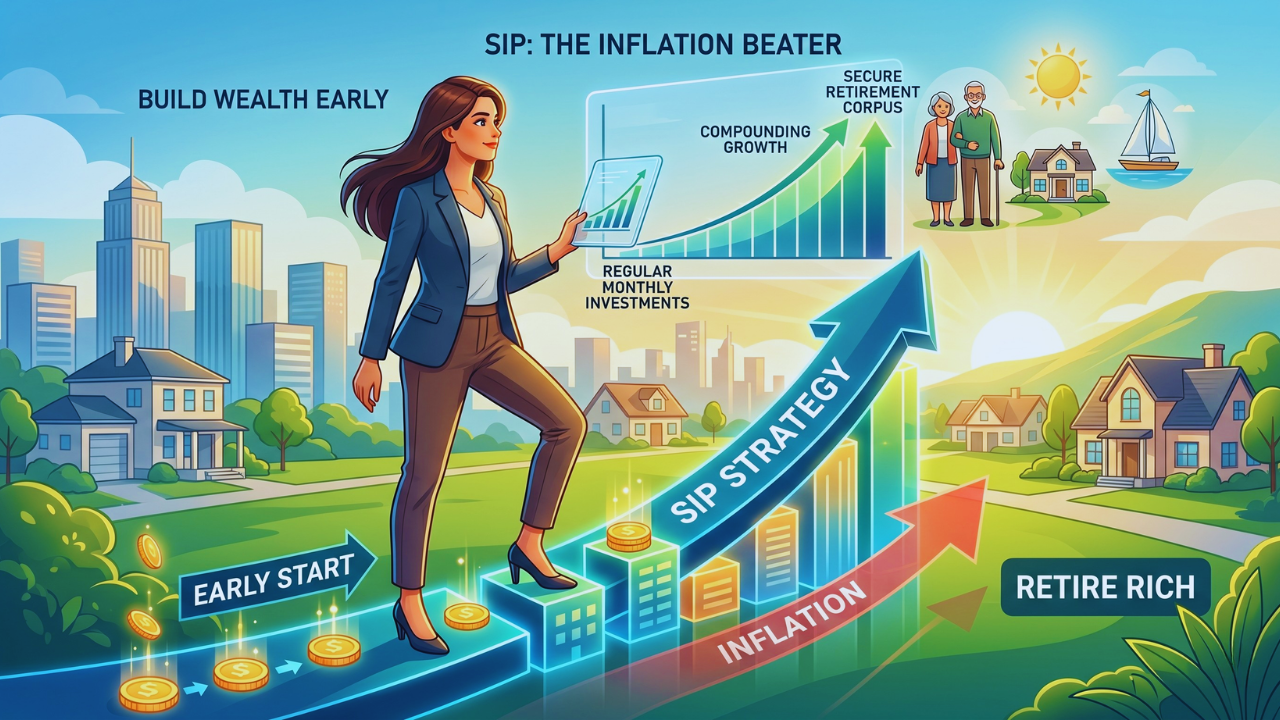
Most people spend their entire working lives focused on one goal—earning more.
A better job, a higher salary, a more comfortable lifestyle.
But very few stop to ask a far more important question:
What happens when the income stops?
Retirement is often imagined as a distant phase, something to think about “later.”
Yet, when it finally arrives, it doesn’t come with a warning.
And by then, the ability to correct financial mistakes becomes limited.
The real challenge of retirement is not just accumulating money—it is ensuring that your savings can sustain the life you are used to, even when there is no active income.
Table of Contents
- The Reality We Avoid Thinking About
- Inflation: The Invisible Force That Changes Everything
- Why ₹1 Crore Is No Longer Enough
- From Overwhelm to Clarity: Breaking Down Big Numbers
- The Real Advantage of Starting Early
- The Mathematics of Time: 21 vs 30
- Making Investing Practical: SIP as a Strategy
- Growing with Time: The Role of Step-Up SIP
- The Psychology of “I Can’t Save Enough”
- Teaching the Next Generation to Build Wealth Early
- Protecting Your Lifestyle in Retirement
- Conclusion
The Reality We Avoid Thinking About
If you ask most people how much they need for retirement, the answers are usually vague.
“Maybe ₹1 crore.”
“Depends on lifestyle.”
“Something big should be enough.”
But these answers are rarely backed by calculation.
We tend to think in today’s numbers, using today’s expenses, without adjusting for the future.
The assumption is simple: if ₹1 crore feels like a large amount today, it should be sufficient tomorrow as well.
That assumption is where the problem begins.
Inflation: The Invisible Force That Changes Everything
Inflation does not feel urgent. It does not demand attention.
But over time, it quietly reshapes your financial reality.
A modest inflation rate of 5% may not seem alarming in a single year.
However, over two decades, it dramatically reduces the value of money.
What you can buy for ₹1 lakh today may require nearly ₹2.7 lakhs in 20 years.
This means your future expenses are not just slightly higher—they are exponentially higher.
Yet, most financial plans ignore this shift.
Why ₹1 Crore Is No Longer Enough
Consider a simple goal: accumulating ₹1 crore over the next 20 years.
At first glance, it sounds reasonable—even ambitious.
But when adjusted for inflation, the picture changes completely.
After 20 years, ₹1 crore may carry the purchasing power of only about ₹37–38 lakh in today’s terms.
In other words, what feels like financial security today may barely cover basic needs in the future.
To maintain the same standard of living that ₹1 crore provides today, you would need approximately ₹2.5–₹2.7 crores two decades from now.
And naturally, higher goals scale accordingly.
This is not a pessimistic projection—it is a realistic one.
From Overwhelm to Clarity: Breaking Down Big Numbers
When faced with such large numbers, it is natural to feel overwhelmed.
“How can I possibly save ₹5 crores?”
“Is this even achievable?”
But this is where perspective matters.
Wealth is not built by focusing on the final number.
It is built by breaking that number into consistent, manageable actions.
Instead of thinking in crores, think in monthly investments.
A long-term goal, when divided into small monthly contributions, becomes far more approachable.
The Real Advantage of Starting Early
Time is the single most powerful factor in wealth creation.
Starting early does not just give your investments more time—it reduces the burden on your monthly savings.
When you begin investing in Mutual Funds via SIP at 21 or 25, you allow compounding to work quietly in the background.
Your money earns returns, and those returns begin to generate further returns.
Over time, this creates exponential growth.
On the other hand, delaying investments until 30 or later compresses this timeline.
To reach the same goal, you are forced to invest significantly higher amounts every month.
The difference is not marginal—it is substantial.
The Mathematics of Time: 21 vs 30
Imagine two individuals with the same financial goal.
One starts investing at 21.
The other starts at 30.
The first investor has nearly a decade more for compounding to work.
This additional time often means:
- Lower monthly investment requirements
- Higher final corpus
- Less financial stress
The second investor, despite earning more, may struggle to catch up without significantly increasing their monthly contribution.
So the question becomes:
Is it better to wait until you can invest more—or start early with what you have?
The answer is almost always the latter.
Making Investing Practical: SIP as a Strategy
For most individuals, investing large sums at once is not feasible.
This is where a Systematic Investment Plan (SIP) becomes useful.
SIP allows you to invest a fixed amount regularly, typically every month.
This approach offers several advantages:
- It builds financial discipline
- It reduces the pressure of timing the market
- It aligns with your monthly income pattern
- It allows you to start small and scale gradually
More importantly, it turns investing into a habit rather than a one-time decision.
Growing with Time: The Role of Step-Up SIP
As your career progresses, your income increases.
However, many people fail to increase their investments accordingly.
A Step-Up SIP addresses this gap by allowing you to increase your investment amount periodically—usually once a year.
Even a small annual increase can significantly boost your long-term wealth.
This ensures that your investments grow alongside your income, without disrupting your current lifestyle.
The Psychology of “I Can’t Save Enough”
One of the most common mental barriers to investing is the belief that the required amount is too high.
“I can’t invest ₹50,000 per month.”
“So what’s the point of starting?”
This all-or-nothing thinking often leads to inaction.
A more practical approach is to focus on what is possible.
Even if you cannot reach your ideal target immediately, starting with a smaller amount creates momentum.
And over time, that momentum builds into meaningful progress.
Teaching the Next Generation to Build Wealth Early
Financial habits are rarely developed overnight.
They are learned over time, often influenced by family.
Parents who introduce their children to saving and investing early create a strong foundation for their future.
Starting small SIPs during childhood and encouraging continuity once the child begins earning can have a transformative effect.
With enough time, even modest contributions can grow into substantial wealth.
Protecting Your Lifestyle in Retirement
The ultimate goal of financial planning is not just accumulation—it is preservation.
You want your future self to enjoy the same level of comfort that you experience today.
To achieve this, your investments must:
- Outpace inflation
- Remain consistent over time
- Adapt to changing income levels
- Be reviewed periodically
Without this, even a large corpus may fall short.
Conclusion
A comfortable retirement is not built through sudden decisions or last-minute efforts.
It is built quietly, consistently, over time.
The sooner you start, the easier the journey becomes.
The later you delay, the steeper the climb.
You don’t need perfect conditions to begin.
You just need to take the first step.
Because when it comes to financial security, time is not just money—
it is everything.
A Certified Financial Planner (CFP) can help you calculate your real retirement needs and design a SIP plan aligned with your goals.

Leave a Comment