

 Listen to this article
Can the Bajaj Life Young Achiever Plan truly help secure your child’s future goals, or do its benefits come with important trade-offs?
Does the Bajaj Life Young Achiever Plan provide the right combination of financial protection and savings for your child, or are there better alternatives available?
Is the Bajaj Life Young Achiever Plan a smart way to plan for your child’s future, or would separating insurance and investment provide greater flexibility?
This article examines the plan’s key features, advantages and limitations, supported by a detailed illustration to assess its financial suitability.
Table of Contents:
What is the Bajaj Life Young Achiever Plan?
What are the features of the Bajaj Life Young Achiever Plan?
Who is eligible for the Bajaj Life Young Achiever Plan?
What are the plan options and their benefits of the Bajaj Life Young Achiever Plan?
What are the advantages of the Bajaj Life Young Achiever Plan?
What are the disadvantages of the Bajaj Life Young Achiever Plan?
Research Methodology of the Bajaj Life Young Achiever Plan
Benefit Illustration – IRR Analysis of Bajaj Life Young Achiever Plan
Bajaj Life Young Achiever Plan Vs. Other Investment
Bajaj Life Young Achiever Plan Vs. Pure-term +PPF/ Equity Mutual Fund
Final Verdict on the Bajaj Life Young Achiever Plan
What is the Bajaj Life Young Achiever Plan?
Bajaj Life Young Achiever Plan shall help you build a secure financial foundation for your child’s milestones- be it higher education, career aspirations or other life goals.
It combines protection and wealth creation, ensuring your child’s dreams stay on track even in your absence.
What are the features of the Bajaj Life Young Achiever Plan?
- Choice of Plan Variant: Choose between a guaranteed lump-sum maturity benefit or a guaranteed regular income to support your child’s future financial goals.
- Comprehensive Protection with New Waiver of Premium Rider: Future premiums are waived upon the earlier occurrence of death, accidental total and permanent disability (ATPD), or any of 25 specified major critical illnesses (CI), subject to the rider terms.
- Financial Security for Your Child: The plan is designed to provide financial support for your child’s education and other future needs, even in your absence.
- Tax Benefits: Premiums paid and benefits received may qualify for tax benefits, subject to applicable tax laws and amendments from time to time.
Who is eligible for the Bajaj Life Young Achiever Plan?
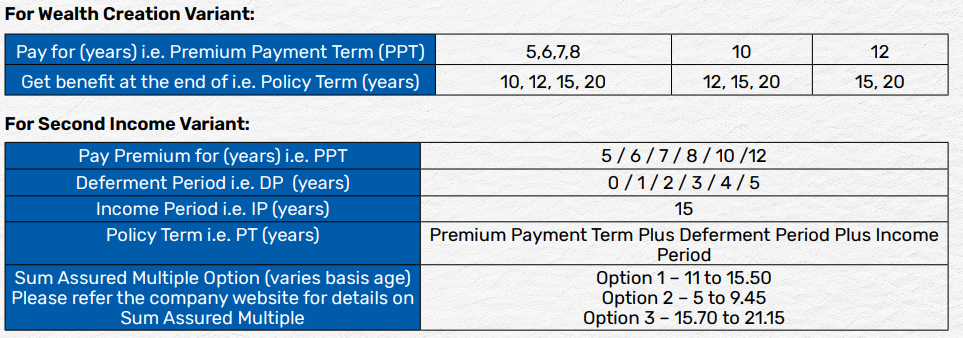
What are the plan options and their benefits of the Bajaj Life Young Achiever Plan?
1. Wealth Creation
You will receive a guaranteed lump-sum benefit at the end of the Policy Term to support your child’s future needs.
2. Second Income
You will receive a guaranteed income along with a lump-sum benefit (in case the Return of Premium option is selected) to meet your child’s future needs.
What are the advantages of the Bajaj Life Young Achiever Plan?
- Optional Protection Riders: Accidental Total and Permanent Disability (ATPD) and Critical Illness Riders can be added to the base policy for additional protection.
- Flexible Premium Options: Choose the premium amount, payment frequency and premium payment term based on your financial capacity and goals.
What are the disadvantages of the Bajaj Life Young Achiever Plan?
- Limited Returns: Although the plan provides guaranteed benefits, the overall returns may be modest compared with other long-term investment avenues.
- Potentially Inadequate Coverage: The sum assured may not be sufficient to meet your child’s long-term financial requirements, particularly as education and other future costs rise with inflation.
Research Methodology of the Bajaj Life Young Achiever Plan
When evaluating an investment product, it is important to consider both the cash-flow requirements and the returns generated by the investment.
Let’s examine the benefit illustration provided in the Bajaj Life Young Achiever Plan policy brochure to understand the cash-flow pattern and potential value of the Bajaj Life Young Achiever Plan.
Benefit Illustration – IRR Analysis of Bajaj Life Young Achiever Plan
Consider a 30-year-old male who opts for the Wealth Creation variant. He chooses a sum assured of ₹11 lakh, a 15-year policy term and a 12-year premium payment term, with an annual premium of ₹1 lakh.
| Male | 30 years |
| Sum Assured | ₹ 11,00,000 |
| Policy Term | 15 years |
| Premium Paying Term | 12 years |
| Annualised Premium | ₹ 1,00,000 |
Under this variant, the maturity benefit is paid as a single lump sum at the end of the Bajaj Life Young Achiever Plan policy term.
The illustrated maturity benefit is ₹20.16 lakh, resulting in an Internal Rate of Return (IRR) of just 5.43% as per the Bajaj Life Young Achiever Plan maturity calculator.
For a 15-year investment horizon, this represents a relatively modest return.
| Age | Year | Annualised premium / Maturity benefit | Death benefit |
| 30 | 1 | -1,00,000 | 11,00,000 |
| 31 | 2 | -1,00,000 | 11,00,000 |
| 32 | 3 | -1,00,000 | 11,00,000 |
| 33 | 4 | -1,00,000 | 11,00,000 |
| 34 | 5 | -1,00,000 | 11,00,000 |
| 35 | 6 | -1,00,000 | 11,00,000 |
| 36 | 7 | -1,00,000 | 11,00,000 |
| 37 | 8 | -1,00,000 | 11,00,000 |
| 38 | 9 | -1,00,000 | 11,00,000 |
| 39 | 10 | -1,00,000 | 11,00,000 |
| 40 | 11 | -1,00,000 | 11,00,000 |
| 41 | 12 | -1,00,000 | 11,00,000 |
| 42 | 13 | 0 | 11,00,000 |
| 43 | 14 | 0 | 11,00,000 |
| 44 | 15 | 0 | 11,00,000 |
| 45 | 20,16,436 | ||
| IRR | 5.43% |
The Wealth Creation variant itself generates a low IRR despite providing the benefit as a lump sum.
The Second Income variant, which provides benefits through periodic payouts, may have a further impact on the compounding of returns, depending on the timing and structure of those payouts.
Further, the sum assured of ₹11 lakh may not provide meaningful life protection when viewed against the potential long-term financial requirements of a family.
Overall, the illustration highlights two key concerns: modest investment returns and potentially inadequate life protection. These factors should be carefully considered before choosing the Bajaj Life Young Achiever Plan for long-term financial goals.
Bajaj Life Young Achiever Plan Vs. Other Investment
An investment that fails to beat inflation over the long term can gradually erode your purchasing power instead of creating real wealth.
The Bajaj Life Young Achiever Plan combines life insurance with guaranteed benefits, but this combination can limit the potential for long-term wealth creation.
A more efficient approach is to separate insurance from investment, allowing each to serve its intended purpose.
Bajaj Life Young Achiever Plan Vs. Pure-term +PPF/ Equity Mutual Fund
A pure-term life insurance policy with a sum assured of ₹11 lakh costs an annual premium of ₹5,000, with a 10-year premium payment term and a 15-year policy term.
This leaves ₹95,000 per year available for investment.
Since the original plan requires premiums for 12 years, the full ₹1 lakh can be invested during the final two years as well.
| Pure Term Life Insurance Policy | |
| Sum Assured | ₹ 11,00,000 |
| Policy Term | 15 years |
| Premium Paying Term | 10 years |
| Annualised Premium | ₹ 5,000 |
| Investment | ₹ 95,000 |
The investment component can be allocated according to the investor’s risk profile — equity-oriented investments for higher long-term growth potential or debt-oriented instruments for relatively lower volatility.
For this comparison, let’s consider PPF and an equity mutual fund.
| Term Insurance + PPF | Term insurance + Equity Mutual Fund | ||||
| Age | Year | Term Insurance premium + PPF | Death benefit | Term Insurance premium + Equity Mutual Fund | Death benefit |
| 30 | 1 | -1,00,000 | 11,00,000 | -1,00,000 | 11,00,000 |
| 31 | 2 | -1,00,000 | 11,00,000 | -1,00,000 | 11,00,000 |
| 32 | 3 | -1,00,000 | 11,00,000 | -1,00,000 | 11,00,000 |
| 33 | 4 | -1,00,000 | 11,00,000 | -1,00,000 | 11,00,000 |
| 34 | 5 | -1,00,000 | 11,00,000 | -1,00,000 | 11,00,000 |
| 35 | 6 | -1,00,000 | 11,00,000 | -1,00,000 | 11,00,000 |
| 36 | 7 | -1,00,000 | 11,00,000 | -1,00,000 | 11,00,000 |
| 37 | 8 | -1,00,000 | 11,00,000 | -1,00,000 | 11,00,000 |
| 38 | 9 | -1,00,000 | 11,00,000 | -1,00,000 | 11,00,000 |
| 39 | 10 | -1,00,000 | 11,00,000 | -1,00,000 | 11,00,000 |
| 40 | 11 | -1,00,000 | 11,00,000 | -1,00,000 | 11,00,000 |
| 41 | 12 | -98,500 | 11,00,000 | -1,00,000 | 11,00,000 |
| 42 | 13 | -500 | 11,00,000 | 0 | 11,00,000 |
| 43 | 14 | -500 | 11,00,000 | 0 | 11,00,000 |
| 44 | 15 | -500 | 11,00,000 | 0 | 11,00,000 |
| 45 | 22,62,487 | 33,30,554 | |||
| IRR | 6.63% | 10.64% | |||
- PPF: After accounting for the minimum annual investment requirement of ₹500, the corpus after 15 years is ₹22.62 lakh, corresponding to an IRR of 6.63%.
- Equity Mutual Fund: The corpus grows to ₹36.24 lakh after 15 years. After accounting for applicable capital gains tax, the post-tax value is ₹33.30 lakh, resulting in a post-tax IRR of 10.64%.
| Equity Mutual Fund Tax Calculation | |
| Maturity value after 15 years | 36,24,205 |
| Purchase price | 11,50,000 |
| Long-Term Capital Gains | 24,74,205 |
| Exemption limit | 1,25,000 |
| Taxable LTCG | 23,49,205 |
| Tax paid on LTCG | 2,93,651 |
| Maturity value after tax | 33,30,554 |
This comparison illustrates the potential advantage of separating insurance and investment. The term policy provides the required life cover, while the investment component can be selected based on the investor’s risk profile and financial goals.
The approach also provides greater flexibility, as investments can generally be accessed or adjusted based on changing financial requirements. In contrast, the Bajaj Life Young Achiever Plan combines protection and investment within a single structure, with relatively modest illustrated returns and more limited liquidity.
For long-term financial planning, adequate insurance protection and goal-oriented investments can therefore be evaluated separately rather than relying on a single product to fulfil both objectives.
Final Verdict on the Bajaj Life Young Achiever Plan
The Bajaj Life Young Achiever Plan is a traditional life insurance product that combines life cover with guaranteed benefits. It offers two variants to suit different cash-flow preferences.
The Wealth Creation variant provides a guaranteed lump-sum maturity benefit at the end of the policy term, while the Second Income variant provides regular income after the deferment period.
However, an analysis of the illustrated returns indicates that the plan offers relatively modest returns and it also has a high agent commission.
The sum assured may also be inadequate to provide meaningful financial protection for your child’s future in the event of an unforeseen circumstance.
These limitations reduce its effectiveness as a long-term wealth-creation option for your child’s education and other future needs.
For your child’s education and other long-term goals, consider separating insurance and investment:
- Choose a pure-term life insurance policy to provide adequate life cover at a relatively lower cost.
- Select investments based on your child’s financial goals, your risk profile and the time available to achieve those goals.
- Build a diversified investment portfolio to balance risk, liquidity and long-term growth potential.
Life and health insurance provide essential financial protection, while goal-oriented investments can help build the corpus required for your child’s education and other important milestones.
Do Quora, Facebook, and Twitter have the final say when it comes to financial advice?
For a well-structured financial roadmap, a Certified Financial Planner (CFP) can help you evaluate your insurance needs and investment strategy and align them with your child’s future goals.

Leave a Comment