
 Listen to this article
Markets are falling, headlines are screaming, and uncertainty feels louder than ever—so what should you really do as an investor right now?
Pause your SIP? Exit the market? Or stay invested and trust the process?
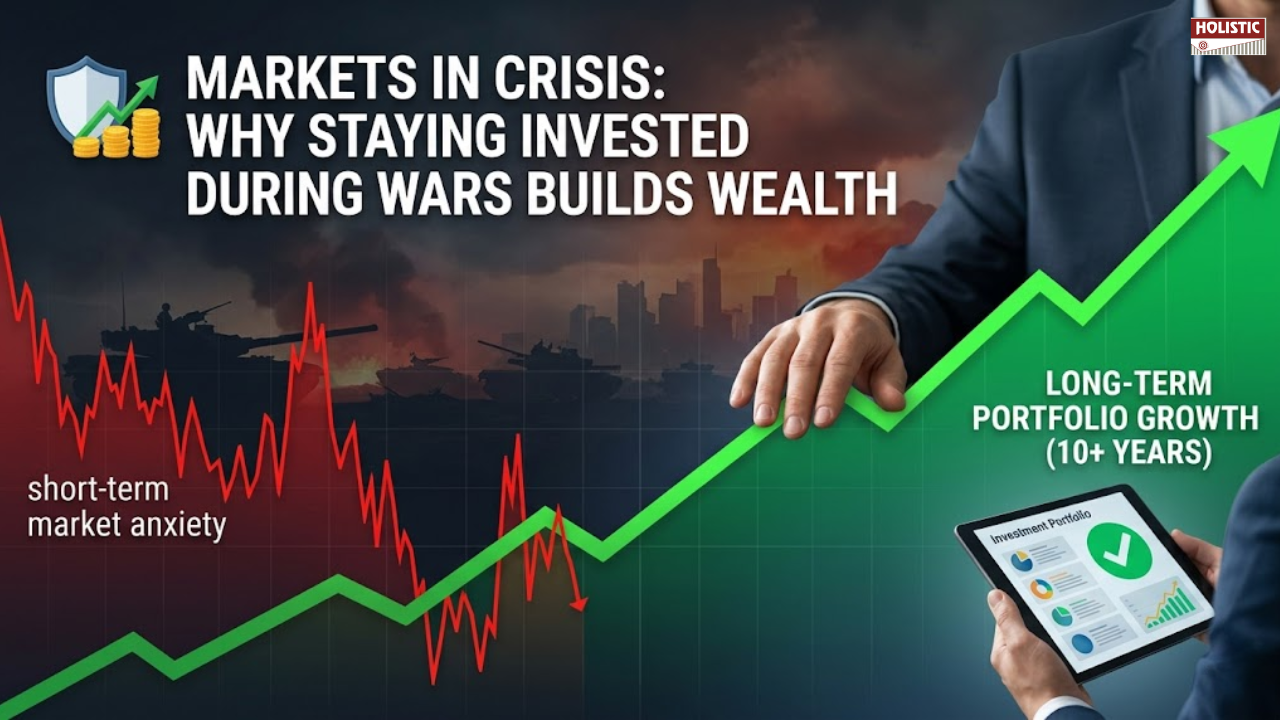
History has seen wars, crises, and global shocks far worse than what we face today—yet, time and again, markets have staged powerful recoveries.
The real question isn’t whether volatility will happen… it’s whether you’re prepared to respond wisely when it does.
Table of Contents
- When Headlines Create Fear
- Why Geopolitical Events Shake Markets
- A Look Back: How Markets Reacted to Global Crises
- The Pattern Most Investors Miss
- Why Investors Panic (and Why It Costs Them)
- Should You Stop Your SIP During Market Uncertainty?
- The Hidden Advantage of Market Corrections
- Lessons from 100 Years of Market Behaviour
- A Smarter Approach During Volatile Times
- Final Thoughts
1. When Headlines Create Fear
When global tensions rise, markets rarely stay calm.
News of conflicts, wars, or geopolitical instability often triggers sharp reactions in stock markets.
Prices fall, volatility increases, and uncertainty dominates investor sentiment.
In such moments, a natural question arises:
“Should I pause my investments until things settle?”
It feels like the sensible thing to do. After all, why invest when markets are falling?
But history tells a very different story—one that most investors overlook in times of fear.
2. Why Geopolitical Events Shake Markets
Stock markets dislike uncertainty more than anything else.
Wars and geopolitical tensions create:
- Unpredictable economic outcomes
- Disruptions in global trade
- Volatility in oil prices and currencies
- Sudden shifts in investor sentiment
As a result, markets react quickly—often sharply.
But here’s something worth asking:
Are markets reacting to actual long-term damage, or just short-term fear?
3. A Look Back: How Markets Reacted to Global Crises
If you look at major global events over the past century, a clear trend emerges.
Markets fall during crises—but they don’t stay down forever.
From wars to financial crises to pandemics, the pattern has been consistent:
- A sudden decline
- A period of uncertainty
- A gradual recovery
And in many cases, the recovery happens faster than expected.
This raises an important insight:
The market’s initial reaction is rarely its final outcome.
4. The Pattern Most Investors Miss
While every crisis feels unique in the moment, market behaviour follows a familiar cycle:
- Shock Phase – Panic selling and sharp declines
- Stabilization Phase – Volatility and uncertainty
- Recovery Phase – Gradual return of confidence
- Growth Phase – Markets move beyond previous highs
The problem?
Most investors react during the first phase and miss the last two.
5. Why Investors Panic (and Why It Costs Them)
When markets fall, emotions take over logic.
Investors begin to think:
- “What if this time is different?”
- “What if markets don’t recover?”
- “Should I exit before it gets worse?”
This leads to one of the most damaging actions in investing:
Selling during a decline.
By doing so:
- Losses become permanent
- Future gains are missed
- Long-term plans get disrupted
Ironically, the biggest risk often comes not from the market—but from our own reactions to it.
6. Should You Stop Your SIP During Market Uncertainty?
This is one of the most common questions during volatile times.
The instinct is to pause SIPs and “wait for clarity.”
But consider this:
When markets fall, SIPs allow you to buy more units at lower prices.
So instead of being a problem, volatility becomes an advantage.
Stopping your SIP during a downturn is like:
- Refusing discounts during a sale
- Waiting for prices to rise before buying
Which raises a simple question:
Are falling markets really a threat—or an opportunity in disguise?
7. The Hidden Advantage of Market Corrections
Market corrections are uncomfortable—but they serve an important purpose.
They:
- Reset valuations
- Remove excess speculation
- Create better entry points
For disciplined investors, this is when long-term wealth is quietly built.
Over time, consistent investing during downturns can significantly improve overall returns.
8. Lessons from 100 Years of Market Behavior
Across decades of wars, crises, and economic shocks, one message stands out:
Markets have always recovered.
Not instantly. Not without volatility.
But consistently.
This doesn’t mean every short-term movement can be predicted. But it does reinforce a powerful principle:
Long-term growth has historically followed short-term disruption.
9. A Smarter Approach During Volatile Times
Instead of reacting emotionally, investors can take a more structured approach:
- Continue SIPs without interruption
- Focus on long-term goals rather than short-term news
- Avoid frequent portfolio changes
- Maintain diversification across asset classes
This approach may not feel exciting—but it is often far more effective.
Because in investing, discipline usually outperforms reaction.
10. Final Thoughts
Every crisis feels different when you’re living through it.
The headlines are louder. The uncertainty feels greater. The fear feels real.
But the market’s behaviour has been remarkably consistent over time.
It falls. It stabilizes. It recovers. It grows.
So the next time markets react to global tensions, pause and ask yourself:
“Am I making a decision based on fear—or on long-term logic?”
Because the difference between the two often defines investment success.
And if you want to navigate such uncertain periods with a clear, goal-based strategy, a Certified Financial Planner (CFP) can help you stay disciplined and aligned with your long-term financial objectives.

Leave a Comment