


 Listen to this article
For many Indian families, buying a house is more than a financial decision—it is deeply emotional.
It represents stability. It signals success.
For parents, it often feels like proof that their children are “settled.”
For young professionals, it can feel like the next milestone after landing a decent salary package.
And let’s be honest—social pressure plays a major role too.
“How long will you keep paying rent?”
“When are you buying your own house?”
“Property prices will only go up from here.”
These statements are repeated so often that many people rush into homeownership without asking a far more important question:
Am I financially ready to buy a house—or am I simply reacting to pressure?
That distinction matters more than most people realize.
Because while homeownership can absolutely create long-term wealth and emotional security, buying a house at the wrong stage of life can damage cash flow, reduce career flexibility, delay retirement planning, and create years of unnecessary financial stress.
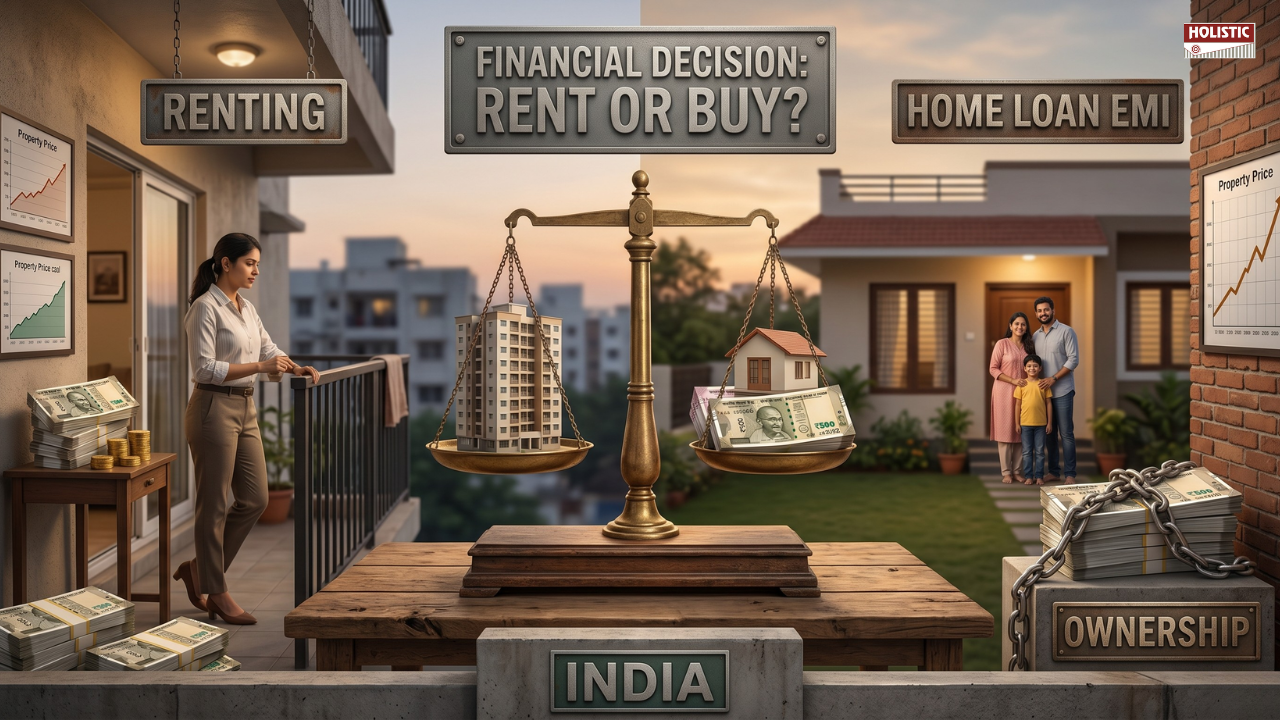
This is why the debate around rent vs buying a house in India is far more complex than comparing monthly rent with monthly EMI.
A home purchase impacts your liquidity, investments, career decisions, lifestyle choices, and even your ability to take personal risks.
Before signing a home loan agreement that could last 20 to 30 years, it’s worth understanding what you’re truly committing to.
Table of Contents:
- Why Indians Are Emotionally Conditioned to Buy a House Early
- Renting vs Buying: Why This Comparison Is Often Misleading
- The Real Cost of a Home Loan in India
- The Hidden Expenses Most Homebuyers Ignore
- How Buying a House Too Early Can Hurt Career Growth
- Is Real Estate Really a Good Investment?
- When Renting Makes More Financial Sense
- When Buying a House Becomes the Right Decision
- A Financial Checklist Before Taking a Home Loan
- Why Working with a CFP Can Save You from a Costly Mistake?
Why Indians Are Emotionally Conditioned to Buy a House Early
Real estate has historically been viewed as one of the safest forms of wealth in India.
Previous generations often saw enormous returns from buying land or homes at relatively low prices decades ago.
Naturally, this created the belief that property ownership automatically leads to wealth creation.
But today’s reality looks very different.
Property prices in major cities have risen sharply, salaries haven’t always kept pace, and younger professionals frequently relocate for better opportunities.
Yet the pressure remains.
Many people purchase homes because:
- Their parents encourage them to
- Their peers are buying houses
- They fear prices will become unaffordable later
- They believe rent payments are “wasted money”
- They want social validation
But should a purchase worth lakhs—or even crores—be driven by fear?
That’s rarely a good financial strategy.
Renting vs Buying: Why This Comparison Is Often Misleading
The biggest mistake people make is reducing the discussion to one question:
“Why pay ₹30,000 rent when I can pay ₹40,000 EMI and own an asset?”
At first glance, buying appears smarter.
But this comparison ignores several important realities.
Rent is a short-term living expense.
An EMI is a long-term financial obligation.
When you rent:
- You can relocate for better career opportunities
- You maintain liquidity
- You avoid maintenance liabilities
- You can upgrade or downgrade housing easily
When you buy:
- You commit capital toward down payments
- You lose flexibility
- You take on debt risk
- You become responsible for maintenance and taxes
The real question isn’t rent versus EMI.
It’s:
Flexibility versus permanence.
And depending on your career stage, flexibility may be far more valuable.
The Real Cost of a Home Loan in India
This is where many buyers underestimate the actual financial burden.
Imagine purchasing a ₹75 lakh property.
- Down payment: ₹15 lakh
- Loan amount: ₹60 lakh
- Interest rate: 8.5%
- Loan tenure: 20 years
Your EMI would be roughly ₹52,000 per month.
Sounds manageable?
Now calculate the total repayment over two decades.
You may end up paying over ₹1.08 crore.
That means the bank earns nearly as much as the original value of your house.
And this is assuming interest rates remain stable.
What happens if rates rise?
Your monthly burden could increase further.
This is why understanding home loan interest costs in India is critical before making a purchase decision.
The Hidden Expenses Most Homebuyers Ignore
The property price itself is only part of the equation.
There are several additional costs buyers frequently underestimate:
i. Registration and Stamp Duty
These costs can range between 5%–8% depending on your state.
ii. Interior Work
Furniture, appliances, modular kitchens, lighting, and renovations can cost lakhs.
iii. Maintenance Charges
Apartment complexes often charge recurring maintenance fees.
iv. Property Taxes
Annual taxes vary based on location and property type.
v. Repairs
Unexpected repairs become your responsibility once you own the home.
Many buyers stretch themselves financially for the property purchase and then struggle with these additional expenses.
How Buying a House Too Early Can Hurt Career Growth
Imagine this:
You’re offered a high-growth role in another city.
The salary increase is attractive.
The learning opportunity is excellent.
But you recently purchased a house.
Now you hesitate.
Should you relocate?
Should you rent out your property?
Should you continue paying EMI while managing rent elsewhere?
What should have been an exciting career move becomes a stressful financial dilemma.
Young professionals working in industries with frequent relocation opportunities should think carefully before locking themselves into real estate too early.
Is Real Estate Really a Good Investment?
Real estate can be a good asset—but not every property is a great investment.
Some properties remain stagnant for years.
Others underperform after adjusting for inflation, maintenance, taxes, and loan interest.
Compare this with disciplined investing in mutual funds, equities, retirement accounts, or diversified portfolios.
In many cases, your wealth may grow faster through diversified investments than through overleveraged real estate purchases.
This doesn’t mean real estate is bad.
It simply means it shouldn’t be your only wealth-building strategy.
When Renting Makes More Financial Sense
Renting may be the smarter choice when:
- Your job location may change
- You’re still building emergency savings
- You don’t have a strong down payment
- Your income is unstable
- You want flexibility for career growth
- Property prices are irrationally high in your city
Sometimes renting while aggressively investing the difference creates better long-term outcomes.
When Buying a House Becomes the Right Decision
Buying may make sense when:
- Your career is stable
- You plan to stay in one city long-term
- You have sufficient emergency savings
- Your EMI remains manageable
- Your retirement goals remain on track
- You can comfortably handle down payment obligations
Buying should feel financially comfortable—not financially suffocating.
A Financial Checklist Before Taking a Home Loan
Before purchasing a property, ask yourself:
- Is my EMI below 35–40% of my monthly take-home income?
- Do I have at least 6–12 months of emergency savings?
- Am I draining all my savings for the down payment?
- Have I planned for hidden costs?
- Will this delay retirement investments?
- Am I buying because I want the home—or because society expects me to?
These questions can prevent costly mistakes.
Why Working with a CFP Can Save You from a Costly Mistake?
Buying a house is not just a real estate decision—it’s a complete financial planning decision.
A Certified Financial Planner (CFP) can help you evaluate:
- Whether you can truly afford the home
- How much down payment makes sense
- Whether renting is currently better
- How the purchase affects retirement goals?
- How to balance property ownership with investment planning
Sometimes the smartest financial decision isn’t buying immediately.
Sometimes it’s waiting until your finances are truly prepared.
And that patience can save you years of unnecessary stress.
Because owning a house should give you peace of mind—not take it away.


Leave a Reply